









TBM arrives in Górki Zachodnie: key phase begins for FSRU offshore pipeline microtunnel in the Gulf of Gdańsk
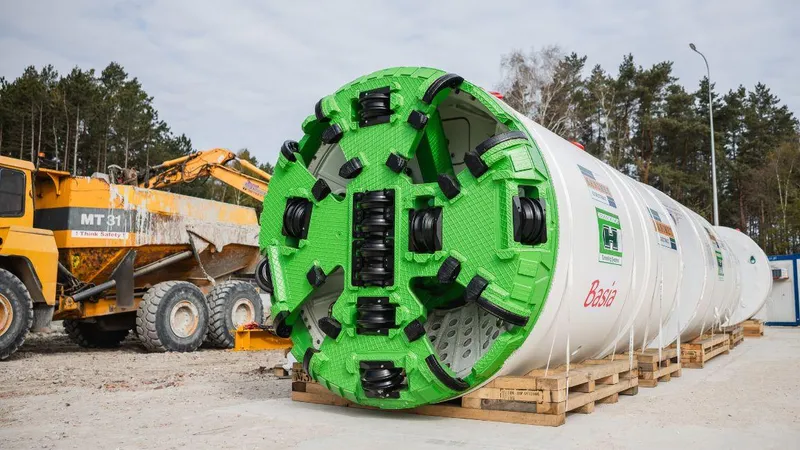
The tunnel boring machine (TBM) head has been delivered to Górki Zachodnie, marking the start of a critical phase in the construction of a microtunnel for the offshore gas pipeline serving the future Floating Storage Regasification Unit (FSRU) terminal in the Gulf of Gdańsk. The investment, carried out by GAZ-SYSTEM, is one of Poland’s strategic energy infrastructure projects aimed at strengthening national energy security and diversifying gas supply routes.
In brief
The cutting head of a TBM has arrived in Górki Zachodnie, where it will begin boring a microtunnel around 1,100 metres long with an outer diameter of around 2.5 metres for the subsea gas pipeline of the FSRU terminal in the Gulf of Gdańsk. A 12.5-metre-long Herrenknecht AVND 2000 AB slurry machine will be used, whose heaviest element with the cutting wheel weighs 42 tonnes. Preparations for boring will last until mid-May, and the microtunnel is to be ready by the end of October. In June GAZ-SYSTEM plans to start piling works at the FSRU terminal quay.
Microtunnel beneath sensitive coastal environment
The planned microtunnel will be approximately 1,100 metres long with an external diameter of around 2.5 metres. It will be executed using a trenchless TBM (Tunnel Boring Machine) method, allowing excavation without open-cut works across environmentally sensitive areas such as coastal forests, dunes, and the beach in Górki Zachodnie, as well as beneath the seabed of the Gulf of Gdańsk.
The tunnel will accommodate the subsea gas pipeline connecting the floating LNG regasification unit — FSRU (Floating Storage Regasification Unit) — with the onshore transmission infrastructure. Once operational, the system will enable natural gas regasified at sea to be fed directly into Poland’s national transmission network.
Environmentally sensitive engineering solution
The adoption of microtunnelling technology was driven by both technical and environmental considerations. The trenchless method significantly reduces surface impact, preserving valuable coastal ecosystems and ensuring uninterrupted public access to the beach.
During TBM passage beneath the shoreline, only short-term safety restrictions may be introduced on limited beach sections. These will be temporary and removed once the machine advances beyond the area.
The tunnel lining will consist of prefabricated reinforced concrete pipes, forming a sealed structural system ensuring stability and durability. Additional steel cable systems will assist in pulling the pipeline through the completed tunnel towards the offshore connection point.
High-spec TBM designed for marine conditions
The works will be carried out using a slurry-type microtunnelling machine AVND 2000 AB manufactured by Herrenknecht. The unit has been custom-built for the FSRU project and adapted for challenging geological and long-distance offshore tunnelling conditions.
The machine is 12.5 metres long, with its heaviest cutting head assembly weighing 42 tonnes. It has been equipped with a “sea recovery” module, enabling safe retrieval from the seabed after completion of excavation works.
The TBM will be assembled in a launch shaft in Górki Zachodnie, followed by system integration, power and control installation, and full SAT testing under the supervision of the manufacturer’s experts.
Project schedule and next offshore phase
Preparatory works for tunnelling are expected to continue until mid-May. The microtunnel itself is scheduled for completion by the end of October, subject to geological conditions and operational performance assumptions.
In parallel, offshore construction is accelerating. In June, foundation and structural works for the FSRU jetty in the Gulf of Gdańsk are planned to begin, marking the transition to the next stage of marine infrastructure development.
Strategic LNG infrastructure for the Baltic region
The FSRU terminal in Gdańsk is a key element of Poland’s long-term energy strategy. The project includes a floating LNG regasification unit, offshore and onshore infrastructure, and a transmission link to the national gas grid.
Once completed, the system will enable the reception, storage, and regasification of LNG delivered by sea, significantly increasing Poland’s import diversification and regional supply resilience across the Baltic Sea area.
Source: Gazeta Morska · Compiled by: Kamil Kusier
Related articles
 Environment The world's largest seahorses move into the Gdynia Aquarium. In this species it is the male that gets pregnant
 Maritime lifestyle and tourism Fuel oil along 50 km of Polish coast. Ustka beaches closed, illegal discharge suspected
 Safety and rescue Fuel oil on the beach in Ustka. The Baltic hands back what nobody wants to collect
 Ports and logistics Maersk to fit a 35 m rotor sail on an 8,700 TEU Lima-class ship in 2027
 Environment From the UAE to Reda: sharks and rays move into a modernized and secured aquarium
 Maritime economy Will the sharks return to Reda? Locals and tourists have grown used to seeing them through the glass
Comments (0)
The discussion is moderated by the editors: a comment appears after review. Your e-mail address is not published.
Nobody has commented on this article yet.