









Fuel oil on the beach in Ustka. The Baltic hands back what nobody wants to collect
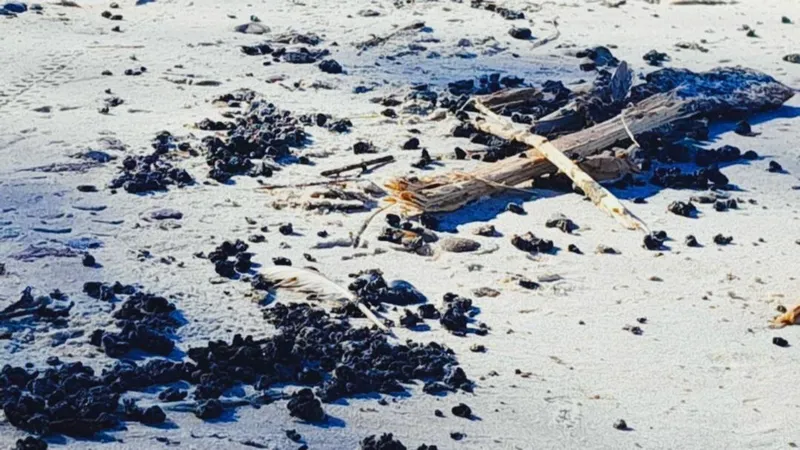
A petroleum substance has appeared on the beach in Ustka on the Polish Baltic coast, and the indications point to heavy fuel oil. A single fire service crew attended, but firefighters did not begin removal work, as clearing such pollution is not among their tasks. The report went to the harbour master's office, which passed the case to the maritime office.
In brief
An oil-based substance, most likely heavy fuel oil, appeared on the beach in Ustka, and the report was passed via the harbour master's office to the Maritime Office. The fire brigade did not remove the pollution because the task is not part of firefighters' duties. Sebastian Kluska, director of the Maritime Search and Rescue Service, assessed the material as heavy fuel oil because it is dark and tarry. The Baltic Sea has special area status, in which oil discharges from ships are banned. In July 2025, six bathing areas on the Gulf of Gdańsk were closed after tarry residue was detected.
Laboratory analysis will settle the matter, but both people we spoke to point to a petroleum product.
- As far as Ustka is concerned, it is probably paraffin or heavy fuel oil - Captain Piotr Basarab of the State Fire Service in Słupsk told Gazeta Morska.
He added that similar situations had occurred before, as the sea regularly throws various kinds of pollution onto the shore.
Sebastian Kluska, director of the Polish Maritime Search and Rescue Service, assesses it differently. In his view what reached the beach in Ustka is heavy fuel oil rather than paraffin, because paraffin is white or cream-coloured and wax-like, while the material washed ashore is dark and tarry. His view carries weight, as combating oil and chemical pollution at sea is among the tasks of the service he heads.
Fuel oil and paraffin, two different phenomena
The distinction matters, because the two substances reach a beach for entirely different reasons.
Paraffin looks like white or cream-coloured lumps resembling wax, often the size of a fist. It is carried by chemical tankers, and residues enter the sea when cargo tanks are washed. Regulations permit such discharges under defined conditions and at a given distance from shore, which is why paraffin appears regularly on Baltic and North Sea beaches. It is not highly toxic, but it can be contaminated with residues of other cargoes and poses a risk above all to dogs and small children, who may pick it up.
Heavy fuel oil, known in the region as mazut, is a dark brown, tarry residue of crude oil distillation. It contains sulphur, heavy metals and polycyclic aromatic hydrocarbons, and skin contact can cause irritation and chemical burns. On a beach it sticks to sand and stones, and its source is usually a leak from a vessel, an installation failure or an illegal discharge.
What else the sea washes ashore
Paraffin and fuel oil are the most common finds, but the list is longer.
Polymer pellets appear on beaches, the millimetre-sized granules of raw material for the plastics industry, lost during transfer and container transport. Solidified vegetable fats turn up too, including palm oil carried as liquid cargo, which resembles dirty wax once it sets. So do tar balls, the weathered remains of petroleum products that have drifted for weeks.
A separate category, characteristic of the southern Baltic, is white phosphorus from dumped munitions. Once dry it self-ignites and causes severe burns, and it looks like amber, which is why walkers sometimes pick it up. Such finds have been recorded mainly on the German coast, but the risk applies to the whole sea, on whose bed munitions were dumped after the Second World War.
Why the Baltic in particular
The answer lies in hydrography. This is a shallow sea, with an average depth of around 52 metres, almost enclosed and connected to the North Sea only through the narrow Danish straits. A full exchange of water takes about thirty years, so anything that enters stays for a very long time.
Then there is traffic. The Baltic is among the busiest seas in the world, with roughly 2,000 ships under way at any moment. At that intensity even small, scattered discharges add up over a year.
The third factor is wind and current. Substances lighter than water, or drifting just below the surface, move with the wind, and in storms from the northern sector they are driven straight onto the Polish coast. Finds therefore come in waves, usually a few days after strong onshore winds, and often on the same stretch of shore.
The fourth is persistence. Paraffin and tar neither dissolve nor evaporate. They can drift for weeks, and fuel oil that sinks to the bottom can return to the surface when the water warms or when heavy seas stir the sediment. That is why a cleaned beach is sometimes polluted a second time.
When a discharge is legal
Not every find means a crime has been committed. Chemical tankers have to wash their tanks between cargoes, and the MARPOL convention permits the discharge of tank washings under defined conditions, including a minimum distance from shore, a minimum depth and a minimum ship speed.
For years paraffin went into the sea under that formula, classified as a low-risk substance. Since 2021 stricter rules have applied to so-called persistent floating products in the Baltic Sea area and north-west European waters, requiring a prewash and the delivery of residues to port reception facilities.
Petroleum products are a different matter. The Baltic has the status of a special area in which discharge of oil from ships is prohibited. If fuel oil is lying on a beach, the cause is either an accident or a deliberate, illegal act.
Why the source is so hard to identify
Pollution reaches the shore with a delay, often several days, by which time the ship is far away. Nothing on the beach reveals where it came from.
Detection relies on satellite systems, including Europe's CleanSeaNet, which provides coastal states with images showing suspected oil slicks, and on aerial patrols run under cooperation between Baltic states. The difficulty is proof. To bring a charge, a slick has to be linked to a specific vessel, ideally by taking samples on board and comparing them with material collected at sea or ashore.
That is why the number of discharges detected in the Baltic has for years been far higher than the number of cases ending in a penalty for an owner.
Who is responsible for clean-up
Responsibility for combating pollution in Polish maritime areas and on the shore rests with the maritime offices, in this case the Maritime Office in Słupsk. In such incidents the fire service secures the site but does not collect petroleum substances from the beach.
Where pollution is more extensive, the national contingency plan for combating threats and pollution of marine waters is activated, and where bathers are at risk the sanitary inspectorate becomes involved and may ban the use of a bathing site. Water quality information is published in the national bathing water service.
Not the first time on the Polish coast
Similar events have occurred before. In July 2025 six bathing sites on the Gulf of Gdańsk, from Mikoszewo to Kąty Rybackie, were closed after tarry residues were found in the water. Earlier, staff of the maritime office and local authorities collected fuel oil from beaches at Rewal and Mrzeżyno, where hundreds of kilograms of contaminated material were involved.
Why the shadow fleet makes speed essential
Every such find now carries an additional context. The Baltic sees a growing number of ageing tankers of the so-called shadow fleet, used to circumvent sanctions on Russian oil. These are often vessels decades old, passing from owner to owner, sailing under flags of convenience, with insurance whose validity is hard to verify and crews replaced without continuity.
The risk is twofold. First, the likelihood of a failure and a spill rises, because the technical condition of such ships is often worse than standards on the regulated market. Second, enforcing liability after a spill is far harder, because behind the vessel there is usually a single-purpose company with no assets, and clean-up costs fall on the coastal state.
Practices that raise the risk further come on top of that: ship-to-ship fuel transfers on the open sea, switching off identification systems and long stays at anchorages beyond port control.
Every report of a petroleum substance ashore should therefore end not only with a cleaned beach but with an attempt to identify the source. The sooner samples are taken and vessel traffic data from recent days are checked, the better the chance of linking the pollution to a specific ship. After a few days that trail effectively disappears.
What to do if you find such a substance
The basic rule is not to touch it. Do not pick a find up, put it in a pocket or take it home, especially if it resembles amber. Mark the spot, note its location and report it to lifeguards, the municipal guard, the harbour master's office or the maritime office directly.
If the substance has come into contact with skin, wash it off with soap and water and see a doctor if irritation develops. Children and dogs deserve particular attention, as they are usually the first to react to such finds.
Awaiting the maritime office's findings
The inspection and analyses carried out by the Maritime Office in Słupsk will be decisive, as they will determine what the substance is and how extensive the contamination is. Until then it is best not to touch any lumps found on the beach and to keep children and animals away from them.
Source: Gazeta Morska · Compiled by: Kamil Kusier
Related articles
 Environment The world's largest seahorses move into the Gdynia Aquarium. In this species it is the male that gets pregnant
 Maritime lifestyle and tourism Fuel oil along 50 km of Polish coast. Ustka beaches closed, illegal discharge suspected
 Ports and logistics Maersk to fit a 35 m rotor sail on an 8,700 TEU Lima-class ship in 2027
 Environment From the UAE to Reda: sharks and rays move into a modernized and secured aquarium
 Maritime economy Will the sharks return to Reda? Locals and tourists have grown used to seeing them through the glass
 Maritime lifestyle and tourism 21 blacktips in Seoul, 17 sharks in Wrocław, 9 in Bournemouth. Will they return to Reda too?
Comments (0)
The discussion is moderated by the editors: a comment appears after review. Your e-mail address is not published.
Nobody has commented on this article yet.