









The world's largest seahorses move into the Gdynia Aquarium. In this species it is the male that gets pregnant
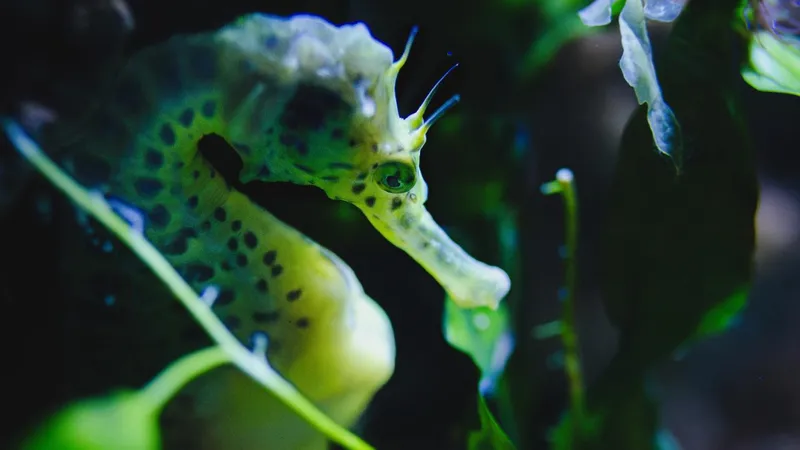
Six big-belly seahorses, the largest seahorse species in the world, have joined the exhibition at the Gdynia Aquarium. Adults can grow to around 35 centimetres, and males are easily recognised by the large brood pouch on the belly in which the young develop.
In brief
Gdynia Aquarium has put on display six big-belly seahorses, the largest seahorse species in the world. Adult big-belly seahorses grow to about 35 centimetres, and males carry the eggs in a brood pouch for several weeks. The big-belly seahorse, Hippocampus abdominalis, comes from the waters of south-eastern Australia and New Zealand. Gdynia Aquarium, part of the National Marine Fisheries Research Institute, does not say where the specimens came from.
The aquarium showed off its new residents in recent days and invites visitors to see them up close. Each of the six looks different: some are cream-coloured, others yellowish, and several carry darker patches and spots, which is normal for a species whose colouring varies widely.
From the other side of the world
The big-belly seahorse, Hippocampus abdominalis, comes from the waters of south-eastern Australia and New Zealand. It lives among kelp and in seagrass meadows, readily settles on harbour walls and structures, and is found from the shallows down to depths of several tens of metres. It owes its name to a prominent belly, enlarged in males by the brood pouch.
That pouch is what makes seahorses so compelling. The female deposits her eggs into it and the male carries them for several weeks, supplying the embryos with oxygen and protection, before releasing up to several hundred tiny, fully formed seahorses. In the big-belly seahorse, given its size, the brood is among the largest in the family.
A protected species, bred rather than caught
All seahorses are listed under CITES, the convention controlling international trade in endangered species. Specimens in public aquariums today come almost exclusively from breeding programmes, and the big-belly seahorse is one of the few species bred in captivity on a larger scale, including at European facilities. For aquariums it is a rewarding species: large, calm, highly visible and easier to keep than its smaller relatives.
The Gdynia Aquarium belongs to the National Marine Fisheries Research Institute, so new species arrive on display together with the institute's research and education backing. The seahorses join a collection that for years has used Baltic and tropical species alike to explain marine biology in a way children remember.
Whether the seahorses will breed in Gdynia, and exactly where they came from, the aquarium has not yet said. One thing is certain: a pregnant male can now be seen on the Southern Pier.
Source: Gazeta Morska · Compiled by: Kamil Kusier
Related articles
 Maritime lifestyle and tourism Fuel oil along 50 km of Polish coast. Ustka beaches closed, illegal discharge suspected
 Safety and rescue Fuel oil on the beach in Ustka. The Baltic hands back what nobody wants to collect
 Ports and logistics Maersk to fit a 35 m rotor sail on an 8,700 TEU Lima-class ship in 2027
 Environment From the UAE to Reda: sharks and rays move into a modernized and secured aquarium
 Maritime economy Will the sharks return to Reda? Locals and tourists have grown used to seeing them through the glass
 Maritime lifestyle and tourism 21 blacktips in Seoul, 17 sharks in Wrocław, 9 in Bournemouth. Will they return to Reda too?
Comments (0)
The discussion is moderated by the editors: a comment appears after review. Your e-mail address is not published.
Nobody has commented on this article yet.