









Fuel oil along 50 km of Polish coast. Ustka beaches closed, illegal discharge suspected
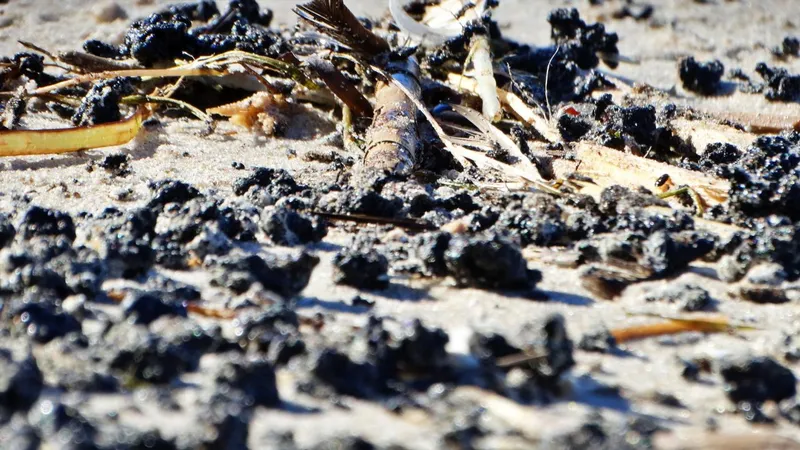
Black, sticky lumps of a petroleum substance have appeared along close to 50 kilometres of beaches on Poland's central Baltic coast, from Rowy in Pomerania to Rusinowo and Wicie in West Pomerania. On Monday afternoon the director of the Maritime Office in Słupsk closed the beaches of the town and municipality of Ustka, where the pollution is heaviest. The closure is in force until further notice. Samples have gone to a laboratory. The office is not yet saying exactly what the substance is, but it has no doubt the sea brought it ashore, and it assumes a breach of the law at sea.
In brief
The Maritime Office in Słupsk closed beaches along the town and municipality of Ustka until further notice after an oil-based substance appeared along a stretch of nearly 50 kilometres from Rowy to Rusinowo and Wicie. The first report came in on Sunday 27 September, and director Anna Sędzińska decided to close the beaches on 28 September after an inspection. Samples of the substance were sent to a laboratory. The Maritime Office in Słupsk suspects a vessel that broke the law at sea.
From a single report to closed beaches
The first report reached the Maritime Office in Słupsk on Sunday 27 September. Throughout the weekend walkers complained of dark lumps lying at the waterline on the western beach in Ustka, smelling of oil and staining everything they touched. Further reports came from different points along the shore, from Jarosławiec to beyond Poddąbie.
On Monday 28 September the office inspected the areas around Ustka, Rowy, Jarosławiec and Rusinowo. That afternoon its director ordered the temporary closure of the beaches of the town and municipality of Ustka. The ban is to remain in place until the substance is removed and neutralised and safety on the beach is assured.
The fire service had earlier been called to the scene but did not begin removal, as that is not among its tasks. The case went to the harbour master's office, which passed it to the Maritime Office.
The fire service's first assessment spoke of paraffin or heavy fuel oil, but Captain Piotr Basarab, spokesman for the State Fire Service in Słupsk, later confirmed to Gazeta Morska that it is heavy fuel oil. Sebastian Kluska, director of the Polish Maritime Search and Rescue Service, gave us the same assessment, pointing out that paraffin is white or cream-coloured and wax-like, while the material on the beach is dark and tarry.
The office has a vessel in mind
Anna Sędzińska, director of the Maritime Office in Słupsk, says the material is a petroleum substance, though its exact nature will be known only after analysis. The office also has suspicions about a vessel that behaved unlawfully at sea.
That changes the character of the case. Until now this was pollution of unknown origin. Now the maritime administration is stating that an unlawful act by a specific ship is suspected, rather than an accident or chance event.
The success of such an investigation depends on time. Linking pollution to a vessel requires comparing samples from the beach with the fuel or cargo of the suspected ship, together with an analysis of its track from identification system data, satellite imagery and aerial patrols. The sooner that is done, the greater the chance the ship is still within reach of Polish or allied services.
The Baltic is a special area
Under the MARPOL convention the Baltic has the status of a special area in which the discharge of oil from ships is prohibited. There are no exceptions for fuel tank washings or for bilge water with oil content above the permitted limit.
Paraffin, carried by chemical tankers and released when tanks are washed, is a different matter. Until 2021 such discharges were permitted under defined conditions; the rules were then tightened for so-called persistent floating products in the Baltic Sea area and north-west European waters. But paraffin is pale and waxy, so if what lies on the beaches is dark and tarry, the case returns to petroleum products and to a prohibition without exceptions.
Such a discharge carries administrative penalties and criminal liability, and once the polluter is identified, an obligation to cover clean-up costs. The difficulty is that for years the number of discharges detected in the Baltic has been far higher than the number of cases ending in a penalty for a shipowner.
Why fifty kilometres
The spread of the pollution over such a distance follows from how a heavy petroleum product behaves in water. It neither dissolves nor evaporates. It forms lumps and patches that drift with wind and current, and with winds from the northern sector reaches the shore in waves, on different stretches and in different quantities.
The Baltic favours such events. It is shallow, almost enclosed, and its water exchange with the North Sea takes decades. Some 2,000 ships are under way on it at any time, so even a single discharge has a good chance of reaching shore before it disperses.
Worse, fuel oil that sinks to the bottom can resurface when the water warms or when heavy seas stir the seabed. A cleaned stretch of beach is often polluted again within days, and clean-up after such events can drag on for weeks.
Two offices, two regions
The polluted stretch crosses the boundary between two provinces, and with it the boundary between two maritime offices. From Rowy to Jarosławiec the Maritime Office in Słupsk is responsible; further west, including Rusinowo and Wicie, the Maritime Office in Szczecin. The closure order currently covers only Ustka, where the pollution is heaviest, but the state of the other stretches depends on the coming days and on the weather.
The Słupsk office is responsible for identifying and securing the affected sites and, once the substance is characterised, for removing it from the beach. Municipalities, Ustka among them, relay the warnings to residents and visitors.
Until the laboratory results arrive the rules are simple: do not touch the substance, do not take it off the beach or home, avoid skin contact, and keep dogs away, as they may lick it or get it into their fur and paws. Any new sighting should be reported to the authorities with as precise a location as possible.
The shadow fleet in the background
It is not yet known which vessel is suspected or where it was sailing from. The context that has been reshaping the Baltic for two years is nonetheless worth keeping in mind. A growing number of ageing tankers of the so-called shadow fleet, used to circumvent sanctions on Russian oil, sail the sea: old vessels passing from owner to owner, under flags of convenience, with insurance that is hard to verify.
The risk they carry is twofold. Poor technical condition raises the likelihood of a spill, and an ownership structure built on single-purpose companies with no assets means clean-up costs fall on the coastal state. Add practices that raise the risk further: ship-to-ship fuel transfers on the open sea, switching off identification systems and long stays at anchorages beyond port control.
If the suspicions of the Maritime Office in Słupsk prove correct, this will be the first case on the Polish coast in which pollution on this scale has been linked to a specific ship. If not, it will join a long list of events for which the shore has paid.
Four questions that will decide the case
Four things will determine how large this case becomes. The laboratory results, which will say whether it is fuel oil and of what kind. The mass of material collected, which alone will show the scale of the discharge. The decision of the Maritime Office in Szczecin on the beaches of West Pomerania. And whether the Border Guard and prosecutors have joined the case, because without them a suspicion about a vessel will remain no more than that.
Source: Gazeta Morska · Compiled by: Kamil Kusier
Related articles
 Environment Two tonnes of oil and sand collected by sieve. Rowy to Ustka clean, two stretches still need work
 Environment A disaster warning on Lake Łebsko, a fishing dispute and a CBA arrest. Słowiński National Park's hardest autumn
 Environment The world's largest seahorses move into the Gdynia Aquarium. In this species it is the male that gets pregnant
 Ports and logistics Maersk to fit a 35 m rotor sail on an 8,700 TEU Lima-class ship in 2027
 Environment From the UAE to Reda: sharks and rays move into a modernized and secured aquarium
 Maritime economy Will the sharks return to Reda? Locals and tourists have grown used to seeing them through the glass
Comments (0)
The discussion is moderated by the editors: a comment appears after review. Your e-mail address is not published.
Nobody has commented on this article yet.