Shipbuilding is stellar. Marcin Ryngwelski on the Kort nozzle and precision installation at the yard
In modern ship propulsion, every knot matters, and every bit of thrust counts. That’s where solutions like the Kort nozzle come in—a deceptively simple piece of engineering that continues to make a major difference, especially in vessels requiring high maneuverability and pulling power. Put simply, the Kort nozzle is a structural element that enhances the performance of a propeller, particularly at low speeds. It's a concept that has stood the test of time.
business education maritime economy work at mare shipbuilding industry shipbuilding industry is awesome equipment and technology news03 august 2025 | 14:21 | Source: Gazeta Morska | Prepared by: Kamil Kusier | Print
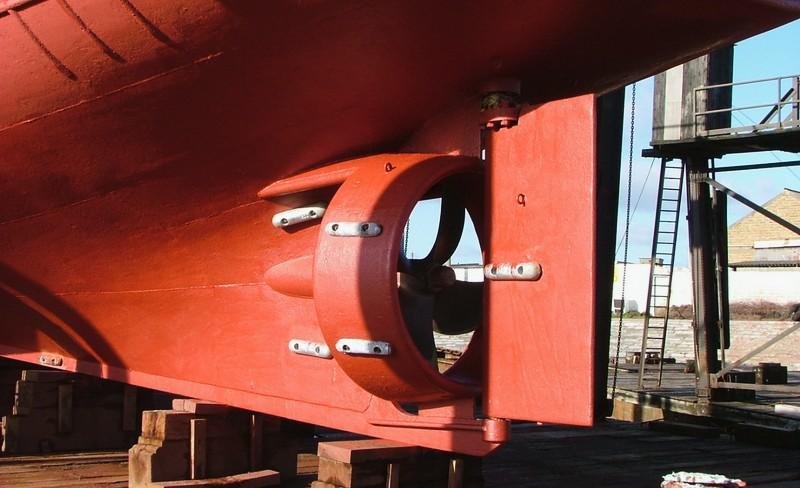
dysza Korta fot. Wikimedia Commons
Ludwig Kort – the engineer who changed the flow
The invention takes its name from Ludwig Kort, a German engineer who dedicated years to studying hydrodynamics and the efficiency of jet propulsion systems—not only in maritime applications but also in aviation.
In 1936, after extensive research, Kort patented the design in the United States. His idea—to enclose a propeller inside a hydrodynamically optimized nozzle—proved revolutionary. To this day, Kort's name is synonymous with improved propulsion in high-resistance, low-speed maritime operations.
Real-world application: from theory to steel
Though modern vessels increasingly rely on azimuth thrusters and hybrid-electric solutions, the Kort nozzle still has its place—particularly in vessels like tugboats, pushers, and utility ships, where responsiveness and thrust are mission-critical.
A fun fact? Kort nozzle-equipped propellers have been installed on ZODIAK and PLANETA, two state-of-the-art vessels built for the Maritime Offices in Szczecin and Gdynia, Poland. They are used in hydrographic and support roles where precision handling is essential.
Installation at the yard: it’s not just plug-and-play
Installing a propulsion unit with a Kort nozzle is a job for experts—this is precision mechanical work involving multi-ton equipment, tight tolerances (often down to millimeters), and specialized tooling.
At Polish shipyards, these operations are typically handled by the Mechanical Department, often in coordination with third-party specialists. The process starts with a Technology Instruction Manual issued in accordance with the manufacturer's guidelines.
Before installation, the nozzle well ("propeller tunnel") must be perfectly prepared, ensuring exact dimensions and cleanliness. Once mounted, sealing tests are conducted to ensure complete watertightness during operation. There’s no room for leaks—or mistakes—when dealing with main propulsion.
Note: The Kort nozzle is not a standalone element installed separately by the yard. It’s an integrated part of the entire propulsion unit.
Bottom line? Shipbuilding is stellar
The Kort nozzle remains a great example of how legacy engineering can still power the future. In today’s advanced maritime sector, proven solutions continue to earn their place—especially when paired with skilled workmanship, precise installation, and deep domain expertise.
see also
Buy us a coffee, and we’ll invest in great maritime journalism! Support Gazeta Morska and help us sail forward – click here!
Kamil Kusier
redaktor naczelny
comments
Add the first comment
see also
StartupHack 3.0 at GPNT: Space and maritime technologies at the core of innovation
Polish technology powers zero-emission public transport. AREX secures largest municipal contract
Defence.Hub strengthens capabilities in technologies supporting maritime infrastructure security
Hanseatic Global Terminals takes full ownership of Florida International Terminal
Aleksandra Kosiorek: The sea has always been a space of openness for us, and that will not change
Gdańsk to launch Baltic Sea monitoring center
Türkiye advances indigenous GNSS ambitions: what FGN-100-D3 means for the maritime sector
Lithium at the core. TKMS and E3 Lithium align on Canada’s submarine ambitions
Błażej Konkol appointed vice president for infrastructure at the Port of Gdańsk Authority
WB Group expands into Romania, strengthening presence in the Black Sea region
ADVERTISEMENT
ADVERTISEMENT