Preparatory seabed works begin for Poland’s first FSRU terminal in the Bay of Gdańsk
GAZ-SYSTEM has launched dredging operations in the southern Bay of Gdańsk, marking a major milestone in the development of Poland’s first floating LNG terminal (FSRU – Floating Storage Regasification Unit). The seabed preparation, covering an area of approximately 656,000 m², is a key step prior to constructing the terminal’s quay and offshore infrastructure.
business power engineering maritime economy investments pomerania ports tricity news29 july 2025 | 21:22 | Source: Gazeta Morska | Prepared by: Kamil Kusier | Print
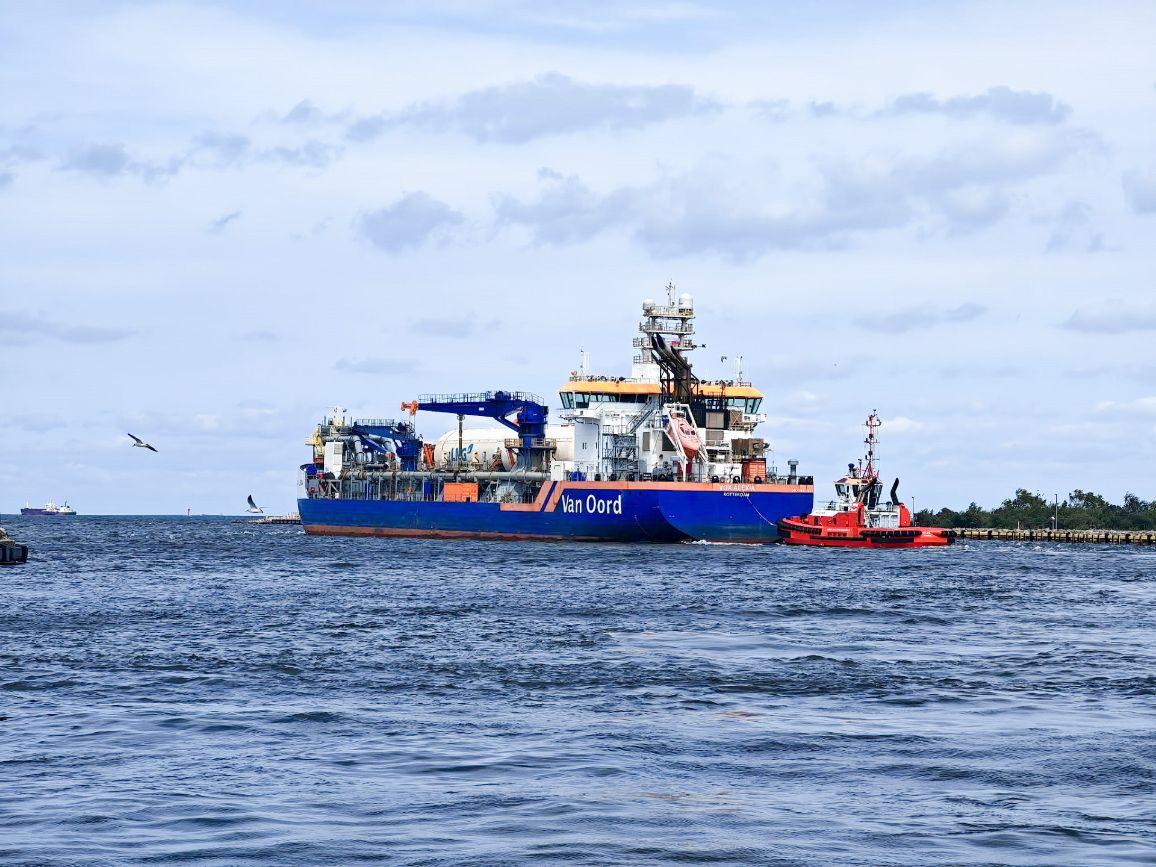
fot. GAZ-SYSTEM
Four-phase dredging and environmental safeguards
The project began with clearing the seabed of ferromagnetic objects, followed by dredging operations divided into four distinct phases. The initial phase focuses on deepening the area where the terminal’s quay will be located. Subsequent stages will extend toward the protective breakwater currently being constructed by the Maritime Office in Gdynia, and eventually encompass the southern and eastern sectors of the marine construction site.
– Starting offshore works is a crucial step in the implementation of the FSRU Programme. Deepening the seabed ensures safe navigation and berthing of large LNG carriers, and lays the foundation for the future functioning of the entire facility, said Sławomir Hinc, CEO of GAZ-SYSTEM.
The construction process will be aligned with local marine environmental protection periods, particularly during sensitive biological cycles such as fish spawning. A portion of the dredged material will be repurposed to reinforce the beach in Górki Zachodnie, while the remainder will be deposited in a designated offshore dumping site.
Strategic infrastructure for energy security
The FSRU terminal in Gdańsk will serve as a new gas entry point to the Polish transmission system. Currently under construction at Hyundai Heavy Industries in South Korea, the regasification vessel will be permanently moored near the Port of Gdańsk, close to the Baltic Hub container terminal and the approach fairway. The facility is designed to handle over 6 billion cubic metres of natural gas annually, bolstering regional energy security and diversification of supply.
Once operational, the Gdańsk terminal will complement the existing LNG terminal in Świnoujście, positioning Poland as a key gas hub for Central and Eastern Europe.
Financing through EU and national recovery funds
The offshore component of the project is co-financed by the Connecting Europe Facility (CEF), with the European Commission allocating €19.6 million for preparatory works.
In June 2025, GAZ-SYSTEM signed a PLN 2.2 billion loan agreement with Bank Gospodarstwa Krajowego (BGK) to fund the broader gas infrastructure expansion under Poland’s National Recovery and Resilience Plan (KPO). The FSRU programme is aligned with REPowerEU, the EU strategy aimed at eliminating dependence on Russian fossil fuels by 2030.
Commissioning expected in 2027–2028
The FSRU project includes the construction of the offshore terminal, an undersea gas pipeline, and nearly 250 km of new onshore transmission lines. Commissioning of the entire system is scheduled for late 2027 to early 2028.
Buy us a coffee, and we’ll invest in great maritime journalism! Support Gazeta Morska and help us sail forward – click here!
Kamil Kusier
redaktor naczelny
gallery


comments
Add the first comment
see also
Austal partners with Damen for local construction of LST 100 for Australian Army
The submarine contract of the decade? Canada weighs South Korea against Germany
Bechtel signs contract with Doraco for Poland’s first nuclear power plant
When two powers clash, Poland must be ready to act. Military security must be the priority
MON, Arka Gdynia and AMW sign letter of intent supporting "Green Industrial District - Kashubia" project
Mine countermeasure vessel Jaskółka begins sea acceptance trials
PEJ relocates headquarters to Pomerania. A strategic step in Poland’s nuclear power development
Radmor hosts delegation from the Republic of Turkey. Advancing maritime security cooperation
3D-printed catamaran: robotic manufacturing sets course for the future of small craft
Navantia and Fincantieri deepen cooperation on the european patrol corvette programme
ADVERTISEMENT
ADVERTISEMENT