Floating hospitals as strategic support for naval and humanitarian missions
Hospital ships remain one of the most distinctive yet underappreciated assets of modern fleets. In times of global humanitarian crises, natural disasters and armed conflicts, they operate as mobile medical bases where land-based infrastructure is either destroyed or absent. Beyond saving lives, they serve as instruments of diplomacy and soft power, projecting both the influence and the prestige of the nations that operate them.
security logistics navy worldwide news19 august 2025 | 08:48 | Source: Gazeta Morska | Prepared by: Kamil Kusier | Print
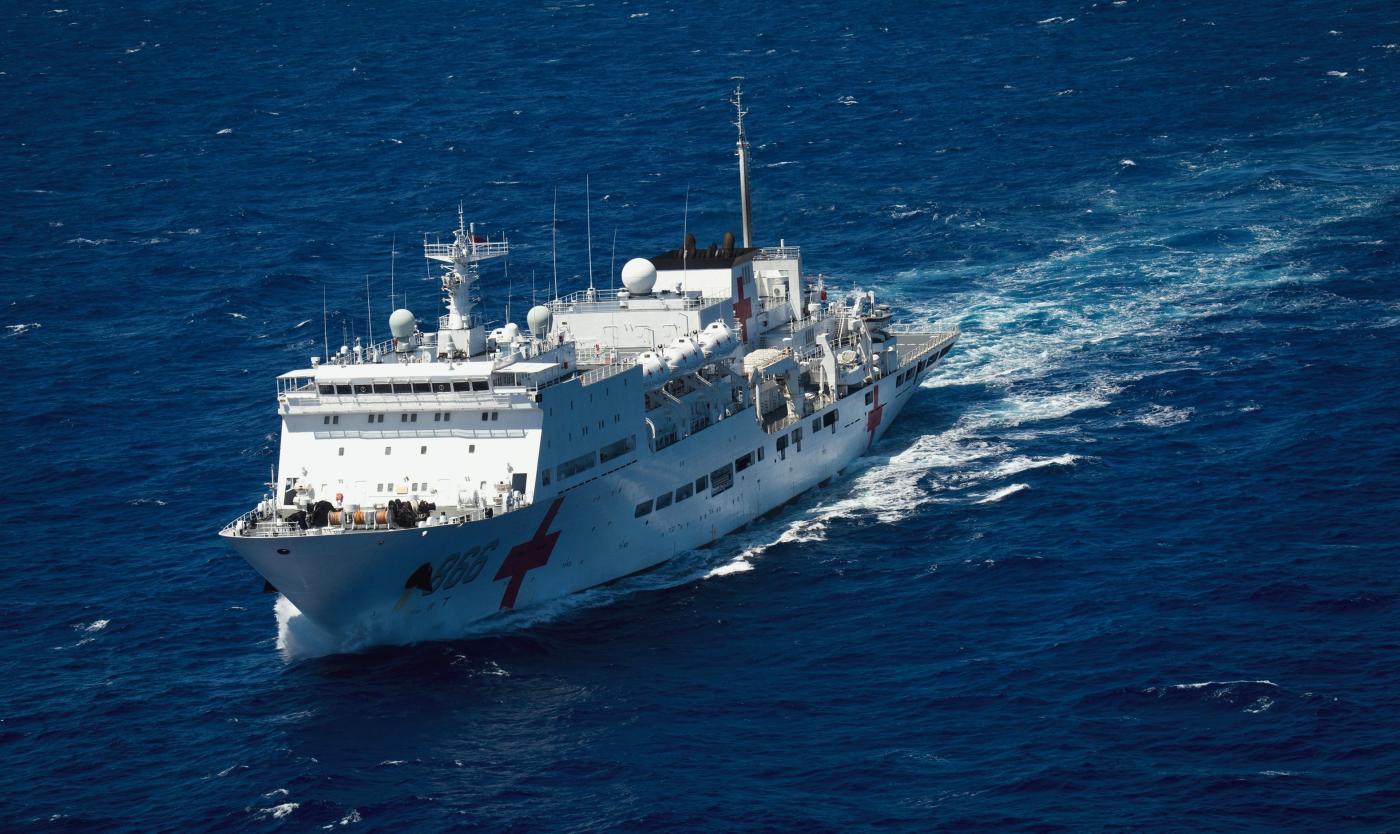
Ark Peace / fot. Wikimedia / Petty Officer 1st Class Ace Rheaume
The American benchmark: Mercy and Comfort
The most iconic examples of hospital ships are the US Navy’s USNS Mercy (T-AH-19) and USNS Comfort (T-AH-20). Originally built as San Clemente-class oil tankers in the 1970s, they were converted into hospital ships during the 1980s. Each vessel can host over one thousand patients, is equipped with twelve operating theatres, modern intensive care units and diagnostic laboratories, and features large helicopter decks for rapid evacuation.
Their role extends far beyond combat support. They have been deployed after the 2010 Haiti earthquake, during typhoons in Southeast Asia and, more recently, in the COVID-19 pandemic, when they supported overburdened hospitals in New York and Los Angeles. Each deployment highlighted both their operational value and their symbolic role as ambassadors of American readiness to act globally.
China’s response: Ark Peace
China’s answer came in 2007 with the commissioning of the Daishan Dao (Ark Peace). With a displacement of more than 14,000 tons, it carries 300 beds, eight operating rooms, intensive care facilities and a full diagnostic suite. Although smaller than its American counterparts, it is designed as a flagship of Chinese maritime diplomacy.
Through the “Harmonious Mission” programme, Ark Peace has visited over forty countries across Africa, South America and Asia. Chinese medical teams on board provide free treatment while the ship itself becomes a highly visible symbol of Beijing’s global outreach. Each mission is presented not only as humanitarian relief but also as proof of China’s growing presence on the world’s oceans.
Europe’s pragmatic approach
European navies have chosen a more pragmatic path. Instead of building specialised hospital ships, they integrate medical facilities into multi-role support and amphibious vessels. Germany’s Berlin-class replenishment ships, Spain’s amphibious assault carrier Juan Carlos I and the United Kingdom’s carriers and landing ships all feature operating theatres, intensive care capacity and medical wards. While useful, these facilities remain modest in scale compared to the American or Chinese examples. The European approach reflects a preference for cost efficiency and operational flexibility rather than symbolic projection.
Civil initiatives in Africa and South America
Outside the naval context, civilian-operated hospital ships are also of major importance. The most prominent example is the Africa Mercy, run by the charity Mercy Ships, which provides thousands of free surgeries and medical services in African ports. Its activity illustrates how maritime medicine can operate beyond the defence sector, directly addressing healthcare deficits in developing regions.
Other nations have introduced smaller initiatives. In 2022, Indonesia commissioned the KRI dr. Radjiman Wedyodiningrat (992), intended to deliver medical care to remote islands of the archipelago. Brazil has also invested in riverine and coastal medical vessels, underlining the relevance of floating hospitals for regional resilience and public health.
The Polish perspective
Poland has so far not prioritised the development of hospital ships. Military medical support relies mainly on land-based infrastructure and NATO partners. However, with the Baltic Sea growing in strategic importance and Poland taking part in more multinational missions, the question of maritime medical capacity may return in a new light.
This debate is given added weight by the planned creation of Military Medical Forces in September 2025, a new structure designed to consolidate and strengthen the armed forces’ medical potential. It may open the way for discussions on whether Poland should invest in its own hospital ship, join a European collaborative programme, or consider a civilian-operated vessel that could serve both humanitarian and defence purposes.
Floating ambassadors of humanitarianism
Hospital ships are more than floating clinics. They are strategic assets that combine military, humanitarian and diplomatic roles. For the United States and China, they are both practical tools and powerful symbols of global reach. Europe has opted for a more modest, integrated approach. For Poland, the question of maritime medical capabilities may soon move from speculation to necessity, as the Baltic becomes an arena of growing geopolitical tension and security cooperation.
see also
Buy us a coffee, and we’ll invest in great maritime journalism! Support Gazeta Morska and help us sail forward – click here!
Kamil Kusier
redaktor naczelny
comments
Add the first comment
see also
Polish Naval Academy and Institute of Fluid-Flow Machinery establish research partnership
SAR search operation in the port of Władysławowo. man who fell into the water not found
Medical evacuation from Wind Osprey underway as winter keeps Polish SAR services under pressure
Coast Guard ensures fishermen safety on the ice of the Vistula Lagoon Select 81 more words to run Humanizer.
Services on ice. False alarm in Swarzewo in Poland. Such behavior endangers those who truly need help
PIRANIA underwater inspection vehicle: Gdańsk University of Technology and Radmor join forces
Grupa WB joins ASD. Strengthening Central and Eastern Europe’s voice in the European defence industry
Poland’s security in focus. President meets with ministers and heads of special services
NATO’s persistent naval presence in the Arctic and the northern Atlantic strengthens sea lane security
Poland launches second DELFIN SIGINT ship ORP Henryk Zygalski in Gdańsk
ADVERTISEMENT
ADVERTISEMENT