USNS Comfort: The U.S. Navy’s Floating Hospital and Strategic Humanitarian Asset
As global maritime operations increasingly intersect with humanitarian needs, conflict response, and public health crises, few naval assets better symbolize the convergence of medical capability and maritime logistics than the USNS Comfort (T-AH-20). Operated by the U.S. Navy’s Military Sealift Command (MSC), this hospital ship exemplifies how naval forces can project not just power, but also care, aid, and stability in times of crisis.
security navy worldwide nato equipment and technology news28 june 2025 | 11:34 | Source: Gazeta Morska | Prepared by: Kamil Kusier | Print
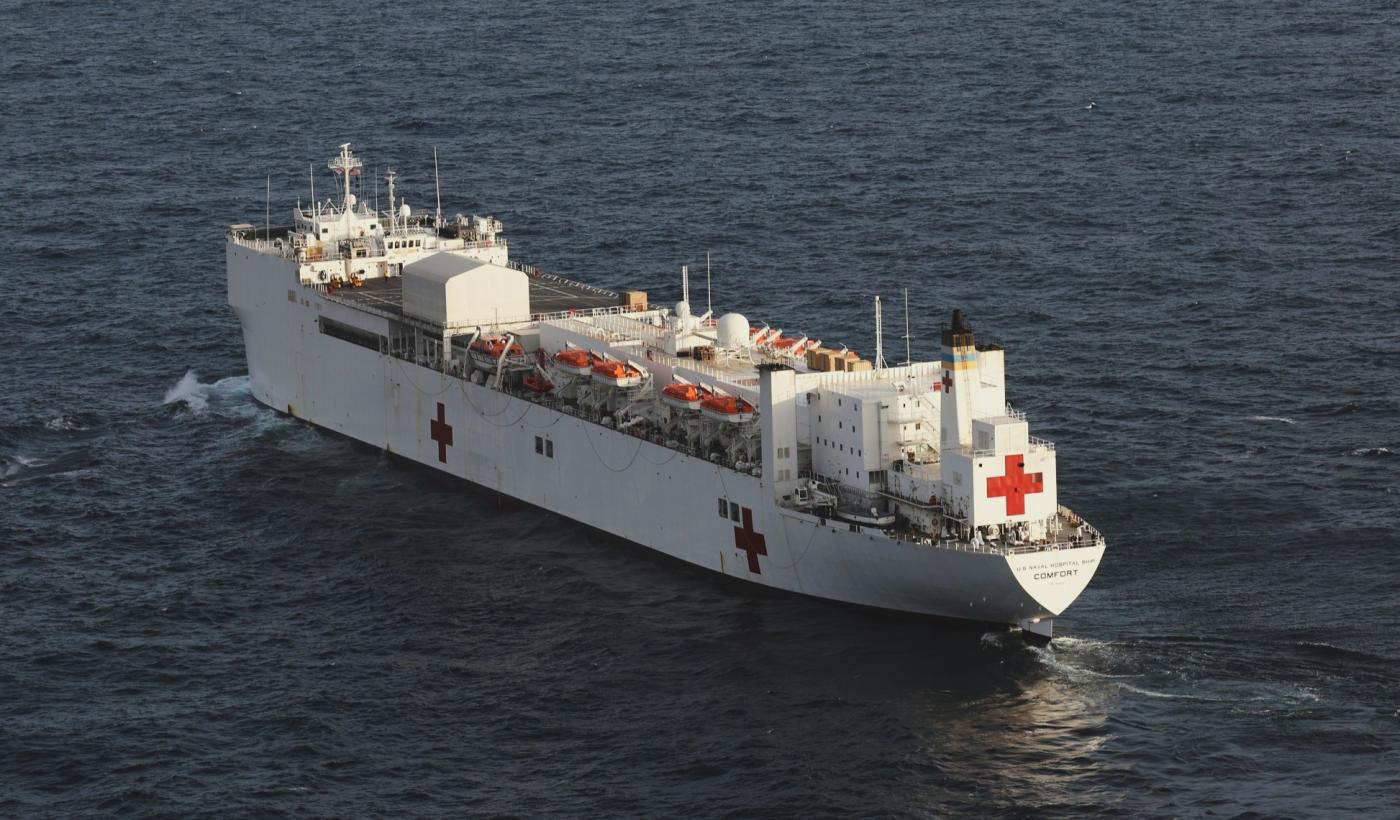
fot. U.S. Navy s Military Sealift Command
Origins and Conversion
Originally built as a commercial San Clemente-class supertanker named SS Rose City, the vessel was acquired and converted by the U.S. Navy in the 1980s. She was commissioned into service in 1987 as one of two purpose-built hospital ships, alongside her sister ship, USNS Mercy (T-AH-19).
USNS Comfort measures 272 meters in length, displaces nearly 69,000 tons, and boasts a beam of 32 meters. Despite her mass, she maintains an operational speed of up to 17 knots, allowing timely deployment to disaster or conflict zones.
Medical and Operational Capabilities
USNS Comfort is one of the largest mobile hospitals in the world, capable of treating up to 1,000 patients at a time. Her medical infrastructure includes:
- 12 fully equipped operating rooms
- 80 intensive care beds
- Radiology and diagnostic imaging (X-ray, CT)
- Medical laboratories and a full pharmacy
- Dental and ophthalmology facilities
- Infectious disease wards
- A psychiatric unit and maternal care services
The ship features an onboard oxygen plant, desalination systems, waste management, and power generation systems, ensuring full medical and logistical autonomy for extended missions.
Crew Structure and Command Model
The USNS Comfort operates under a civilian-military hybrid model. The vessel itself is managed by Military Sealift Command, with civilian mariners responsible for navigation, propulsion, and maintenance. Meanwhile, the medical staff consists of up to 1,200 Navy personnel, including doctors, nurses, medics, and medical specialists from the U.S. Navy Medical Corps.
This structure allows the ship to remain rapidly deployable while maintaining the highest levels of operational readiness.
Missions: From Combat Support to Humanitarian Relief
While designed for casualty treatment during wartime, Comfort has become a cornerstone of the Navy’s humanitarian and disaster response operations. Notable deployments include:
- Desert Storm (1991) – treatment of wounded service members in the Persian Gulf
- Haiti Earthquake (2010) – life-saving trauma care in the aftermath of a major natural disaster
- Hurricane Maria (Puerto Rico, 2017) – support to strained local healthcare infrastructure
- COVID-19 Pandemic (New York City, 2020) – relief to overwhelmed hospitals during the first wave
- Continuing Promise Missions (2007–present) – ongoing medical outreach across Central America and the Caribbean
Each mission reinforces the ship’s dual role as a tool of soft power and humanitarian projection, demonstrating the strategic utility of health diplomacy at sea.
Strategic Relevance in a Changing World
In today’s multipolar geopolitical climate, hospital ships like Comfort serve not only as tools of mercy but also as instruments of influence. Their presence can stabilize regions in turmoil, bolster alliances, and demonstrate logistical supremacy in areas with compromised infrastructure.
From a maritime logistics standpoint, sustaining operations aboard a floating hospital requires a highly coordinated supply chain involving fuel, medical cargo, food, fresh water, and personnel rotations. This highlights Comfort as a case study in complex afloat logistics and interagency coordination.
Implications for the Global Maritime Sector
The operational success of USNS Comfort offers valuable lessons for navies and maritime organizations worldwide. In the face of increasing hybrid threats, climate-driven disasters, and regional instability, mobile medical platforms can serve as strategic multipliers—combining naval reach with medical relief.
European and allied maritime forces may find value in considering similar platforms, whether purpose-built or converted, to enhance their crisis response capabilities and improve regional engagement.
Conclusion. USNS Comfort - maritime innovation
The USNS Comfort is more than a ship—she is a symbol of operational compassion, maritime readiness, and the evolving role of naval assets in the 21st century. As sea power adapts to new humanitarian and global challenges, vessels like Comfort will remain at the forefront of maritime innovation and international goodwill.
see also
Buy us a coffee, and we’ll invest in great maritime journalism! Support Gazeta Morska and help us sail forward – click here!
Kamil Kusier
redaktor naczelny
comments
Add the first comment
see also
"Let everyone know we will prevail". Poland’s armed forces set strategic course for 2026-2039
“Army 500” and strategic transformation: Poland sets the course for long-term deterrence and allied readiness
Medical evacuation from offshore vessel in the Baltic. Rescue 511 helicopter and m/s Huragan deployed
Karol Nawrocki: “The strength of the republic lies in its armed forces”. Security requires national unity
Human trafficking, money laundering, millions frozen. Successful operation by border guard and tax administration
Evening SAR operation in the Baltic. Two kitesurfers stranded offshore
Medical evacuation from sailing ship in Gdynia port. 17-year-old safely transported
Medical evacuation from Danish-flagged vessel Skoven off Łeba. Joint SAR operation in the Baltic Sea
Almost 2.5 million travellers cleared in 2025 by the Maritime Border Guard
Frontex officers train with Polish Maritime Border Guard
ADVERTISEMENT
ADVERTISEMENT