Piotr Gorzeński, president of the Port of Gdynia: I prioritise consistency over competition
The Port of Gdynia is steadily strengthening its position as a modern, universal hub and a key node of the Baltic–Adriatic Corridor, with president Piotr Gorzeński emphasising in an interview with Gazeta Morska the evolution of the management model and the port’s response to contemporary maritime market challenges — from infrastructure development and process digitalisation to major investment projects such as the Outer Port and the dual-use intermodal terminal — highlighting that Gdynia’s strength stems from a balanced approach to sea- and land-side modernisation, close cooperation with public and private partners, and a growing focus on sustainability, including OPS deployment, low-emission technologies and shifting cargo to rail, all of which will enable the port to remain competitive in an increasingly dynamic European maritime landscape.
only here business maritime economy opinions and comments pomerania ports work at mare tricity news28 november 2025 | 07:07 | Source: Gazeta Morska | Prepared by: Kamil Kusier | Print
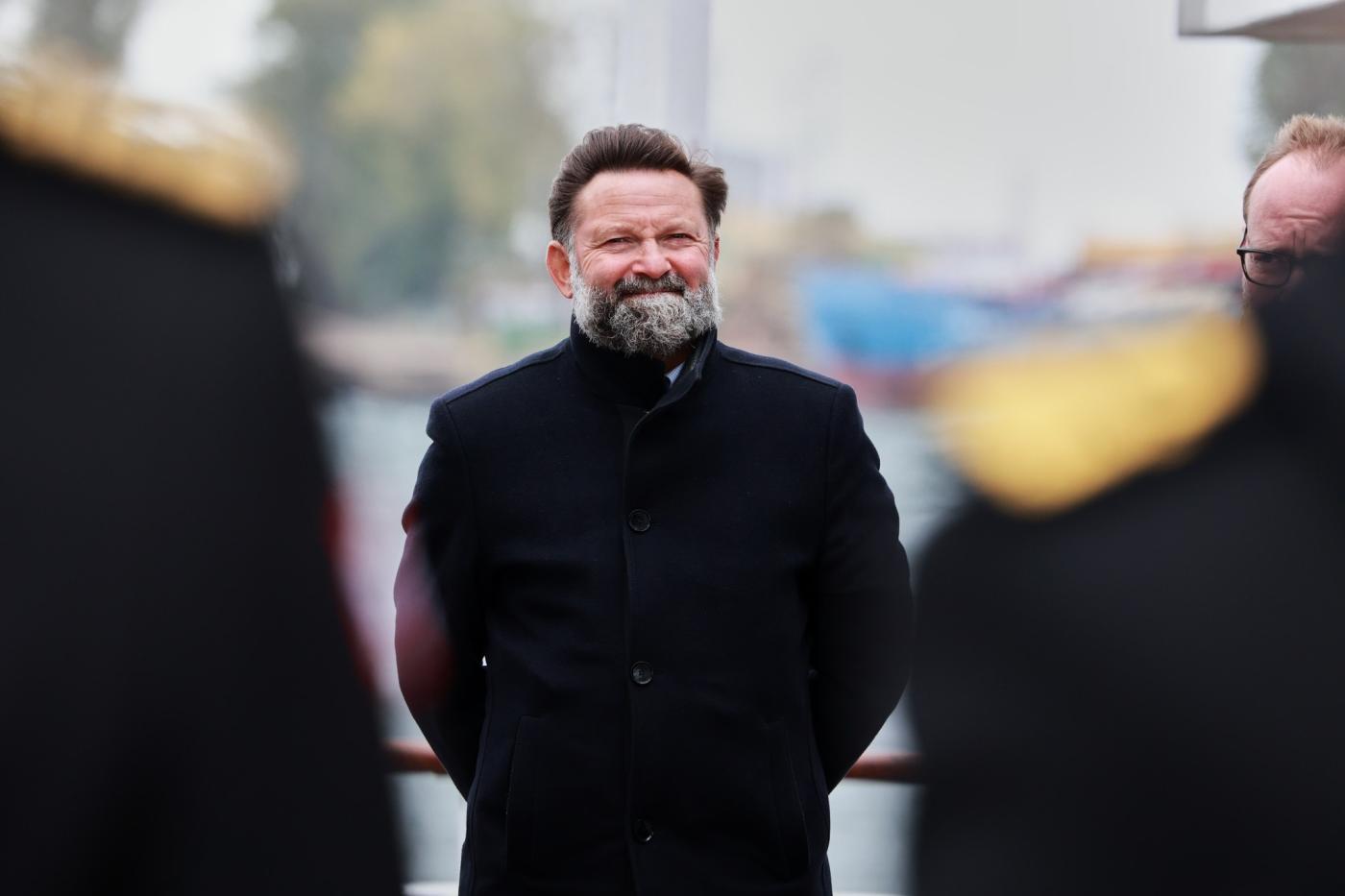
fot. Port Gdynia
What key organisational and management changes are being introduced at the Port of Gdynia in response to the current developments in the maritime market?
Piotr Gorzeński: The Port of Gdynia’s management structure is evolving in line with the development priorities laid out in the Port of Gdynia Strategy to 2027. These are not revolutionary shifts but rather a consistent, long-term adaptation of the organisation and management processes to the realities of today’s maritime market — including the emergence of new terminals, the rising importance of intermodal transport, and increasingly demanding environmental and technological requirements.
Today, the Port of Gdynia operates as a modern, universal port and a multimodal logistics hub on the Baltic–Adriatic Corridor. This means that organisational development focuses on integrating infrastructure, operations and investment activities, and on working closely with public and private partners to maintain fluid port processes and transport access.
From a management perspective, priorities include coordinating investments that expand handling and transport capacity, ensuring full maritime, rail and road accessibility, strengthening cooperation with terminal operators and investors, and implementing advanced digital solutions that drive safety and sustainable growth. All these efforts serve one long-term goal: maintaining the port’s universal profile and Gdynia’s competitive position in the Baltic region.
How does the Port of Gdynia plan to respond to growing regional competition, particularly from the Port of Gdańsk? Do you view Gdańsk as a competitor, or is there room for broader partnership?
In today’s maritime environment, consistent cooperation creates more value than “port versus port” rivalry. Gdynia and Gdańsk — despite their differences in quay layout and specialisation — serve the same economic ecosystem and form a joint commercial gateway to Poland and Central Europe. That is why we actively develop collaboration wherever scale effects matter: standardising systems and procedures, aligning priorities for access infrastructure, and jointly engaging with national and EU institutions.
Such partnership strengthens the negotiating position of Polish ports, accelerates regulatory and financial decisions, and offers clients clearer procedures, system compatibility, and easier planning of rotations and hinterland flows. In other words, we compete through service quality and reliability, but in fundamental areas such as infrastructure, digitalisation and the green transition, we work together to strengthen the entire Baltic–Adriatic Corridor. This direction is precisely embedded in the Polish ports’ cooperation agreement — from unified IT solutions to coordinated OPS, renewable energy and infrastructure funding efforts.
What infrastructure challenges do you see as priorities for Baltic ports in the coming years?
For Gdynia, the priority is balancing two dimensions: maritime parameters and reliable land access. On the maritime side, we aim for full Baltmax-class capability and for unlocking the potential of the Outer Port — an investment that removes current vessel size limitations and opens a new operating scale. On the land side, critical elements include the modernisation of Gdynia Port rail station (already completed), accelerating work on rail line 201, and delivering the Red Road as a modern link to national and expressway networks.
For customers, this means shorter port stays, more stable operational windows and lower chain vulnerability to disruptions. For the region, it means a more resilient logistics system capable of handling larger cargo volumes without costly bottlenecks within the city.
What technologies and innovations in port logistics are you implementing to enhance operational efficiency?
Technology is valuable only when it reduces port time and structures coordination among multiple stakeholders. On the seaside, we deploy precise GBAS-RTK-based navigation and guidance systems that speed up manoeuvring and improve safety during port entry. On the landside, we are developing the Port Community System as a unified environment for information and decision-making — from agency declarations and berth window planning to integration with terminals, rail and road carriers.
We are introducing operational planning modules, digital rail handling, and predictive analytics to better match resources with expected demand peaks. The effect is clear: fewer unnecessary idle hours, more reliable schedules and the ability to adjust plans quickly based on shared real-time data. This is the essence of port operations: precision on entry, transparency in process, and predictability on departure.
You highlight sustainable development as a strategic priority. What concrete actions are being taken to reduce CO₂ emissions and environmental impact?
We view decarbonisation as an investment in the quality of the port’s product. We are preparing permanent Onshore Power Supply (OPS) infrastructure for container and passenger quays. This means a tangible reduction in emissions and noise at berth, easier compliance with AFIR requirements from 2030 and a more comfortable stay for the vessel.
In parallel, we maintain LNG bunkering capability (truck-to-ship) and continue evaluating methanol and ammonia scenarios in terms of technological maturity and fleet demand. The third pillar is process digitalisation: well-coordinated operations reduce idle hours for both vessels and equipment, thus lowering the carbon footprint without compromising efficiency.
For shipowners, this translates into operational comfort; for the city — cleaner, quieter port neighbourhoods.
Digitalisation and automation are becoming increasingly important. How are these areas shaping operations at the Port of Gdynia?
Digitalisation is becoming one of the core pillars of our operating model. We are expanding the PCS as a consistent environment where all process participants — from ship agents to rail operators — work on uniform, up-to-date data. The Cargo Module and planning tools already improve infrastructure utilisation and reduce delays.
The next step is full digital rail handling with automated information flow and resource allocation. We complement this with precise RTK-based navigation, ensuring a seamless “approach-to-departure” operational chain. For clients, this simply means: shorter, faster and more predictable port calls.
What are your plans for the development of container terminals in light of the growing trend in global container trade?
Within the inner port, we have deepened the fairway and internal channels, and we are modernising key assets such as the Helskie Quay to enhance parameters and ergonomics. In parallel, we are preparing for the Outer Port — approximately 150 hectares of new land and a terminal ultimately capable of 2.5 million TEU annually, designed for larger vessels and high-efficiency regimes. The project is executed as a public–private partnership, combining capital and know-how.
Its success depends on synchronised landside access: rail line 201 and the Red Road must ensure smooth cargo outflow so new capacity translates into real competitive advantage — shorter cycles, stable operational windows and greater flexibility.
Intermodal logistics remains a challenge. How are you addressing it?
The challenge is well understood: rail’s share in container transport remains below expectations, especially on shorter distances dominated by road haulage. Our answer is infrastructure and organisation. Together with the Polish NDI Group, we are building a dual-use intermodal terminal in the port’s western zone. It will handle 750-metre trains, feature 22.5-t/axle load and dedicated shunting infrastructure. The project is co-funded under CEF/Military Mobility, with delivery planned for 2026.
A key element — given today’s security realities — is enabling rapid handling of military cargo. The terminal will include a dedicated heavy-vehicle ramp for efficient loading and unloading of military and civilian equipment.
In addition, we leverage the upgraded Gdynia Port rail station (approx. 100 km of new electrified tracks) and push for progress on rail line 201. For operators, this means more stable routes and predictable planning; for customers — a real opportunity to shift volumes to rail where it is more cost- and eco-efficient.
Beyond cooperation with Gdańsk, how does the Port of Gdynia collaborate with other Baltic ports? Is joint infrastructure development also on the table?
We are an active member of the Baltic Ports Organization, which facilitates knowledge exchange and best practices in safety, digitalisation, OPS and alternative fuels. This accelerates the adoption of European standards and improves interoperability across the Baltic.
We also maintain close working relationships with neighbouring port authorities and strengthen national cooperation within the Polish ports’ agreement to unify procedures and present a coherent offering at EU forums. This gives customers greater planning certainty and strengthens our influence in regulatory and funding processes.
How do you assess the evolving European maritime landscape, especially regarding the rise of intermodal transport and sustainable growth?
The maritime industry is accelerating along three axes: intermodal growth, digitalisation and decarbonisation. We respond directly by enhancing maritime access parameters, increasing capacity, and building predictability and resilience — the two attributes customers value most.
Predictability stems from harmonised standards and transparent data; resilience from the ability to reroute flows and maintain continuity during disruptions. As a universal port with a diversified terminal base, Gdynia can flexibly respond to changing market needs and handle peaks across multiple cargo groups. Our position within TEN-T and the Baltic–Adriatic Corridor further strengthens our role as a hub connecting short-sea shipping, feedering and hinterland logistics within a cohesive product.
How is the Port of Gdynia addressing supply chain security amid global crises such as the pandemic or the war in Ukraine?
Resilience is not a reaction to crisis — it must be built into the system. Upgraded rail infrastructure, the development of the intermodal terminal and progress on rail line 201 form a stable operational backbone. Digitalisation, from notifications to planning, accelerates decision-making and improves real-time coordination.
This ensures continuity even during extraordinary events and elevates communication with clients. Consistent infrastructure development helps minimise risks of cargo flow disruption, allowing Gdynia to maintain strong operational performance even under economic or geopolitical instability.
What impact do recent EU legislative changes — especially those linked to the Green Deal — have on the Port of Gdynia?
We view EU regulations not as a list of obligations but as a framework enabling a higher-quality port product and a better port–city coexistence. The AFIR Directive and its 2030 OPS requirement clarify the direction of energy investments. With dedicated OPS infrastructure under development for container and passenger quays, we are shifting from temporary solutions to a stable standard that cuts emissions and noise at berth, supports shipowners’ compliance and shortens operations.
In parallel, digital environments and harmonised procedures decrease coordination costs for clients — less paperwork means fewer errors and faster cargo turnaround. For Gdynia, this translates into an attractive value proposition: a quiet, predictable and interoperable port is the natural choice for Baltic–Adriatic cargo flows.
How do you improve cooperation with shipowners and terminal operators to streamline cargo-handling processes?
Effective cooperation begins with a shared data environment. That is why we are developing the PCS as a unified workspace for agents, terminal operators, port services and carriers. Planning and cargo modules, rail and road integrations, and digital handling of previously manual processes all reduce uncertainty in berth allocation, synchronise equipment deployment and ensure faster, more reliable plan adjustments.
On the maritime side, this is reinforced by precise RTK-based navigation, shortening manoeuvres and supporting schedule integrity. For business partners, the gains are direct: stable port time, transparent processes and improved utilisation of fleet and terminal assets.
What role should ports play in addressing climate change? Is this a real challenge for maritime transport?
Ports are the natural interface where climate policy becomes operational practice. Our ambition is for every investment to deliver both environmental and operational benefits. This is why we are developing OPS, maintaining LNG bunkering capability, evaluating methanol and ammonia options, and using PCS to reduce idle work hours for vessels and equipment.
We support shifting cargo to rail where it lowers emissions and costs, and we design access infrastructure to minimise heavy-vehicle movement in the city. We also cooperate with research institutions on environmental projects, such as the LIMIT initiative addressing micro-pollutants.
For shipowners and operators, the logic is simple: lower emissions and noise at berth, more predictable operations, and easier compliance with rising environmental standards.
Which upcoming investments will have the greatest impact on Gdynia’s competitive position in Europe?
The Outer Port will be the most significant scale-changer. In parallel, we are modernising the inner port — including the Helskie Quay — and consistently strengthening the ro-ro segment. The number of maritime services calling at Gdynia, both ocean and feeder, continues to increase.
In ro-ro, two strategic directions are key. First, Finnlines’ weekly service connects Gdynia with Bilbao, integrating us into the Grimaldi Group’s Atlantic network. Second, Lakeway Link offers fast (approx. 22-hour) services between Gdynia and Södertälje — launched in May 2024 with three sailings per week and, from November 2025 after adding the vessel Mistral, providing daily departures (Monday–Friday). This enhances frequency, eases pressure on land routes and gives customers new loading windows.
In containers, we see effects of “network densification”: ONE has launched an additional feeder, Gdynia is included in MSC’s Britannia service (Asia–North Europe), and Maersk calls under the Gemini Cooperation increase frequency and flexibility. All of this strengthens resilience.
The entire system is tied together by land access — essential for shortening and stabilising turnaround times. The upgraded Gdynia Port rail station is operational; the new dual-use intermodal terminal is under construction; and rail line 201 plus the Red Road will complete the access chain. For customers, the outcome is clear: shorter, more predictable port calls, greater flexibility across services and modes, and confidence that rising volumes will not create hinterland bottlenecks.
To what extent is the Port of Gdynia involved in R&D projects and cooperation with universities and research institutions?
We treat cooperation with academia as a natural extension of our innovation process — the place where laboratory concepts can become operational practice. We work with research centres and universities at multiple levels, from expert consultations to participation in national and international consortia. Joint projects with the Gdynia Maritime University, Gdańsk University of Technology and the Naval Academy include automation of port processes, intermodal logistics and new technologies for infrastructure and energy management.
R&D is, for us, not experimentation but an investment in system resilience. Any improvement that enhances decision precision, safety or energy efficiency brings tangible value to customers and to the city.
Buy us a coffee, and we’ll invest in great maritime journalism! Support Gazeta Morska and help us sail forward – click here!
Kamil Kusier
redaktor naczelny
comments
Add the first comment
see also
StartupHack 3.0 at GPNT: Space and maritime technologies at the core of innovation
Polish technology powers zero-emission public transport. AREX secures largest municipal contract
Defence.Hub strengthens capabilities in technologies supporting maritime infrastructure security
Hanseatic Global Terminals takes full ownership of Florida International Terminal
Aleksandra Kosiorek: The sea has always been a space of openness for us, and that will not change
Gdańsk to launch Baltic Sea monitoring center
Türkiye advances indigenous GNSS ambitions: what FGN-100-D3 means for the maritime sector
Lithium at the core. TKMS and E3 Lithium align on Canada’s submarine ambitions
Błażej Konkol appointed vice president for infrastructure at the Port of Gdańsk Authority
WB Group expands into Romania, strengthening presence in the Black Sea region
ADVERTISEMENT
ADVERTISEMENT