









NATO conducts historical ordnance disposal operation in the Baltic Sea
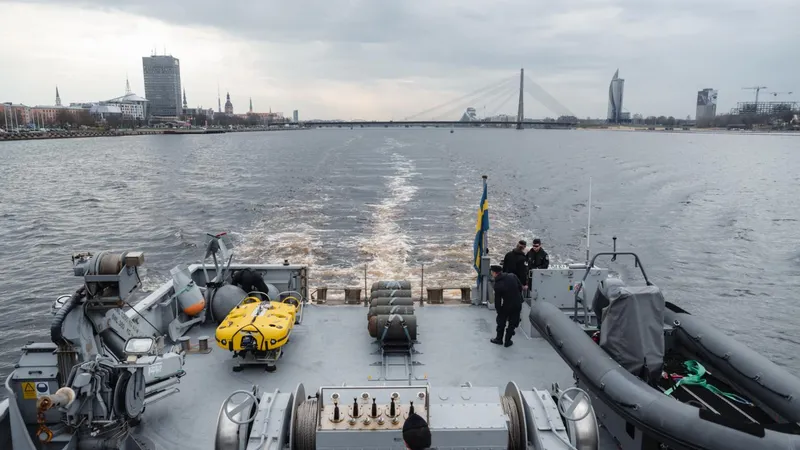
After several days of coordinated efforts, NATO’s Standing Mine Countermeasures Group One (SNMCMG1) has successfully completed a focused Historical Ordnance Disposal Operation (HODOPS) in the Gulf of Riga. As part of the Baltic Sentry mission, the multinational group conducted intensive training in detecting, classifying, identifying, and disposing of historical sea mines and unexploded ordnance (UXO) dating back to World War I and World War II.
In brief
Standing NATO Mine Countermeasures Group 1 completed an operation in the Gulf of Riga to clear historical explosive ordnance, conducted as part of the Baltic Sentry mission. Nine unexploded objects, from torpedoes to sea mines from the First and Second World Wars, were found and neutralised, and each vessel in the group disposed of at least one item. The Dutch command ship Luymes scanned the seabed with a towed sonar, passing contacts to the Belgian vessel Lobelia. Latvian authorities received updated seabed data and the locations of two unregistered wrecks, Captain (Navy) Erik Kockx said.
- The threat from historical ordnance remains very real. Our presence and operations served both as a safeguard and a signal – NATO is committed to the safety and security of the Baltic region, said Commander Erik Kockx, Belgian Commander of the Task Group.
From torpedoes to sea mines – real results at sea
During the operation, nine UXOs were found, ranging from torpedoes to sea mines, all of which were successfully neutralized. Every ship in the group contributed to the effort, with each vessel neutralizing at least one UXO. The Dutch staff ship Luymes contributed to the HODOPS by scanning the seabed using its Towed Side Scan Sonar, classifying contacts, and handing them over to the Belgian minehunter Lobelia for identification and disposal.
- This was a textbook example of real-world minehunting: detect, classify, identify, and dispose. Our teams worked through weather challenges and limited underwater visibility to get the job done, said Commander Erik Kockx.
Technology meets history
Using modern technology, the participating ships were able to compare current data with historical records, allowing for more precise identification and efficient clearance. Weather conditions played an important role; clearer weather improved underwater visibility, enhancing detection and identification rates.
Throughout the HODOPS, the ships received orders from the SNMCMG1 staff, who maintained an operational overview, tasked individual units, and managed reports to create a comprehensive picture of the minefield.
Strengthening regional ties in Riga
While in Riga, SNMCMG1 didn’t just focus on operations. The port visit included meetings with Latvia’s Minister of Defence, Andris Sprūds, and Flotilla Admiral Māris Polencs, Commander of the Latvian Navy. These engagements deepened professional ties and reaffirmed NATO’s commitment to regional security.
- These port visits are more than just a logistical necessity – they’re an opportunity to exchange ideas, deepen professional relationships, and reaffirm our shared commitment to maritime security, said Commander Erik Kockx.
Long-term impact through shared information
In addition to neutralizing ordnance, SNMCMG1 also shared updated seabed data and mine-related findings with Latvian authorities, contributing to long-term maritime safety. Besides UXOs and remnants of historical mining activities, two unrecorded wrecks were also found and shared with Latvian authorities.
- When we find or destroy a mine, that information is immediately passed on to the relevant national authorities. It’s not just about clearing the mines – it’s about raising awareness, improving safety, and maintaining open sea lanes for all, said Commander Erik Kockx.
SNMCMG1’s cooperation in these operations highlights the strength of NATO’s interoperability and its unwavering focus on safe navigation, preparedness, and resilience across the Baltic region.
Source: Gazeta Morska · Compiled by: Kamil Kusier
Related articles
 Maritime economy Poland’s constitutional crisis is also a maritime story
 Navy and defence Norwegian submarine Utstein completes NATO patrol guarding offshore oil and undersea infrastructure
 Safety and rescue Polish SAR’s new rescue vessel Mistral launched at Kewatec in Finland
 Safety and rescue Icelandic Coast Guard and police delegation visits Polish Border Guard’s Maritime Division
 Safety and rescue Polish Navy helicopter evacuates man from Baltic platform 100 km off Władysławowo
 Navy and defence SNMG2 joins Allied warships in PASSEX as Italy's Mare Aperto 2026 gets under way
Comments (0)
The discussion is moderated by the editors: a comment appears after review. Your e-mail address is not published.
Nobody has commented on this article yet.