Did Mars once have an ocean and beaches? New findings from China's Zhurong rover
Mars, though appearing today as an inhospitable world with a harsh landscape, may once have resembled a more welcoming environment with oceans and beaches. New research provides evidence of ancient shorelines, suggesting that the red planet once hosted large bodies of water.
other worldwide opinions and comments news25 february 2025 | 16:00 | Source: theguardian / Gazeta Morska | Prepared by: Daniel Nawrocki | Print
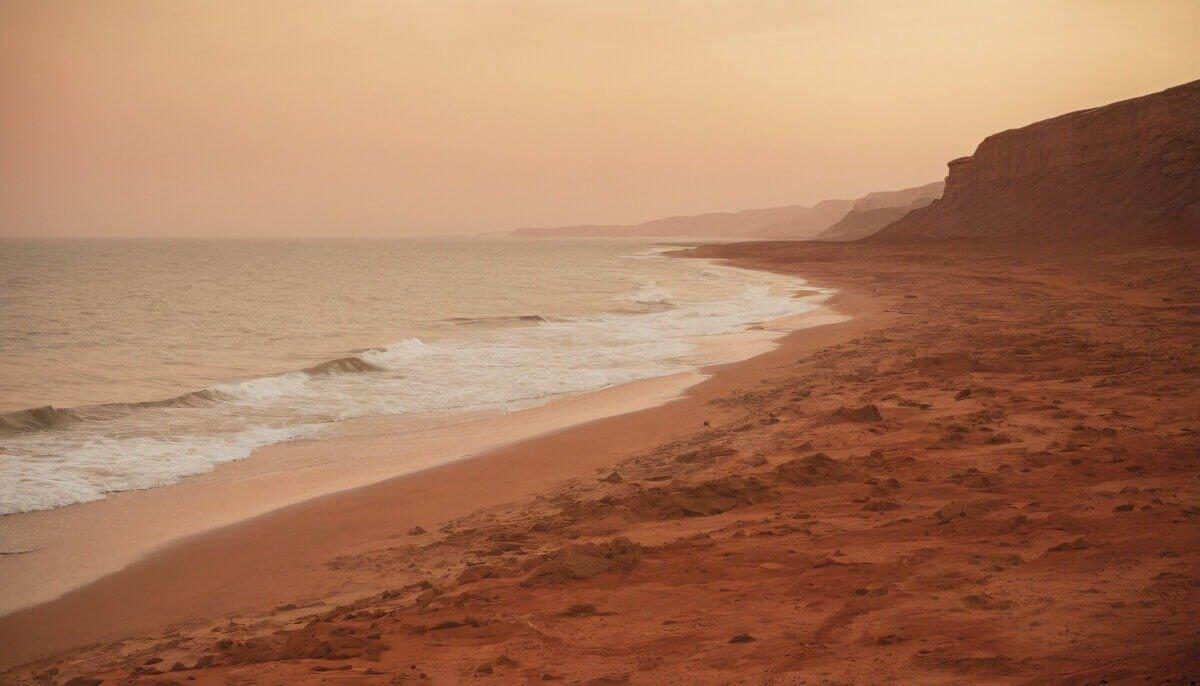
fot. x.com/MarioNawfal
Discovery of Martian shores
An international team of scientists, analyzing data from China's Zhurong rover, has uncovered subsurface structures resembling Earth's beaches. The findings were published in Proceedings of the National Academy of Sciences.
- Zhurong was deployed to the southern part of Utopia Planitia, near areas where ancient shorelines had been mapped based on satellite data, said Dr. Benjamin Cardenas from Pennsylvania State University, a co-author of the study.
A ground-penetrating radar (GPR) onboard the rover allowed scientists to peer beneath the Martian surface. The results revealed structures sloping northward, suggesting that these formations were shaped by oceanic activity.
- The radar detects even subtle changes in sediment sizes, which is likely what we're seeing here, Cardenas explained.
Furthermore, researchers discovered that Mars' shoreline shifted over time. This implies that waves and tides influenced sediment deposition, reinforcing the presence of vast bodies of water.
- The beach moved at least 1.3 km northward into the ocean, Cardenas added.
Potential conditions for life
This discovery has significant implications for studying Mars' past potential for sustaining life.
- A beach is where shallow water, air, and land converge. On Earth, such environments were crucial for the emergence of life, Cardenas emphasized.
The researchers ruled out alternative explanations for the discovered structures.
- We exclude volcanic activity, river formations, and wind-shaped sand dunes. While these phenomena are common on Mars, the structures we found simply do not fit those patterns, the scientist noted.
A beach, but not for relaxation
Although Martian beaches may be geologically similar to those on Earth, they would be far from inviting vacation spots.
- Of course, there would be no palm trees or seagulls, and temperatures would be quite low, Cardenas admitted.
However, he added that uncovering Mars' ancient landscapes is an exciting endeavor:
- Reconstructing these prehistoric sceneries is excellent fuel for the imagination, he concluded.
Buy us a coffee, and we’ll invest in great maritime journalism! Support Gazeta Morska and help us sail forward – click here!
Daniel Nawrocki
redaktor
comments
Add the first comment
see also
Winter on Puck Bay: ice conditions, natural values, and responsible use
The technical backbone of Poland’s maritime economy: from port fuel tanks to comprehensive support
Dolphins spotted in Szczecin: rare observation near the Pioneers’ Bridge ahead of Christmas
Naval officer’s courage beyond duty: Polish Navy commander saves life in the Tatra Mountains
A shared course towards the sea: KPH Group and the Polish Naval Academy join forces in education and maritime media
First Commander Maciej Janiak Award presented aboard ORP Błyskawica
Seafarers’ service books: important reminder on upcoming expiry
The sound of heavy boots: summer season begins at Poland’s Arctowski Station
Gdynia Maritime University pays tribute to those who have sailed on their eternal watch
Blessed Fr. Cmdr. Lt. Władysław Miegoń: the priest who stayed with his sailors to the end
ADVERTISEMENT
ADVERTISEMENT