









M940 Oostende: Belgium’s leap into the future of naval mine warfare
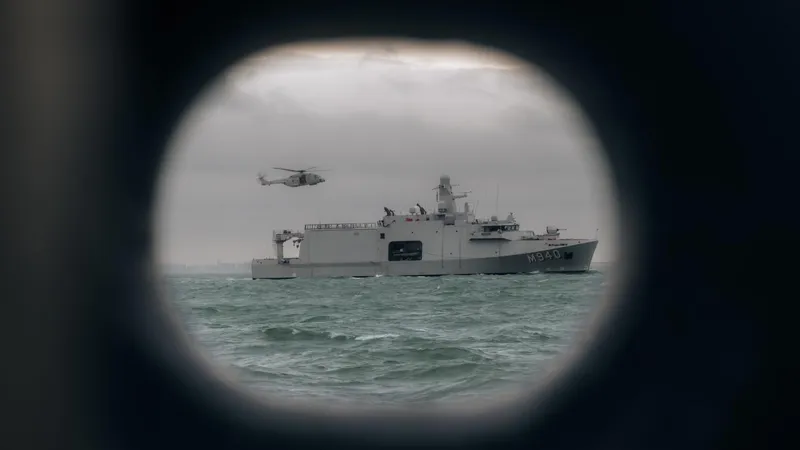
A landmark day for Belgium’s navy and for European mine warfare. The brand-new M940 Oostende, the first of a next-generation fleet of mine countermeasure (MCM) vessels, made her historic arrival at the naval base of Zeebrugge — welcomed by the veteran M921 Lobelia. Her commissioning marks not just the arrival of a ship, but the dawn of a new operational philosophy: one that replaces traditional minehunting with remote, autonomous and networked operations.
In brief
M940 Oostende made its first call at Belgium's Zeebrugge naval base as the first of twelve rMCM mine countermeasures ships, six each for Belgium and the Netherlands. Belgium Naval and Robotics, a consortium of Naval Group and Exail, holds the contract worth over 1.8 billion euros. M940 Oostende is 82.6 metres long, displaces about 2,800 tonnes and, instead of entering minefields, controls Inspector 125 surface drones, A18-M underwater drones and Seascan and K-STER vehicles. Vice Admiral Tanguy Botman, Belgian Navy commander, called the arrival the first step toward new-generation mine warfare.
From minehunting to remote operations
The Oostende is the lead ship of twelve new MCM vessels (six for Belgium and six for the Netherlands) being built under the rMCM – remote mine countermeasures program. The contract, worth approximately €1.8 billion, is being executed by Belgium Naval & Robotics, a consortium formed by Naval Group and Exail (formerly ECA Group).
Unlike traditional minehunters, Oostende is not designed to sail into minefields. Instead, she serves as a command-and-control mothership, deploying and coordinating an array of uncrewed systems — surface, subsurface and aerial — that perform the dangerous tasks of detection, classification and neutralization at a safe distance.
- The arrival of Oostende marks the first step in our transition toward a new generation of mine warfare — safer, more efficient and better suited to the maritime challenges of tomorrow, said Vice Admiral Tanguy Botman, Commander of the Belgian Navy.
High technology at sea
Measuring 82.6 meters in length with a full-load displacement of around 2,800 tons, Oostende is a striking blend of traditional naval design and advanced digital infrastructure.
Her onboard “toolbox” includes a full suite of unmanned systems:
- Inspector 125 USVs (uncrewed surface vessels) for mission deployment,
- A18-M autonomous underwater vehicles (AUVs) for mine detection,
- and Seascan and K-STER remotely operated vehicles (ROVs) for identification and neutralization.
All systems are linked through an integrated command-and-control architecture, enabling Oostende to coordinate complex MCM operations over long distances while minimizing human risk.
In practice, the ship acts as a floating operations center — a node in a broader network of autonomous platforms.
Carrying a legacy forward
For decades, Belgium’s Tripartite-class minehunters — developed jointly with France and the Netherlands — represented NATO’s benchmark for mine warfare excellence.
The Oostende inherits that legacy, combining Belgian expertise, NATO know-how and European innovation.
As the Belgian navy phrased it:
- Oostende is not built to hunt mines herself. She is a mothership — a platform from which drones and autonomous vehicles operate. Mine warfare of the future happens remotely — faster, safer and more precise.
Versatility beyond mine warfare
Although designed primarily for mine countermeasures, Oostende was conceived with multirole flexibility in mind.
The vessel can also undertake:
- patrol and surveillance operations,
- protection of critical underwater infrastructure such as cables, pipelines and offshore wind farms,
- search-and-rescue and maritime reconnaissance missions.
Her modular architecture allows for future upgrades, integrating new generations of drones, AI-assisted sonar analysis and advanced data-fusion systems.
A European model of cooperation
The rMCM program goes far beyond shipbuilding: it embodies a new model of European naval cooperation.
Construction of hulls takes place in Lorient and Concarneau (France), while integration and fitting-out are carried out in Belgium.
The project involves dozens of European companies and research institutes, reinforcing Europe’s strategic autonomy in unmanned maritime technologies.
- This is not just a new ship — it’s a new way of operating, reads an official navy statement. - With Oostende, Belgium takes a decisive step into an era where human skill and technology work hand in hand to secure our seas.
Symbolism and future outlook
The ship’s name carries deep meaning. The city of Ostend (Oostende) hosts both Belgium’s Naval Academy and the NATO Centre of Excellence for Mine Warfare.
Her arrival there is thus more than ceremonial — it symbolizes the meeting of tradition and innovation, a bridge between Belgium’s proud naval heritage and the digital age of autonomous maritime operations.
In a time when undersea infrastructure security and hybrid maritime threats are growing in importance, Oostende represents a strategic leap forward.
By merging human expertise with robotic precision, Belgium once again positions itself at the forefront of NATO mine-warfare innovation — showing how European cooperation can shape the oceans of tomorrow.
Source: Gazeta Morska · Compiled by: Kamil Kusier
Related articles
 Maritime economy Poland’s constitutional crisis is also a maritime story
 Navy and defence Norwegian submarine Utstein completes NATO patrol guarding offshore oil and undersea infrastructure
 Safety and rescue Polish SAR’s new rescue vessel Mistral launched at Kewatec in Finland
 Safety and rescue Icelandic Coast Guard and police delegation visits Polish Border Guard’s Maritime Division
 Safety and rescue Polish Navy helicopter evacuates man from Baltic platform 100 km off Władysławowo
 Navy and defence SNMG2 joins Allied warships in PASSEX as Italy's Mare Aperto 2026 gets under way
Comments (0)
The discussion is moderated by the editors: a comment appears after review. Your e-mail address is not published.
Nobody has commented on this article yet.