









M3 Amphibious System: Latvia Demonstrates Next-Level Mobility Across Water Obstacles
The Latvian National Armed Forces have recently showcased the capabilities of the M3 amphibious bridging and ferry system – a high-mobility engineering platform designed to support rapid maneuverability across rivers, canals, and inland waters. The demonstration highlights the growing strategic relevance of operational mobility in the Baltic Sea region.
In brief
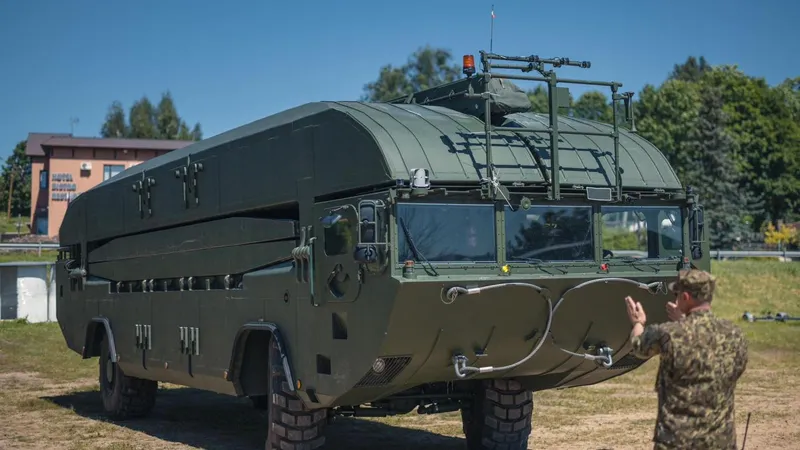
The Latvian Armed Forces have demonstrated the capabilities of M3 amphibious vehicles, used for rapid crossing of rivers, canals and lakes. Individual M3 vehicles operate as ferries or join together into a pontoon bridge with a load capacity of up to 85 tonnes and a length of up to 75 metres, sufficient for combat vehicles and main battle tanks. Three soldiers convert an M3 from a wheeled vehicle into a crossing asset, and the vehicle reaches up to 80 km/h on roads and 14 km/h in water. The demonstration reflects the growing importance of operational mobility in the Baltic Sea region.
Developed for both independent and combined operations, the M3 system can function autonomously as a self-propelled ferry unit, or interconnect with other M3s to form pontoon bridges up to 75 meters long, supporting loads of up to 85 tonnes – sufficient to carry main battle tanks and heavy armored vehicles.
One of the platform’s most striking features is its rapid deployability: just three soldiers are required to convert the vehicle from road mode to a fully functional bridge or ferry without external support. The M3 reaches speeds of up to 80 km/h on roads and 14 km/h in water, enabling fast deployment even in complex terrain.
Latvia’s deployment of M3 units reinforces the increasing emphasis on combat engineering capabilities among NATO's eastern flank members. It also aligns with the Alliance’s focus on interoperability, mobility, and rapid reinforcement – especially relevant for the geographically fragmented and river-rich terrain of Central and Eastern Europe.
For Poland and other regional allies regularly involved in multinational training exercises such as Defender Europe, Anakonda, or Baltic Operations (BALTOPS), the M3 presents a proven, field-ready model for enhancing strategic mobility across natural obstacles.
As mobility and logistical agility become defining components of 21st-century warfare, the M3 system stands out not just as a vehicle, but as a force multiplier – offering swift, adaptable, and scalable crossing capabilities for both national defense and allied operations.
Source: Gazeta Morska · Compiled by: Kamil Kusier
Related articles
 Maritime economy Poland’s constitutional crisis is also a maritime story
 Navy and defence Norwegian submarine Utstein completes NATO patrol guarding offshore oil and undersea infrastructure
 Safety and rescue Polish SAR’s new rescue vessel Mistral launched at Kewatec in Finland
 Safety and rescue Icelandic Coast Guard and police delegation visits Polish Border Guard’s Maritime Division
 Safety and rescue Polish Navy helicopter evacuates man from Baltic platform 100 km off Władysławowo
 Navy and defence SNMG2 joins Allied warships in PASSEX as Italy's Mare Aperto 2026 gets under way
Comments (0)
The discussion is moderated by the editors: a comment appears after review. Your e-mail address is not published.
Nobody has commented on this article yet.