









Humanitarian flotilla to Gaza attacked. Polish diplomacy under pressure
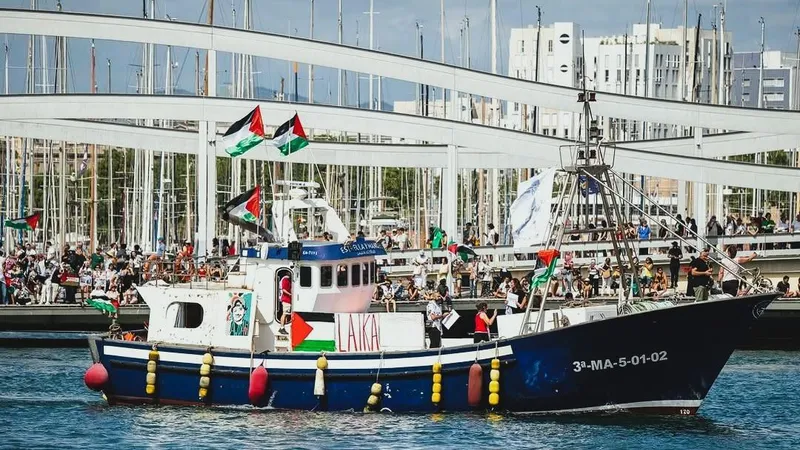
A Polish vessel participating in the international Global Sumud Flotilla, carrying humanitarian aid to the Gaza Strip, came under drone attack overnight from Tuesday to Wednesday. According to flotilla organizers, besides the Polish vessel, Italian and British ships were also hit. The flotilla consists of pro-Palestinian activists from over 40 countries, including climate activist Greta Thunberg.
In brief
Drones attacked a Polish vessel of the Global Sumud Flotilla, which is carrying humanitarian aid to the Gaza Strip, on the night from Tuesday to Wednesday, and Italian and English vessels were reportedly damaged as well. Civic Coalition MP Franciszek Sterczewski, who is on board, expects the Ministry of Foreign Affairs to state that the attack violates international law and to protect the Polish participants. The Global Sumud Flotilla, with activists from more than 40 countries, is in the area of Crete, about six days' sailing from Gaza, and does not intend to turn back. Italian Defence Minister Guido Crosetto announced the dispatch of an Italian Navy frigate.
On board the Polish vessel is Franciszek Sterczewski, a Polish MP, who told PAP that participants expect a clear statement from the Ministry of Foreign Affairs.
– We expect an unambiguous position that the attack constitutes a violation of international law – said Sterczewski, adding that activists also demand protection for the flotilla, or at least for Polish citizens taking part.
Other Polish participants include Omar Faris, president of the Polish-Palestinian Social and Cultural Association, Nina Ptak, head of the Nomada Association, and journalist-activist Ewa Jasiewicz, author of “Podpalić Gazę” (“Ignite Gaza”).
Sterczewski emphasized that despite the attacks, the flotilla will not turn back. The ships are currently near Crete, about six days’ sailing from Gaza. – These attacks only strengthen our determination to break the illegal blockade and deliver humanitarian aid – he said.
Naval response from Italy
Italy’s defense minister Guido Crosetto announced that an Italian Navy frigate has set sail towards the flotilla to provide support if necessary. The Israeli side has also been informed of these plans.
Flotilla organizers have appealed for safe passage to deliver humanitarian aid to Gaza and stressed that they have repeatedly requested protection for the Polish delegation from Poland’s foreign minister Radosław Sikorski.
A long history of contested blockades
The Global Sumud Flotilla is the latest in a series of initiatives aimed at breaking Israel’s maritime blockade of the Gaza Strip, in place since 2007, when Hamas took power in the enclave. Israel justifies the blockade on security grounds, arguing that it prevents arms and materials from reaching Hamas.
Humanitarian organizations and the UN, however, point out that the blockade has devastating effects on civilians – restricting access to food, medicine, fuel, and materials needed for reconstruction. The nearly two-year war between Israel and Hamas has further deepened the humanitarian crisis, with reports of widespread hunger. Experts emphasize that the amount of aid allowed through by Israel remains insufficient to meet the basic needs of Gaza’s population.
Flotillas attempting to break the blockade have been organized for over a decade. The most notorious incident occurred in 2010, when Israeli commandos stormed the Turkish vessel Mavi Marmara, leaving 10 activists dead. The raid triggered a major diplomatic rift between Israel and Turkey and continues to serve as a reference point in debates on the legality of the blockade.
Risks for shipping and maritime law
The flotilla situation again highlights pressing concerns about maritime security in the Eastern Mediterranean. Drone strikes against civilian vessels and the involvement of naval forces raise significant challenges for the law of the sea, particularly in operations outside territorial waters. Industry experts stress that such humanitarian missions effectively serve as a litmus test for the effectiveness of international maritime law, including freedom of navigation and the protection of civilian ships at sea.
Source: Gazeta Morska / PAP · Compiled by: Kamil Kusier
Related articles
 Maritime economy Poland’s constitutional crisis is also a maritime story
 Navy and defence Norwegian submarine Utstein completes NATO patrol guarding offshore oil and undersea infrastructure
 Safety and rescue Polish SAR’s new rescue vessel Mistral launched at Kewatec in Finland
 Safety and rescue Icelandic Coast Guard and police delegation visits Polish Border Guard’s Maritime Division
 Safety and rescue Polish Navy helicopter evacuates man from Baltic platform 100 km off Władysławowo
 Navy and defence SNMG2 joins Allied warships in PASSEX as Italy's Mare Aperto 2026 gets under way
Comments (0)
The discussion is moderated by the editors: a comment appears after review. Your e-mail address is not published.
Nobody has commented on this article yet.