









Dead whale from Świnoujście resurfaces - this time on Wisełka beach
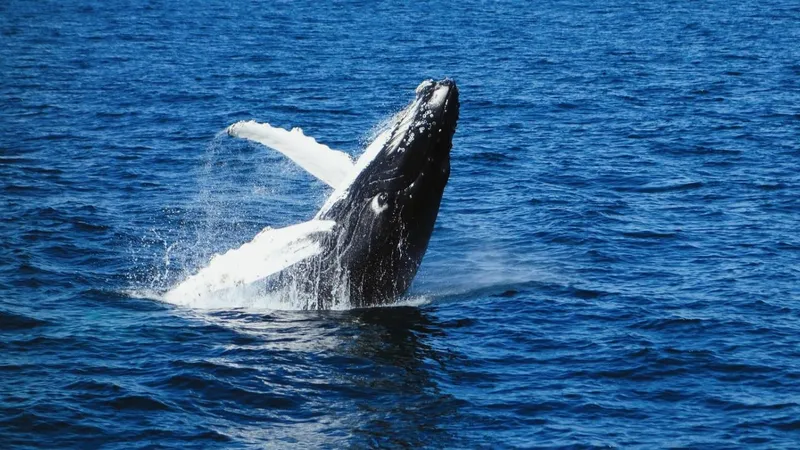
The dead whale that was brought to the LNG terminal in Świnoujście by a tanker on 25 July, and subsequently transported offshore and sunk in the Pomeranian Bay on 2 August, has resurfaced – this time washing ashore in Wisełka, east of Międzyzdroje.
In brief
The carcass of a whale, sunk on 2 August in the Pomeranian Bay more than 3 nautical miles from shore, resurfaced on Sunday on the beach in Wisełka east of Międzyzdroje. The whale's body was dragged in on 25 July by a tanker to the LNG terminal in Świnoujście, and strong currents and weekend wind pushed it towards the shore, said Ewa Wieczorek, spokeswoman for the Maritime Office in Szczecin. Regional Director for Environmental Protection in Szczecin Sylwia Jurzyk-Nordlöw indicated that decomposition prevented the collection of genetic samples and identification of the species. Services held a meeting in Woliński National Park, and another sinking is planned.
According to the Maritime Office in Szczecin, strong sea currents and weekend winds pushed the carcass back toward the coast.
– It was anchored. As recently as Thursday, the contractor reinforced its mooring – said Ewa Wieczorek, spokesperson for the Maritime Office in Szczecin. She noted that over the weekend the area experienced strong winds and high waves, which may have loosened the securing system.
The whale carcass was already in an advanced state of decomposition during the initial operation.
– The carcass was in a very advanced stage of decomposition. It was partially floating but mostly submerged, which gave the false impression that sampling might be possible and that its condition was better than it really was – explained Sylwia Jurzyk-Nordlöw, Regional Director for Environmental Protection in Szczecin.
She added that especially in the submerged parts, the whale’s body was breaking apart. Officials from the Maritime Office had previously taken photographic documentation and measured the whale’s dimensions and weight. However, sampling for genetic testing proved impossible, and the species could not be determined.
– The whale’s body was sunk east of Świnoujście, in the waters of the Pomeranian Bay, in a collision-free area, more than three nautical miles from the shoreline – added Sylwia Jurzyk-Nordlöw.
Professor Andrzej Ossowski, head of the Department of Forensic Medicine and the Forensic Genetics Unit at the Pomeranian Medical University in Szczecin, was present during the Świnoujście operation.
– The whale was falling apart – he reported. – We wanted to take samples, bone material. I was very interested in this as a geneticist, but it turned out to be too dangerous. The whale could have ‘exploded’ – added Professor Andrzej Ossowski, estimating that the animal had been drifting in the water for at least several weeks.
On Monday at 10:00, a coordination meeting is scheduled at Wolin National Park, involving representatives of the park, the Maritime Office, the Regional Directorate for Environmental Protection, and the company that removed the whale from the port in Świnoujście. Since Wisełka lies within Wolin National Park, securing and disposing of the carcass remains the responsibility of the ship’s owner.
According to unofficial information obtained by PAP, the plan is to transport the whale carcass back to the waters of the Pomeranian Bay and sink it again.
Source: Gazeta Morska / PAP · Compiled by: Michał Iwański
Related articles
 Environment Two tonnes of oil and sand collected by sieve. Rowy to Ustka clean, two stretches still need work
 Environment A disaster warning on Lake Łebsko, a fishing dispute and a CBA arrest. Słowiński National Park's hardest autumn
 Environment The world's largest seahorses move into the Gdynia Aquarium. In this species it is the male that gets pregnant
 Maritime lifestyle and tourism Fuel oil along 50 km of Polish coast. Ustka beaches closed, illegal discharge suspected
 Safety and rescue Fuel oil on the beach in Ustka. The Baltic hands back what nobody wants to collect
 Ports and logistics Maersk to fit a 35 m rotor sail on an 8,700 TEU Lima-class ship in 2027
Comments (0)
The discussion is moderated by the editors: a comment appears after review. Your e-mail address is not published.
Nobody has commented on this article yet.