









Baltic Sea: SNMCMG1 tests mine response capabilities in live-fire drill
In the Baltic Sea, the Standing NATO Mine Countermeasures Group 1 (SNMCMG1) recently conducted a high-intensity live fire and emergency response drill. As one of NATO’s four permanent maritime groups, SNMCMG1 specializes in countering naval mine threats and ensuring freedom of navigation in strategically important waters across Northern Europe, including the North Sea, the Baltic Sea, and the Atlantic approaches.
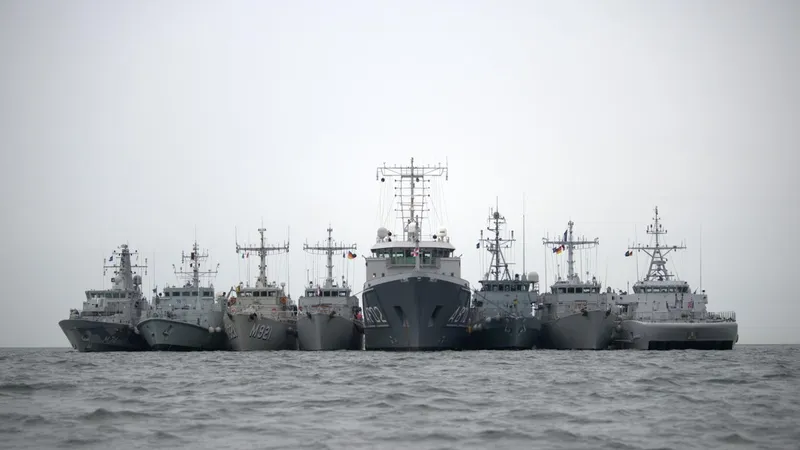
In brief
Standing NATO Mine Countermeasures Group 1, SNMCMG1, conducted an exercise in the Baltic Sea based on a scenario of a simulated explosion aboard the Swedish mine countermeasure vessel HMS Kullen. Belgium commands the current rotation from the Dutch hydrographic ship HNLMS Snellius, which provides logistical and medical support. The crew of HMS Kullen carried out firefighting procedures and a rescue operation with support from teams from HNLMS Snellius. Sweden has been a full member of NATO since March 2024.
Currently under Belgian command, SNMCMG1 operates from the Royal Netherlands Navy’s hydrographic vessel HNLMS Snellius, which serves as the flagship and command platform for the group. The Snellius provides not only operational coordination but also logistical and medical support to the participating NATO units.
During the recent drill, the Swedish Navy's minehunter HMS Kullen simulated an onboard explosion, triggering a rapid emergency response scenario. The Kullen’s crew executed fire suppression protocols and a casualty evacuation with professionalism and precision, supported by damage control and medical teams from the Snellius.
This exercise provided a realistic and demanding training environment aimed at improving crisis response, inter-crew communication, and NATO-level interoperability. It also reinforced key operational procedures under high-pressure conditions that mirror real-world maritime incidents.
With Sweden joining NATO as a full member in March 2024, the participation of Swedish naval assets like the Kullen underscores the growing integration and cohesion of allied maritime forces in the Baltic region.
As regional tensions continue to challenge maritime security, drills like these not only ensure the operational readiness of allied navies but also send a clear message about the collective commitment to safeguarding freedom of navigation and maintaining regional stability.
Source: Gazeta Morska · Compiled by: Kamil Kusier
Related articles
 Maritime economy Poland’s constitutional crisis is also a maritime story
 Navy and defence Norwegian submarine Utstein completes NATO patrol guarding offshore oil and undersea infrastructure
 Safety and rescue Polish SAR’s new rescue vessel Mistral launched at Kewatec in Finland
 Safety and rescue Icelandic Coast Guard and police delegation visits Polish Border Guard’s Maritime Division
 Safety and rescue Polish Navy helicopter evacuates man from Baltic platform 100 km off Władysławowo
 Navy and defence SNMG2 joins Allied warships in PASSEX as Italy's Mare Aperto 2026 gets under way
Comments (0)
The discussion is moderated by the editors: a comment appears after review. Your e-mail address is not published.
Nobody has commented on this article yet.