









When the storm moves east. Why the most beautiful sky at sea arrives just after a squall
Sailors know the moment. One minute the wind is screaming through the rigging, the rain is coming in almost horizontal, and visibility has dropped to a few dozen metres. Then, suddenly, stillness. The cloud rolls on toward the shore, and over the water spreads a light you will not see on any ordinary evening. It is not a reward from the heavens for surviving the squall, nor a trick of a tired eye. Behind the most beautiful sunsets at sea lies some very real atmospheric physics - and it is worth understanding, because it can also serve as a useful weather signal.
In brief
Spectacular sunsets over the sea after a squall are caused by the inflow of cooler, drier and stable air behind the front and the washing out of aerosols by intense rain. Gazeta Morska meteorologist Mariusz Jasłowski explains that after the front, air subsidence and a rise in pressure begin, convection dies down, and residual clouds act as a screen for the setting sun. Mariusz Jasłowski warns that on the Baltic a beautiful clearing can be a gap between the cells of a squall line and advises checking the radar and the cloud cover animation.
What a squall actually does
A violent thunderstorm squall is rarely a lone event - it usually accompanies the passage of a cold front or the leading edge of a well-developed storm cell. It is precisely this edge of the system that delivers the sudden burst of wind, the drop in temperature, and the wall of rain. What matters most, though, is what happens after it passes: behind the front comes air that is cooler, drier, and far more stable. An atmosphere that was boiling with energy moments earlier can settle within a quarter of an hour. To an observer, it looks like a change of scenery.
- What catches the eye most - the sheer violence of the squall - is really a symptom of the whole column of air being rebuilt, explains Mariusz Jasłowski, meteorologist at Daily Mare. - Behind the front, the air begins to subside and pressure rises, the convection that powered the storm dies out, and the atmosphere stabilises. It is that stabilisation that gives us the characteristic calm right after the cell has moved through.
Air that has been washed clean
The second character in this story is the rain. Heavy precipitation acts like a filter - it washes dust, aerosols, salt, and all the haze that normally dulls colours and limits visibility out of the atmosphere. After a squall passes, the air is, quite literally, rinsed. Hence that distinctive sense that the world looks sharper after a storm, the colours almost unnaturally saturated. The horizon, which an hour earlier was drowning in a milky blur, is suddenly drawn with a hard line.
A theatre of light
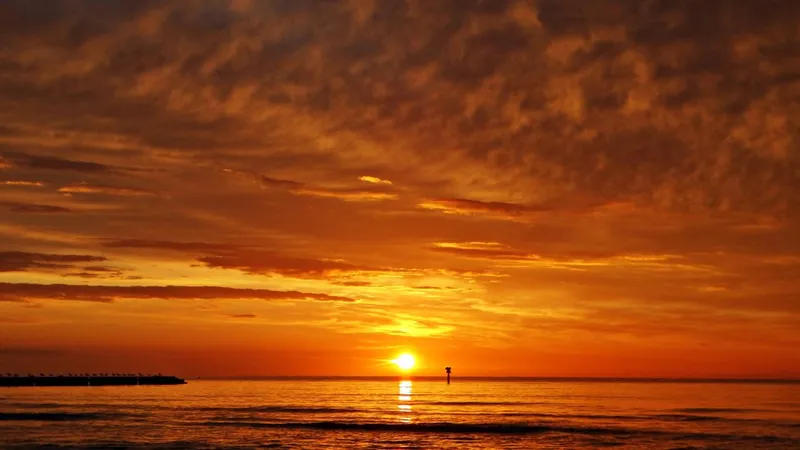
This is where the most spectacular element comes in. After a storm the sky rarely clears completely at once - usually there are torn, billowing remnants of cloud trailing the departing front. If this coincides with sunset, the low sun lights them from the side and from below. Its rays then pass through a far thicker layer of atmosphere than at noon, and the short, blue wavelengths scatter along the way (this is the Rayleigh scattering effect). What reaches the clouds is mostly red, orange, and deep pink. The effect can be breathtaking precisely because there is something for the light to catch on - a clear blue sky with no cloud cannot stage that kind of show.
- I'm often asked whether it's »really« more beautiful after a storm, or just relief after the ordeal, says Mariusz Jasłowski. - Well, it is measurably more beautiful. Rainfall removes part of the aerosols and condensation nuclei from the air, so atmospheric clarity increases. And the residual mid- and high-level clouds act as a screen for the setting sun. Clean air plus that screen is a ready-made recipe for genuinely saturated colour.
Why it happens at sea
On land the same mechanism is at work, but you rarely see it in full - trees, buildings, and rising ground get in the way. The sea is the perfect stage. An unobstructed horizon lets you follow the sun all the way down to the waterline and take in the full drama of the sky. Add to that the surface of the water, which reflects the colours and doubles the effect, and the local air circulation that favours rapid, vivid changes in weather. Little wonder that sailors and seafarers have been the keenest observers of this phenomenon for generations.
Wisdom written into a proverb
Long before meteorology proper existed, sailors had decoded this pattern in their own way. Hence one of the oldest weather sayings at sea: "Red sky at night, sailor's delight." The logic is simple and quite sound - if the sun is setting red in the west, the direction from which weather most often arrives in our latitudes, it means the low and its front have already moved off east, while a high bringing settled weather is moving in from the west. A red glow after a squall, then, can be not only beautiful but promising.
A rule with exceptions
It is worth keeping a healthy dose of seamanlike scepticism, though. This is no law without exception. Sometimes one line of squalls is followed by another - and instead of a picturesque sunset, we get a second hit. Sometimes the sky stays overcast long after the storm, or the front passes only after dusk and the whole show plays out in the dark. Even so, the sequence "squall - clearing - spectacular sunset" is common enough, and so well explained, that it can safely be called a real, repeatable phenomenon rather than a lucky coincidence.
- On the Baltic, though, I'd advise against stowing the foul-weather gear too soon, Mariusz Jasłowski warns. - In summer we often deal with a whole line of squalls or a multicell system, where the first hit is followed by another. A beautiful clear spell can be just a gap between cells. Before deciding it's all over, it's worth a glance at the radar and the cloud animation, not just the sky overhead.
More than a pretty view
For some it is simply a moment worth being on the water for. For others - a reminder that weather at sea is a sequence of unfolding processes that can be read. The most beautiful sky really can arrive right after the worst stretch of a passage. And there is something deeply maritime in that: a reward not for the weather being kind, but for having weathered it.
Source: Gazeta Morska · Compiled by: Kamil Kusier
Related articles
 Shipbuilding industry Lionel Messi orders a Sunreef catamaran. The Ultima 88 is being built at the Gdańsk firm’s UAE yard
 Investments A Szczecin firm is to design the world's tallest Christ statue. A 207-metre core in 40 days
 Sailing and water sports A century-old Inga Lisa and Czarny Diament after 32 years at sea. Over 30 classic yachts in Gdynia
 Sailing and water sports Eleven years of trying and metres at the finish. Witold Karałow's Scamp 4 wins the 75th Blue Ribbon
 Sailing and water sports Stanisław Trepczyński's bronze in Puck after five hours of fighting for wind
 Environment The world's largest seahorses move into the Gdynia Aquarium. In this species it is the male that gets pregnant
Comments (0)
The discussion is moderated by the editors: a comment appears after review. Your e-mail address is not published.
Nobody has commented on this article yet.