









A Szczecin firm is to design the world's tallest Christ statue. A 207-metre core in 40 days
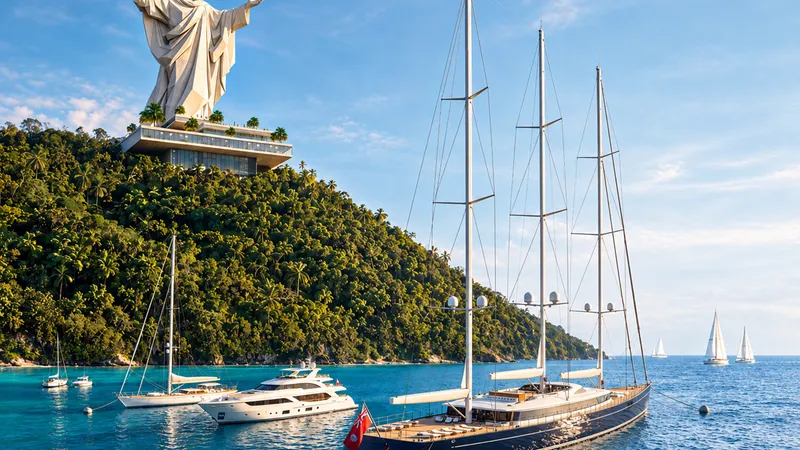
SLIPFORM, a Szczecin engineering firm specialising in reinforced concrete structures built with slipform technology, has handed a Philippine investor the concept design for a 207-metre monument of Jesus Christ to stand in the province of Ilocos Sur in the north of the Philippines. If built, it would be more than five times taller than Christ the Redeemer in Rio de Janeiro and 25 metres taller than India's Statue of Unity, today the world's tallest statue. The concept is under evaluation by the investor; detailed engineering would follow approval.
In brief
Szczecin-based company SLIPFORM handed a Philippine investor a conceptual design for a 207-metre monument of Jesus Christ in Ilocos Sur province. The concept was presented during President Karol Nawrocki's visit to the Philippines on 6 and 8 October, attended by SLIPFORM CEO Daniel Kisała. SLIPFORM estimates that it could build the reinforced concrete load-bearing core using slipform technology in about 40 days, using up to 27 thousand cubic metres of concrete. The design awaits the investor's assessment, and technical documentation will begin after approval.
The design was handed over during President Karol Nawrocki's official visit to the Philippines on 6 to 8 October, the first ever by a sitting Polish president, in which SLIPFORM's chief executive Daniel Kisała took part. The company's road to that market began with a trade mission organised by the West Pomeranian Economic Initiatives Centre, followed by meetings supported by the Polish Investment and Trade Agency.
- Our presence on the Philippine market is no accident. It is the result of successive trade missions, meetings and consistent relationship-building with local partners. Today we can say that technology developed in Szczecin is being considered for a project that may go down in the history of world construction - said Daniel Kisała.
A 200-metre core in 40 days
The heart of the project is a reinforced concrete load-bearing core more than 200 metres tall, measuring around 49 by 30 metres in plan, requiring up to 27,000 cubic metres of concrete. SLIPFORM's technology raises a structure continuously in formwork that climbs with the pour, around the clock, without dismantling and reassembling. The system guides the formwork along a programmed trajectory with a maximum deviation of three millimetres. The company estimates it could build the core itself in around 40 days, stressing that this is the time for the main concrete stage, not for the whole monument.
- We assume that we are able to build the reinforced concrete core of a monument of more than 200 metres in around 40 days. That shows the potential of the technology we developed in Szczecin - Daniel Kisała says.
The firm developed and implemented the technology in 2023 with EU funding, initially for industrial and infrastructure structures. Its portfolio includes concrete radar towers for the Polish Air Navigation Services Agency, meteorological installations and industrial buildings.
The formwork will sail from Poland, the concrete stays local
The monument would stand in a country of seven thousand islands, in a province several hundred kilometres from Manila, and that settles the logistics. Slipform technology requires specialised, oversized equipment: the formwork system, hydraulic jacks and working platforms, made in Szczecin and not available locally. The only realistic route from Poland to the Philippines for such cargo is the sea: containers or project cargo from Gdynia or Szczecin, via Suez and Singapore, to Manila or directly to the Ilocos ports such as Currimao or Salomague, which today handle mostly coastal traffic. The voyage takes five to seven weeks, and moving the equipment would be one of the first tasks of the contract, if it comes.
The concrete, 27,000 cubic metres, would be produced in the Philippines, because nobody ships concrete across an ocean; that means working with local batching plants and cement producers under Polish supervision of the mix, on which depends whether the core can be poured continuously in a tropical climate. Polish engineers and system operators would have to be on site without a break for the 40 days of pouring.
There is a second, less obvious maritime thread. SLIPFORM is developing concrete gravity-based foundations for offshore wind turbines, the structures used in Europe where the seabed does not allow steel monopiles. Baltic Power, Poland's first offshore farm, was completed this month entirely on steel foundations; for the Szczecin firm, the next Baltic projects and the experience of a 200-metre core in the Philippines could be an argument to compete for concrete foundations on its own sea.
From a radar tower to the world's tallest statue
A concept design is the first of several steps: ahead of the investor lie approval, financing and permits, and ahead of SLIPFORM the detailed engineering that turns a concept into a construction site. The company speaks openly about this stage and does not yet name the investor or the project's value, which for projects of this scale is normal practice until a contract is signed.
What is already certain says a great deal about the Szczecin firm. A technology developed three years ago for radar towers and industrial structures proved versatile enough to land on an investor's desk on the other side of the globe, with an argument nobody else brought there: speed. If the monument is built, it will be the world's tallest statue with a Polish core inside, raised with equipment that sailed from Szczecin. And the road that leads there, through a regional trade mission, the investment agency and a presidential delegation, is a ready template for other West Pomeranian companies that have the technology but do not yet know how to show it to the world.
Source: Gazeta Morska · Compiled by: Kamil Kusier
Related articles
 Energy and offshore Equinor takes over Bałtyk 2 and 3 O&M base in Łeba. Port to serve 1.44 GW of offshore wind for 30 years
 Navy and defence Port Gdański Eksploatacja secures NATO NCAGE code. Gdańsk port company lines up for defence tenders
 Energy and offshore Energa renames Gdańsk gas plant company as foundations for 6,000-tonne turbine and boiler are laid
 Equipment and technology WB Group takes Polish drones from Tokyo to SOFEX in Jordan in a single week
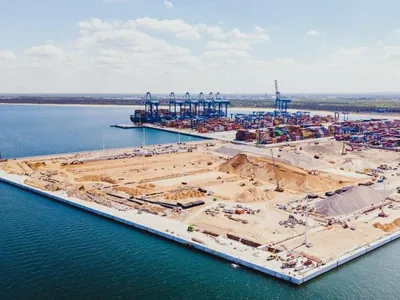 Ports and logistics PGE books Gdańsk’s T5 terminal for the long haul: Baltica 2 first, then more offshore wind farms
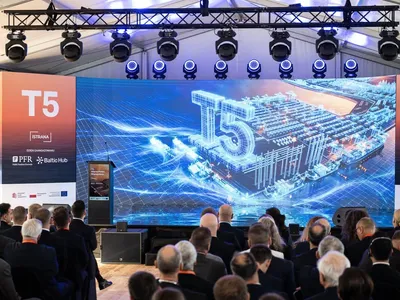 Investments Port of Gdańsk opens T5 offshore installation terminal, bringing Baltica 2 logistics home from Bornholm
Comments (0)
The discussion is moderated by the editors: a comment appears after review. Your e-mail address is not published.
Nobody has commented on this article yet.