









WAT strengthens NATO logistics capabilities. Polish military university joins elite training network
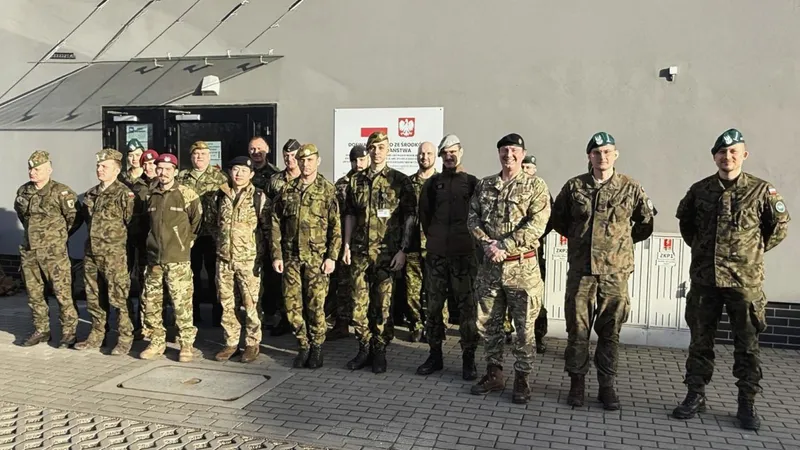
The Military University of Technology (WAT) is reinforcing its position as one of NATO’s key logistics training hubs, following the achievement of the highest NATO Approved certification for all logistics courses delivered by its Faculty of Security, Logistics and Management.
In brief
The Military University of Technology has obtained NATO Approved status for all logistics courses run at its Faculty of Security, Logistics and Management, granted by Allied Command Transformation. Only seven institutions worldwide offer logistics courses with full NATO Approved certification, and the Military University of Technology is also among just four centres providing training in the LOGFAS system. The university's experts have so far trained 891 specialists from 39 countries, and 170 people have taken part in the courses since the ACT accreditation in 2024. In March 2026 the LOGFAS Operational Movement Planning Course obtained NATO Approved status.
This distinction places the Polish military university among a highly selective group of just seven institutions worldwide authorized to provide fully certified NATO logistics training programs.
Top-level NATO certification
The accreditation, granted by Allied Command Transformation (ACT), represents the highest level of recognition within NATO’s education and training system. It confirms that WAT’s programs meet strict standards in interoperability, standardization, and multinational operational readiness.
NATO formally recommends that member states delegate personnel to NATO Approved courses, making such institutions critical nodes in the Alliance’s training architecture.
Strategic relevance for maritime and joint operations
From a maritime security perspective, advanced logistics capabilities are increasingly vital—particularly in the Baltic Sea region, where operational effectiveness depends on:
- secure and resilient military supply chains
- rapid deployment and mobility of forces
- seamless interoperability across allied forces
A cornerstone of WAT’s training portfolio is the use of the LOGFAS system—one of NATO’s primary tools for logistics planning and coordination. WAT is among only four institutions globally certified to deliver LOGFAS training, underscoring its strategic importance.
Operationally oriented training
WAT’s programs are designed to prepare military and civilian specialists for real-world operational environments, with a focus on:
- planning and execution of logistics operations
- coordination in multinational frameworks
- management of troop and equipment movements
A notable milestone is the LOGFAS Operational Movement Planning Course (CORSOM Operator), which received NATO Approved status in March 2026.
Expanding international footprint
To date, WAT experts have trained 891 specialists from 39 countries, including participants from NATO partner nations. Since obtaining ACT accreditation in 2024, the scale of training has accelerated significantly, with 170 participants completing courses in that period alone.
The university is also actively engaged in major NATO exercises, co-organizing initiatives such as:
- Capable Deployer 2025
- Connected Logisticians 2026
These exercises play a critical role in validating logistics capabilities under operational conditions.
Poland as a NATO logistics competence hub
Achieving full NATO Approved certification across all logistics courses confirms WAT’s role not only as a training provider but also as a contributor to the evolution of NATO’s logistics doctrine and education standards.
For Poland, this marks a significant step in strengthening its position as a regional hub for military logistics expertise—particularly in the context of maritime security and critical infrastructure protection in the Baltic Sea region.
As NATO continues to adapt to evolving security challenges, institutions like WAT will remain essential in building resilient, interoperable logistics systems capable of supporting complex multinational operations.
Source: Gazeta Morska · Compiled by: Kamil Kusier
Related articles
 Education From Newton's prism to a microplate reader. A Science Evening in Charzykowy on light and matter
 Energy and offshore Offshore wind enters the classroom in Świnoujście. ORLEN Neptun to teach logistics and navigation students
 Education Drones at the Naval Academy, Dar Młodzieży in Gdynia, a sports hall at UG. Coastal universities open the year
 Sailing and water sports Poland argues over where Dar Młodzieży should retire, while its successor still does not exist
 Education Dar Młodzieży is back in Gdynia after five months, two Atlantic crossings and three intakes of cadets
 Navy and defence Polish Naval Academy swears in 114 cadets as an intake of 185 begins officer training
Comments (0)
The discussion is moderated by the editors: a comment appears after review. Your e-mail address is not published.
Nobody has commented on this article yet.