









Dar Młodzieży is back in Gdynia after five months, two Atlantic crossings and three intakes of cadets
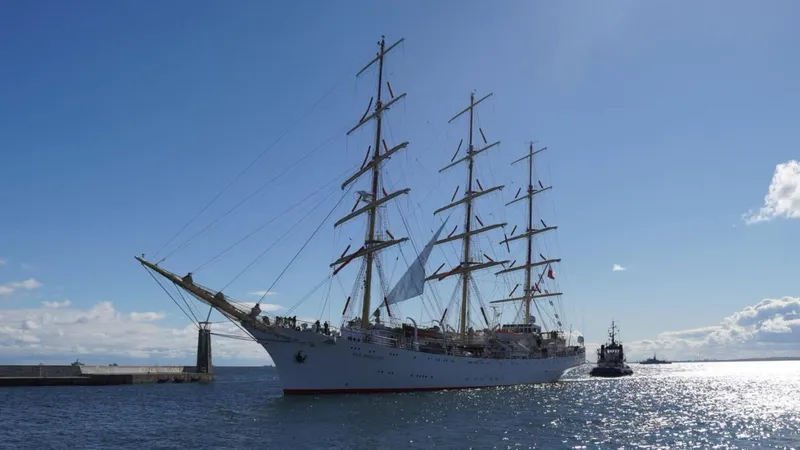
The sail training frigate of the Gdynia Maritime University berthed in her home port on 23 September. The voyage lasted more than five months and included two Atlantic crossings and calls in European and North American ports. She was welcomed on the quay by the university's rector, Professor Adam Weintrit, the head of its shipowning and sea practice department, Captain Dariusz Jellonnek, and Thomas Mandeville of the United States Embassy, along with residents of Gdynia and the families of crew and cadets completing their training.
In brief
The Gdynia Maritime University training frigate Dar Młodzieży moored in Gdynia on 23 September after a voyage lasting more than five months with two Atlantic crossings. Dar Młodzieży left Gdynia on 16 April, called at ports including Cádiz, Norfolk, New York and Boston, and on 4 July joined the tall ship parade in New York marking the 250th anniversary of US independence. Three groups of trainees rotated aboard Dar Młodzieży. After damage to the propeller blades, the frigate underwent servicing from 16 August at the Gryfia shipyard in Szczecin.
The route and a symbolic departure date
The voyage began on 16 April. From Gdynia the frigate set course for the Isle of Man, then Cádiz, and from there across the Atlantic to the Bahamas and the United States, calling at Norfolk, New York and Boston.
The departure date was chosen deliberately. Exactly half a century earlier, on 16 April 1976, the sail training ship Dar Pomorza set out on a voyage marking the bicentennial of the United States. This time the occasion was the 250th anniversary of American independence and participation in the international Sail 250 events.
Training first, representation second
The frigate's core task remains educating future maritime professionals, so the voyage was divided into three stages with successive groups of cadets on board.
On the first leg, from Gdynia via the Isle of Man to Cádiz, the trainees were students of the university's faculty of marine engineering together with pupils of the maritime school in Świnoujście. In Cádiz more than a hundred first-year navigation students joined for the ocean crossing, the Bahamas and the passage to the United States. A further changeover took place in New York, where second-year navigation students came aboard.
The frigate entered Norfolk, her first American port, on 18 June under the command of Captain Michał Sadowski. The return crossing from Boston was led by Captain Krzysztof Kocyba.
The Fourth of July parade and a 44th birthday
The high point of the voyage was the international parade of sail in New York on 4 July, part of the celebrations of the 250th anniversary of American independence.
The date carried additional meaning for the ship herself. Exactly 44 years earlier, on 4 July 1982, the Polish ensign was raised on the frigate for the first time. On her own anniversary she was therefore representing Poland at one of the central events of the American jubilee.
Propeller damage and a yard stay in Szczecin
After the passage from New York to Boston, damage was found to the blades of the propeller, most probably caused during a squall in the New York anchorage on 3 July. A technical assessment confirmed that the voyage could safely continue.
Once the Atlantic training leg was complete, the frigate entered the Gryfia ship repair yard in Szczecin on 16 August for the necessary service work. That also marked the end of the training period for the second-year navigation students who had joined in New York.
After the yard stay she sailed on 29 August for Hamburg, arriving on 2 September. Her next call was Stavanger, from 11 to 14 September, before setting course for Gdynia.
What it means for maritime education
Beneath the ceremony lies what matters most to the industry: several hundred cadets who completed sea training in ocean conditions rather than on a coastal cruise. Crossing the Atlantic under sail is an experience no simulator and no placement on a merchant ship replicates, because it teaches teamwork, watchkeeping and responsibility in a setting where no outside help is available.
With shipyards, offshore wind and merchant shipping all competing for the same people, each such training campaign is a real contribution to the workforce balance of the Polish maritime economy, not merely a promotion of the flag.
Source: Gazeta Morska · Compiled by: Kamil Kusier
Related articles
 Education From Newton's prism to a microplate reader. A Science Evening in Charzykowy on light and matter
 Energy and offshore Offshore wind enters the classroom in Świnoujście. ORLEN Neptun to teach logistics and navigation students
 Education Drones at the Naval Academy, Dar Młodzieży in Gdynia, a sports hall at UG. Coastal universities open the year
 Sailing and water sports Poland argues over where Dar Młodzieży should retire, while its successor still does not exist
 Navy and defence Polish Naval Academy swears in 114 cadets as an intake of 185 begins officer training
 Equipment and technology Łukasiewicz and Radiotechnika sign in Kielce. Motors and generators for combat vehicles and drones
Comments (0)
The discussion is moderated by the editors: a comment appears after review. Your e-mail address is not published.
Nobody has commented on this article yet.