









Violating a drone restricted area in the Port of Gdańsk could cost you thousands - or even jail time
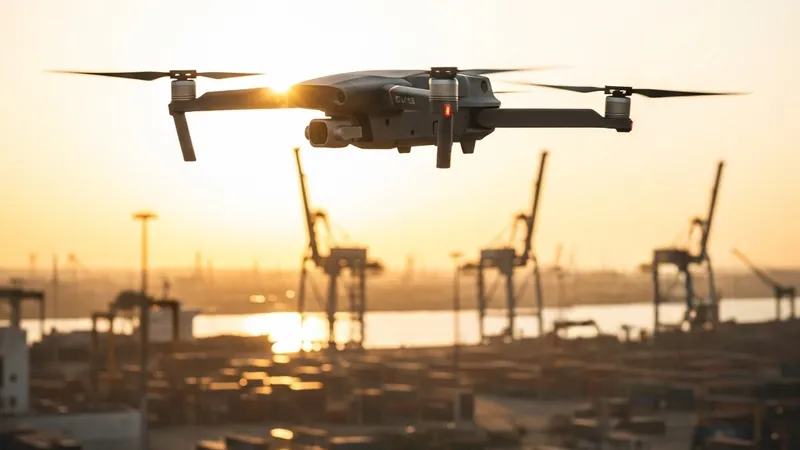
The use of unmanned aerial vehicles (UAVs), commonly known as drones, has become widespread across industries — from media and surveying to logistics and port operations. Yet, not every area is open for flight. The Port of Gdańsk, one of Poland’s key maritime gateways, is covered by a drone restricted area (DRA) – a specially designated zone where flying drones without authorization is strictly prohibited.
In brief
The Port of Gdańsk is covered by DRA zones in which an unauthorised drone flight carries a penalty of up to 5 years' imprisonment under Article 212 of the Aviation Law. The Civil Aviation Authority may impose administrative fines: PLN 10,000 for a flight in breach of zone rules, PLN 10,000 for failure to register the operator and PLN 4,000 for violating open category regulations, a total of PLN 24,000 for a single flight. Ireneusz Litwinowicz, head of the Port of Gdańsk Operations Centre, explains that every unauthorised flight is treated as a potential threat. Every flight in the Port of Gdańsk requires prior authorisation from the site manager.
Violating this restriction can lead to confiscation of the drone, financial penalties of up to PLN 24,000 (≈€5,500), and in severe cases – criminal prosecution and imprisonment.
What are drone restricted areas (DRA)?
DRA zones are defined areas where drone operations are limited or entirely banned due to national security and safety considerations.
Such zones are typically established around seaports, refineries, airports, power plants, and military bases.
In the case of the Port of Gdańsk, DRA boundaries protect:
- critical cargo-handling infrastructure,
- vessel traffic and navigation safety,
- port personnel and passengers.
- Any unauthorized drone flight within the DRA is treated as a potential threat to port security. It’s not about restrictions – it’s about protecting people and infrastructure, explains Ireneusz Litwinowicz, head of the operations centre at the Port of Gdańsk.
Legal consequences: up to 5 years in prison
According to article 212 of the Polish Aviation Law, an individual who:
- violates aviation traffic rules, or
- breaches airspace restrictions imposed for public safety,
may face up to 5 years of imprisonment.
If the violation is unintentional, penalties may include a fine, community service, or imprisonment of up to one year.
Even a simple recreational flight “to capture a sunset over the port” can result in a criminal case if it occurs within a protected airspace.
Financial penalties: up to PLN 24,000 per incident
Beyond criminal liability, drone operators are subject to administrative fines issued by the Civil Aviation Authority (ULC):
- PLN 10,000 – for operating against DRA rules,
- PLN 10,000 – for failing to register as a drone operator,
- PLN 4,000 – for violating EU open-category drone regulations.
Combined, these sanctions can total PLN 24,000 per single incident.
Real case: unauthorized drone halts port operations
Last year, a drone entered a restricted cargo-handling zone in a Polish port, forcing a temporary shutdown of a container crane. The operator claimed ignorance of the restriction, but port security immediately reported the case to the police and the Civil Aviation Authority. The incident led to formal proceedings for breaching aviation regulations.
- Lack of knowledge doesn’t excuse the violation,” says Litwinowicz. “Every operator must be aware of the legal framework governing the airspace they fly in.
Flying legally near the Port of Gdańsk
Before launching a drone near the port, operators should:
- Register at drony.gov.pl and label the UAV with their operator ID.
- Complete online training and pass the mandatory test (depending on the drone’s category).
- Check airspace availability using the Drone Tower app before every flight.
- Keep the UAV within visual line of sight and below 120 meters altitude.
- Obtain prior authorization from the Port of Gdańsk before operating within port boundaries.
Drones are not toys – especially over maritime infrastructure
Drone technology offers enormous potential for inspection, logistics, and monitoring, but within port environments, it poses serious safety risks.
Unauthorized flights can disrupt vessel navigation, crane operations, and cargo logistics, creating hazards for workers and infrastructure.
The Port of Gdańsk reminds all UAV users: check the rules before you fly. The cost of ignorance can far exceed the value of the drone itself.
Source: Gazeta Morska · Compiled by: Kamil Kusier
Related articles
 Sailing and water sports GB1's America's Cup AC75 reaches Naples, swapping cyclors for batteries
 Safety and rescue From lightships to solar power: 160 years of the Grundkallen light station
 Shipbuilding industry Lionel Messi orders a Sunreef catamaran. The Ultima 88 is being built at the Gdańsk firm’s UAE yard
 Investments A Szczecin firm is to design the world's tallest Christ statue. A 207-metre core in 40 days
 Sailing and water sports A century-old Inga Lisa and Czarny Diament after 32 years at sea. Over 30 classic yachts in Gdynia
 Sailing and water sports Eleven years of trying and metres at the finish. Witold Karałow's Scamp 4 wins the 75th Blue Ribbon
Comments (0)
The discussion is moderated by the editors: a comment appears after review. Your e-mail address is not published.
Nobody has commented on this article yet.