









Port of Gdańsk in the European lead. New US connections, Arctic test route and record short-sea volumes
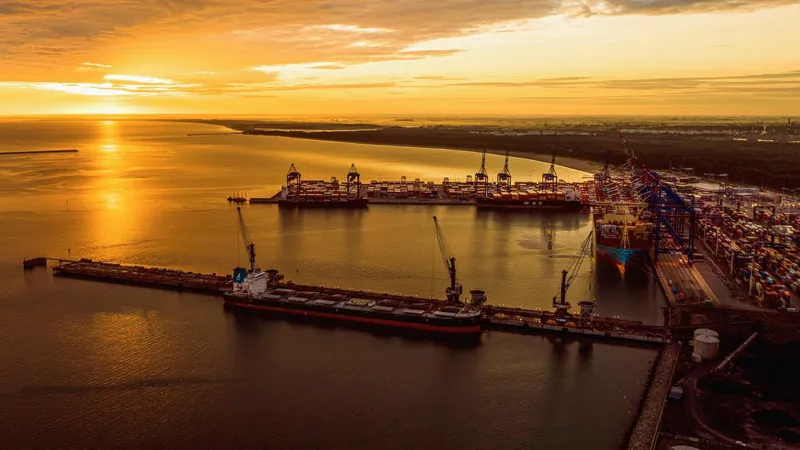
The Port of Gdańsk has joined the group of European ports offering direct container services to the United States. MSC, the world’s largest shipping line with a fleet of more than 850 vessels, has expanded its Albatross service to include regular calls at New York and Charleston. But that is not the only news.
In brief
The Port of Gdańsk has gained a direct container service to the United States after MSC extended its Albatros service with calls at New York and Charleston, with transit times of 13 and 17 days. Singapore-based shipowner Sea Legend has launched a trial connection via the Northern Sea Route, and the first vessel is due to reach the Port of Gdańsk on 13 October, cutting the voyage from China to 18 to 20 days. According to Eurostat, the Port of Gdańsk handled 61 million tonnes in short sea shipping in 2023 against 81 million tonnes in total, moving up to third place in the European Union after Rotterdam and Antwerp-Bruges.
The new link with the US gives Polish exporters faster and more competitive access to the American market, while positioning the Port of Gdańsk to capture part of the cargo volumes from Central and Eastern Europe that have traditionally been handled by German ports. The service is operated by Baltic Hub, the largest container terminal in the Baltic Sea region. The terminal plays a key role in integrating maritime, rail and road transport, strengthening its position as a hub for Poland, the Czech Republic, Slovakia, Ukraine and Lithuania.
The transit time for this weekly service is 13 days to New York and 17 days to Charleston.
In Poland’s trade with the United States, exports dominate, accounting for over 80 percent of total turnover. The main exports are high-value goods – automotive parts, components for the aerospace industry, pharmaceuticals, furniture, food products and luxury goods. Energy resources and chemicals are also gaining in importance.
Although transatlantic shipping volumes are smaller than those on Asian routes, their significance is growing, supported by LNG exports from the US to Europe and the rising import of American agricultural products.
Arctic sea route
A test container connection along the Northern Sea Route, running along Russia’s Arctic coast, has been launched by Singapore-based carrier Sea Legend. This alternative to the Suez Canal and the Cape of Good Hope could soon reshape trade between Asia and Europe. The service covers ports in Qingdao, Shanghai and Ningbo, and in Europe calls at Felixstowe, Rotterdam, Hamburg and Gdańsk.
The route is expected to reduce transit time from China to Northern Europe to 18–20 days, compared with 40–50 days via the Suez Canal or around the Cape of Good Hope, and even 25 days by intercontinental rail.
The first vessel is scheduled to arrive at the Port of Gdańsk on 13 October. The voyage will be operated by an ice-class vessel, and in the future the carrier plans to introduce ships powered by alternative fuels.
- Reducing transit time between Asia and Europe to 18 days provides a real advantage in serving time-sensitive cargo such as electronics or apparel, says Dominik Landa, Director of Strategy and Development at the Port of Gdańsk. - We are, however, aware of the limitations of Arctic navigation – variable ice conditions, geopolitical factors, and legitimate environmental concerns about the impact on the fragile Arctic ecosystem.
If the test voyage receives a positive market response, Sea Legend plans to launch regular seasonal Arctic services (May–October) starting next year.
This solution may become an attractive alternative given the increasing risks for shipping in the Red Sea, where Houthi attacks have raised costs and safety concerns.
A strong maritime Poland
The Port of Gdańsk is not only about deep-sea routes. According to the latest Eurostat report published in early September, Gdańsk has advanced to third place among the largest ports in the European Union in terms of short-sea shipping volumes.
In 2023, the Port of Gdańsk handled 61 million tonnes of short-sea cargo (out of a total of 81 million tonnes), placing it just behind Europe’s largest ports – Rotterdam (159 million t) and Antwerp-Bruges (119 million t). A year earlier, Gdańsk ranked fifth. Thanks to dynamic growth, it surpassed such well-established ports as Trieste and Amsterdam, which closed the year with 46 and 39 million tonnes respectively.
Short-sea shipping (SSS) covers maritime transport over relatively short distances – mainly between EU ports, and to and from the Mediterranean and Black Sea regions. It is a key segment of the EU economy, accounting for 56.6 percent of total maritime goods transport in 2023.
Overall, EU short-sea shipping volumes reached 1.6 billion tonnes last year, a decline of 5.4 percent year-on-year. Notably, 16 of the 20 largest EU ports recorded lower throughput. The biggest drops were seen in Amsterdam, Barcelona, Haropa and Rotterdam. One of the few exceptions was the Port of Gdańsk, whose growth rate was among the highest in Europe (+40 percent).
This was the second-best result in Europe, behind only Taranto (+50 percent). For comparison, Genoa achieved a 13.5 percent increase, while many leading ports such as Rotterdam and Antwerp faced declines.
Eurostat highlights that the development of Polish ports is part of a broader trend of European trade routes shifting eastward. Poland’s maritime infrastructure is becoming an increasingly important link connecting Northern and Central Europe with the North Sea and the Baltic Sea basins.
Across the EU, Poland ranks among the countries with the strongest short-sea shipping growth. According to Eurostat, Poland’s SSS volume increased by 21.6 percent in 2023 – placing it on the podium alongside Malta (+40.4 percent) and France (+22.6 percent).
Source: Gazeta Morska · Compiled by: Kamil Kusier
Related articles
 Shipbuilding industry Poland christens ro-pax ferry Bursztyn Unity in Szczecin on Independence Day. Ystad service starts 18 November
 Energy and offshore Orlen Neptun deploys V-LiDAR buoys at Baltic West ahead of Poland's 2027 offshore wind auction
 Energy and offshore Equinor takes over Bałtyk 2 and 3 O&M base in Łeba. Port to serve 1.44 GW of offshore wind for 30 years
 Navy and defence Port Gdański Eksploatacja secures NATO NCAGE code. Gdańsk port company lines up for defence tenders
 Shipbuilding industry Ex-Enterprise towed to Mobile under $418.5m contract. Test case for Nimitz-class disposal begins
 Energy and offshore Energa renames Gdańsk gas plant company as foundations for 6,000-tonne turbine and boiler are laid
Comments (0)
The discussion is moderated by the editors: a comment appears after review. Your e-mail address is not published.
Nobody has commented on this article yet.