









U.S. Coast Guard cutter Polar Star concludes Operation Deep Freeze 2025, departs Antarctica
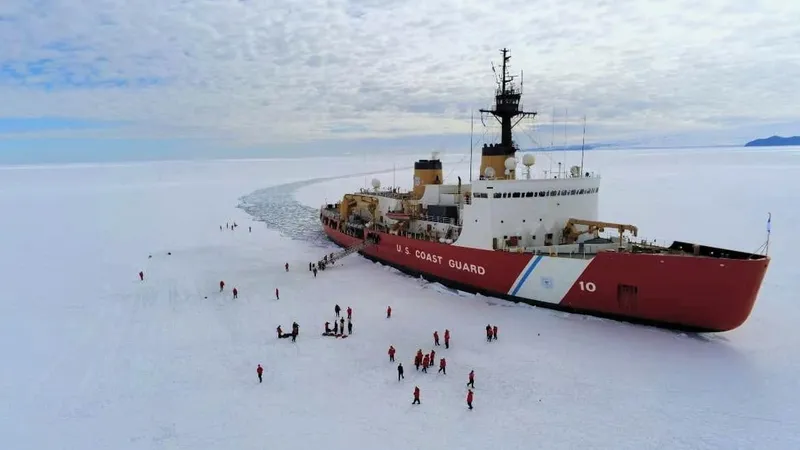
After 65 days operating south of the Antarctic Circle, the U.S. heavy icebreaker USCGC Polar Star (WAGB 10) has completed its mission in support of Operation Deep Freeze 2025 and departed the Antarctic region.
In brief
The American icebreaker USCGC Polar Star completed 65 days of operations south of the Antarctic Circle as part of Operation Deep Freeze 2025 and left the Antarctic region. The crew broke an ice channel in the McMurdo Sound area, enabling deliveries to McMurdo Station and New Zealand's Scott Base, and the vessel became the first American surface ship to support CCAMLR fisheries monitoring. Since leaving Seattle in November, USCGC Polar Star has covered nearly 16,000 nautical miles, calling at Honolulu, Sydney and McMurdo Station. Commanding officer Captain Jeff Rasnake pointed to the challenges of operating the 49-year-old ship.
Operation Deep Freeze is an annual mission led by the U.S. Antarctic Program (USAP) in collaboration with the U.S. Department of Defense, supporting the National Science Foundation (NSF). The program advances U.S. commitments under the Antarctic Treaty, fosters international scientific cooperation, ensures the conservation of Antarctic resources, and promotes their sustainable management.
This highly complex mission involves strategic and tactical airlift operations, medical evacuation support, search and rescue capabilities, sealift logistics, seaport access, bulk fuel delivery, and port cargo handling. Polar Star’s primary task was icebreaking in McMurdo Sound, ensuring a navigable passage for supply vessels servicing both the U.S. McMurdo Station and New Zealand’s Scott Base.
- This year, the sea ice conditions in McMurdo Sound were exceptionally light, a welcome change from last year’s extreme conditions, said Capt. Jeff Rasnake, commanding officer of USCGC Polar Star. - Operation Deep Freeze presents significant challenges, particularly when maintaining and operating a 49-year-old ship on such a demanding mission. However, our meticulous deployment planning allowed us to take full advantage of favorable conditions, keeping ahead of developments without overexerting the cutter or the crew. That planning made a major difference.
During the mission, Polar Star conducted a crew exchange with the Royal New Zealand Navy’s replenishment vessel HMNZS Aotearoa, further emphasizing the importance of international defense cooperation in Antarctic operations.
The icebreaker also supported the Commission for the Conservation of Antarctic Marine Living Resources (CCAMLR), becoming the first U.S. surface asset to assist in monitoring fishing activities and safeguarding marine resources in the Southern Ocean.
- Each deployment to Antarctica requires precise planning and coordination due to the extreme and unpredictable environment, Jeff Rasnake added. - The joint-agency collaboration within Joint Task Force – Support Forces Antarctica this year was outstanding and upheld the proud tradition of U.S. military support for the U.S. Antarctic Program, ensuring security and stability in the region.
Since departing its Seattle homeport in November, USCGC Polar Star has covered nearly 16,000 nautical miles, with port calls in Honolulu, Sydney, and McMurdo Station. The crew marked the vessel’s 49th anniversary with a visit to Cape Polar Star in the northern Ross Sea—named after the icebreaker in recognition of its scientific contributions during Operation Deep Freeze 86.
USCGC Polar Star remains the United States’ only icebreaker capable of operating in both polar regions. The Seattle-based cutter, commissioned in 1976, is 399 feet (122 meters) long, 84 feet (25 meters) wide, with a 34-foot (10-meter) draft. Powered by six diesel engines and three gas turbines generating up to 75,000 horsepower, it remains a critical asset for U.S. operations in the world’s most extreme maritime environments.
Source: Gazeta Morska · Compiled by: Kamil Kusier
Related articles
 Environment 51st Polish Antarctic Expedition arrives at Arctowski Station aboard Ukrainian vessel Noosfera
 Sailing and water sports Poland wins two medals and team title at iQFOiL Youth and Junior European Championships
 Navy and defence Norwegian submarine Utstein completes NATO patrol guarding offshore oil and undersea infrastructure
 Safety and rescue Polish SAR’s new rescue vessel Mistral launched at Kewatec in Finland
 Energy and offshore ORLEN’s Afrodite discovery more than doubles in size on the Norwegian shelf
 Energy and offshore ORLEN to open LNG trading office in Singapore as it builds a global portfolio
Comments (0)
The discussion is moderated by the editors: a comment appears after review. Your e-mail address is not published.
Nobody has commented on this article yet.