









TUKAN - a new underwater vehicle from Gdańsk Tech to identify naval mines
At the Faculty of Mechanical Engineering and Ship Technology of Gdańsk University of Technology, engineers are developing an advanced system for detecting and identifying naval mines and other underwater threats. The project, code-named TUKAN, has secured over PLN 8.6 million in funding from the National Centre for Research and Development (NCBR). It is expected to significantly strengthen the technological capabilities of the Polish Navy.
In brief
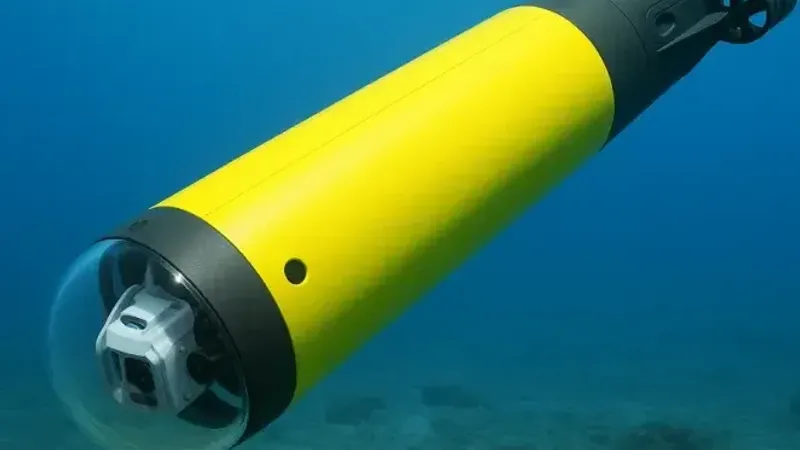
Gdańsk University of Technology is developing TUKAN, a semi-autonomous underwater vehicle for detecting and identifying sea mines and improvised explosive devices. The project at the Faculty of Mechanical Engineering and Ship Technology received more than PLN 8.6 million in funding from the National Centre for Research and Development, and work begun in 2021 will continue until December 2025. The vehicle, weighing about 100 kg, operates to a depth of 200 m, working with an operator console and a server with artificial intelligence algorithms. Project leader Professor Jerzy Kowalski announced pool trials, tests on Lake Jeziorak in Iława and research in the Baltic.
Next-generation mine countermeasure system
The TUKAN programme focuses on the detection, classification and identification of naval mines and improvised explosive devices (IEDs) through the use of remotely operated and semi-autonomous underwater vehicles. The vehicle can be deployed from both conventional manned platforms and unmanned surface vessels controlled via radio link.
The system will consist of:
- a semi-autonomous underwater vehicle weighing approx. 100 kg, designed to operate at depths of up to 200 metres,
- an operator’s console,
- a server running AI-powered software.
The vehicle will be equipped with forward-looking and side-scan sonars as well as a camera, ensuring effective underwater reconnaissance. With the use of artificial intelligence algorithms, the system will automatically assess whether a detected object is a mine, unexploded ordnance or an improvised explosive device – leaving the final verification to the operator.
Testing roadmap
According to Prof. Jerzy Kowalski, project leader from the Institute of Ship Design and Construction, model basin trials at Gdańsk Tech will begin shortly. These will be followed by tests at the experimental facility in Iława on Lake Jeziorak, before progressing to sea trials in the Baltic.
The concept and core technological solutions behind TUKAN were initiated by Prof. Lech Rowiński.
Building on tradition
Gdańsk University of Technology has a strong track record in the development of underwater systems. Previous designs – including Głuptak, Ukwiał and Morświn – are already in service with the Polish Navy.
Funding and outlook
The project, officially titled “Development of a semi-autonomous underwater vehicle for the detection and identification of naval mines and hazardous objects – TUKAN”, is carried out under NCBR Competition No. 11/2020, Round 2. The work began in 2021 and is scheduled for completion in December 2025.
TUKAN is part of a broader trend towards autonomous and semi-autonomous maritime systems, aimed at enhancing the safety, effectiveness and resilience of modern mine countermeasure operations.
Source: Gazeta Morska · Compiled by: Kamil Kusier
Related articles
 Education From Newton's prism to a microplate reader. A Science Evening in Charzykowy on light and matter
 Energy and offshore Offshore wind enters the classroom in Świnoujście. ORLEN Neptun to teach logistics and navigation students
 Education Drones at the Naval Academy, Dar Młodzieży in Gdynia, a sports hall at UG. Coastal universities open the year
 Sailing and water sports Poland argues over where Dar Młodzieży should retire, while its successor still does not exist
 Education Dar Młodzieży is back in Gdynia after five months, two Atlantic crossings and three intakes of cadets
 Navy and defence Polish Naval Academy swears in 114 cadets as an intake of 185 begins officer training
Comments (0)
The discussion is moderated by the editors: a comment appears after review. Your e-mail address is not published.
Nobody has commented on this article yet.