









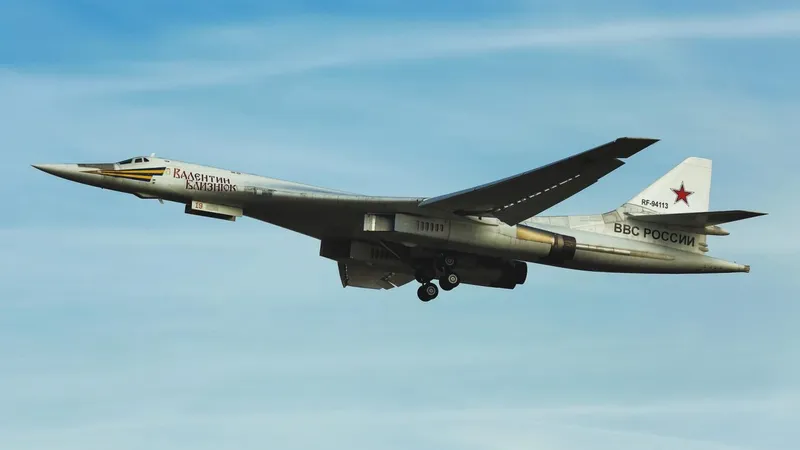
Tu-160 over the Barents Sea. Russian strategic bombers rehearse cruise missile strikes during Zapad-25
Russian long-range aviation has carried out live-fire training over the Barents Sea, launching cruise missiles as part of the Zapad-25 exercise series, which concluded on Tuesday.
In brief
Russian strategic aviation carried out training launches of cruise missiles over the Barents Sea during the Zapad-25 exercises, which ended on Tuesday. According to the Russian Ministry of Defence, Tu-160 strategic bombers took part in the drills, and the scenario also covered the Baltic Sea, the Kaliningrad region and the territory of Belarus. Around 30 thousand Russian and Belarusian troops took part in the Zapad-25 exercises, including 8 thousand at Belarusian training grounds. Russia has around 20 Tu-160 bombers, each of which carries up to 12 Kh-55 or Kh-101 missiles.
According to Russia’s Ministry of Defence, the drills involved Tu-160 “Blackjack” strategic bombers, one of the two mainstays of Moscow’s long-range strike capability alongside the Tu-95. The Barents Sea sorties were integrated into a wider Zapad-25 scenario, which also covered operations in Kaliningrad, Belarus, the Baltic Sea, and other areas within Russian territory.
Approximately 30,000 Belarusian and Russian troops took part in the exercise, including 8,000 operating on training grounds in Belarus. The drills aimed to synchronize air, naval, and ground assets in joint operations near key maritime approaches, including the Arctic routes that are of growing strategic interest.
Each Tu-160 can carry up to 12 Kh-55 or Kh-101 cruise missiles, enabling it to strike maritime or land targets from standoff ranges. Russia operates around 20 of these bombers, many of which have been modernized, and since 2022 has been introducing the upgraded Tu-160M2 variant.
The Barents Sea launches underscore Moscow’s continued focus on projecting power across northern maritime domains and securing access to the Arctic, including potential influence over the Northern Sea Route (NSR).
Source: Gazeta Morska / PAP · Compiled by: Kamil Kusier
Related articles
 Safety and rescue Three hundred metres and 42 seconds. A Russian Mi-8 crossed into Polish airspace near Braniewo
 Navy and defence Polish fighters intercept Russian Il-20 over the Baltic, the tenth such intercept this year
 Safety and rescue Nearly 22-hour search on Puck Bay. One of two missing jet ski users found
 Navy and defence Kaliningrad in Moscow’s shadow. Russia’s fortress, NATO and the future of Baltic security
 Navy and defence Neutrality written into the Constitution. Disputes end where the security of the Republic begins
 Safety and rescue Satellite navigation interference, intercepts and the shadow fleet. Baltic security in summer 2026
Comments (0)
The discussion is moderated by the editors: a comment appears after review. Your e-mail address is not published.
Nobody has commented on this article yet.