









Saab presents first GlobalEye for the Swedish Air Force, three aircraft on order
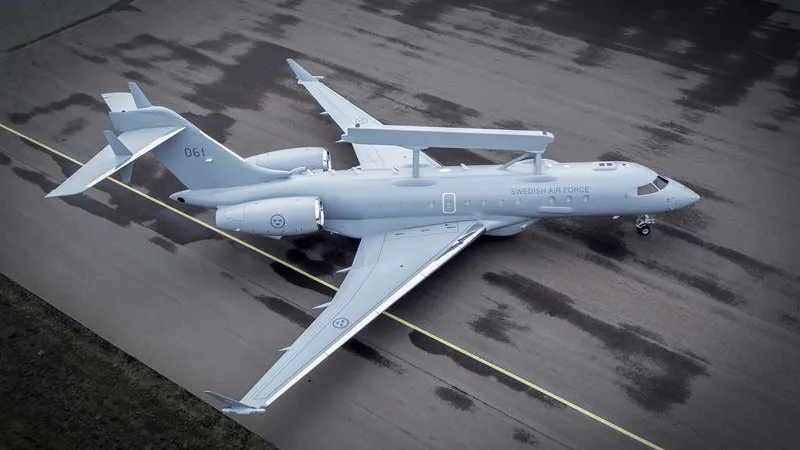
Saab has presented the first of three GlobalEye airborne early warning and control (AEW&C) aircraft ordered by the Swedish Defence Materiel Administration (FMV) for the Swedish Air Force. The aircraft now enters testing and verification ahead of its first flight and delivery. Designated S 106 in Swedish service, GlobalEye will replace the Saab 340 Erieye (ASC 890) fleet in use since the late 1990s, two of which Sweden has decided to donate to Ukraine.
In brief
Saab unveiled the first of three GlobalEye airborne early warning and control aircraft ordered by the Swedish defence materiel agency FMV for the Swedish Air Force. FMV contracted the first two GlobalEye aircraft in June 2022 for about 7.3 billion kronor and ordered the third in 2024. In Sweden the GlobalEye, designated S 106, will replace the Saab 340 Erieye (ASC 890), two of which Sweden is handing over to Ukraine. The GlobalEye aircraft carries the Erieye ER radar with a range exceeding 650 km.
Two aircraft ordered in 2022, a third in 2024, deliveries from 2027
FMV contracted the first two GlobalEyes in June 2022 for about SEK 7.3 billion, with deliveries planned for 2027 and options for two more. Sweden exercised one option in 2024 and ordered a third aircraft. After the decision to donate two ASC 890s to Ukraine, FMV signed an agreement with Saab to bring deliveries forward and keep the gap in AEW&C capability as short as possible. The first Global 6000 airframe arrived from Bombardier in Canada in July 2023, and mission system installation began in Linköping in January 2024.
- The presentation of Sweden's first GlobalEye marks an important milestone for both Saab and the Swedish Armed Forces. As the programme progresses towards delivery, GlobalEye will provide Sweden with a powerful capability for airborne surveillance and situational awareness - says Micael Johansson, President and CEO of Saab.
The Swedish aircraft is a version tailored to national requirements and to interoperability with allies. Its task is to deliver a real-time picture of the air, sea and land domains so that decisions in headquarters and aboard ships are taken faster than the adversary's.
Erieye ER: a radar with more than 650 km of reach over the Baltic
GlobalEye is a converted Bombardier Global 6000 business jet carrying the Erieye ER (Extended Range) radar in the dorsal plank above the fuselage. The gallium nitride AESA array has a range in excess of 650 km and is complemented by a maritime surveillance radar, an electro-optical turret and passive sensors. A single aircraft watches the airspace, the sea surface and the land at the same time and feeds the picture in real time to air force, army and navy units.
For Sweden, a NATO member since March 2024, this means deep surveillance of the Baltic, from the Kaliningrad exclave to the Gulf of Finland, from an orbit over its own territory. The capability matters to the wider region: Swedish AEW&C aircraft complement the picture over the southern Baltic, and Poland ordered two Saab 340 AEW aircraft with the Erieye radar from Saab in 2023, the first of their kind in the Polish Air Force.
Five for the UAE and new orders in 2026
The United Arab Emirates launched the programme with an order in 2015 and has taken delivery of five aircraft; the prototype first flew on 14 March 2018 in Linköping. In July 2026 Saab booked an order for two more GlobalEyes from an undisclosed Middle Eastern customer worth SEK 10.1 billion, and in September the Netherlands signed a letter of intent with Sweden on acquiring the type. In parallel Saab is developing LoyalEye, an airborne early warning sensor for uncrewed platforms, which flew for the first time on an MQ-9B in May 2026.
Source: Gazeta Morska · Compiled by: Kamil Kusier
Related articles
 Energy and offshore Equinor takes over Bałtyk 2 and 3 O&M base in Łeba. Port to serve 1.44 GW of offshore wind for 30 years
 Navy and defence Port Gdański Eksploatacja secures NATO NCAGE code. Gdańsk port company lines up for defence tenders
 Shipbuilding industry Ex-Enterprise towed to Mobile under $418.5m contract. Test case for Nimitz-class disposal begins
 Energy and offshore Energa renames Gdańsk gas plant company as foundations for 6,000-tonne turbine and boiler are laid
 Equipment and technology WB Group takes Polish drones from Tokyo to SOFEX in Jordan in a single week
 Ports and logistics PGE books Gdańsk’s T5 terminal for the long haul: Baltica 2 first, then more offshore wind farms
Comments (0)
The discussion is moderated by the editors: a comment appears after review. Your e-mail address is not published.
Nobody has commented on this article yet.