









Training and science aboard: "Horyzont II" sets sail for Svalbard
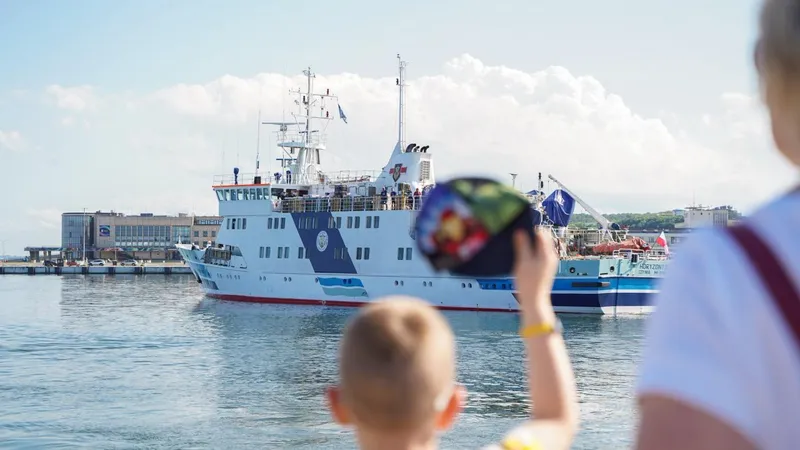
The research and training vessel Horyzont II departed from the Kutrowe Quay in Gdynia, beginning her Arctic voyage to the Svalbard archipelago. Operated by Gdynia Maritime University (GMU), the vessel plays a dual role in this mission—supporting scientific operations in the High North while delivering hands-on training for future maritime professionals.
In brief
The training and research vessel Horyzont II of Gdynia Maritime University departed from Nabrzeże Kutrowe in Gdynia on a voyage to the Svalbard archipelago. Horyzont II carries 47 participants: 15 permanent crew members, 19 students of the Faculty of Electrical Engineering with a supervisor, a student of the Faculty of Navigation and 12 polar researchers from the Institute of Geophysics of the Polish Academy of Sciences, under the command of master mariner Ryszard Durlik. The voyage to Svalbard is to take around 8 days, with visits to the research stations in Hornsund and Longyearbyen to deliver food, fuel and scientific equipment and exchange research teams.
The eight-day northbound journey to Spitsbergen marks another key logistical and educational endeavor under the university's longstanding Arctic program. Onboard are 15 permanent crew members, 19 electrical engineering cadets from GMU’s Faculty of Electrical Engineering accompanied by a faculty supervisor, one student from the Faculty of Navigation, and 12 polar researchers from the Institute of Geophysics of the Polish Academy of Sciences (IGF PAS).
Commanded by Capt. Ryszard Durlik, Horyzont II is carrying essential supplies—including food, fuel, station equipment, and scientific instruments—to support the operation of Polish polar research stations. The itinerary includes scheduled stops at Hornsund and Longyearbyen, enabling both the resupply and the rotation of overwintering scientific personnel, many of whom have spent the past year stationed in the Arctic.
The vessel was ceremonially seen off by GMU’s Rector, Prof. Dr. Eng. Master Mariner Adam Weintrit, along with Capt. Dariusz Jellonnek, Director of the Ship Management and Maritime Training Division. Families and friends of the crew and researchers also gathered on the quay to bid farewell.
Beyond its logistical importance, the voyage offers invaluable experience for GMU students, integrating real-world seamanship and technical training under Arctic conditions. “There is no substitute for learning aboard a working vessel in demanding waters,” commented one of the voyage supervisors. “This is where theory truly meets practice.”
The return voyage is expected to begin later this month, following the successful exchange of polar teams and completion of resupply operations.
As a flagship training and research platform, Horyzont II continues to serve a critical role in Poland’s polar research infrastructure, while simultaneously preparing the next generation of maritime professionals for careers in demanding global environments.
Source: Gazeta Morska · Compiled by: Kamil Kusier
Related articles
 Education From Newton's prism to a microplate reader. A Science Evening in Charzykowy on light and matter
 Energy and offshore Offshore wind enters the classroom in Świnoujście. ORLEN Neptun to teach logistics and navigation students
 Education Drones at the Naval Academy, Dar Młodzieży in Gdynia, a sports hall at UG. Coastal universities open the year
 Sailing and water sports Poland argues over where Dar Młodzieży should retire, while its successor still does not exist
 Education Dar Młodzieży is back in Gdynia after five months, two Atlantic crossings and three intakes of cadets
 Navy and defence Polish Naval Academy swears in 114 cadets as an intake of 185 begins officer training
Comments (0)
The discussion is moderated by the editors: a comment appears after review. Your e-mail address is not published.
Nobody has commented on this article yet.