









The sound of heavy boots: summer season begins at Poland’s Arctowski Station
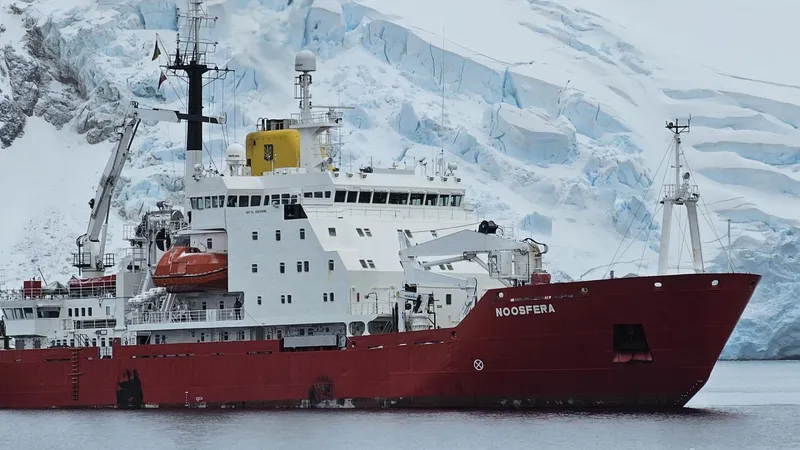
Summer has officially arrived at the Henryk Arctowski Polish Antarctic Station, operated by the Institute of Biochemistry and Biophysics of the Polish Academy of Sciences (PAN). Along with the seasonal change came the Ukrainian research icebreaker Noosfera, which reached Admiralty Bay after a two-week voyage from Cape Town, bringing fresh personnel, supplies, and technical equipment for the Polish polar team.
In brief
The Ukrainian research icebreaker Noosfera has reached Admiralty Bay, opening the summer season at the Henryk Arctowski Polish Antarctic Station. The vessel of the National Antarctic Scientific Center of Ukraine, after a voyage of more than ten days from Cape Town, brought a new crew, equipment and supplies for scientists of the Institute of Biochemistry and Biophysics of the Polish Academy of Sciences. The Henryk Arctowski Station on King George Island has operated continuously since 1977, conducting research in oceanography, marine biology, climatology and geology.
For the overwintering crew, who have maintained the station through months of isolation and sub-zero conditions, the ship’s arrival meant only one thing – the end of silence and the beginning of an intense operational rush. As one of the team members wrote in the station’s log, “The arrival of new people, equipment and noise is a real armageddon – loud conversations, heavy machinery, movement everywhere.”
Noosfera – a key partner in polar logistics
The Noosfera is well known among the global polar community. Operated by Ukraine’s National Antarctic Scientific Center, the vessel regularly serves southern research stations. For Poland, it has become one of the most important logistics partners in recent years, enabling the delivery of cargo, fuel, and personnel to King George Island – home to the Arctowski Station.
Each voyage from Cape Town to the South Shetland Islands takes around two weeks and marks the start of the summer research season, when scientific and technical activity on the station reaches its peak.
Polish Academy of Sciences – at sea and in ice
Poland’s presence in Antarctica dates back to 1977, when the Polish Academy of Sciences established the Arctowski Station, named after renowned polar explorer and oceanographer Henryk Arctowski. Since then, the facility has operated continuously, symbolizing Poland’s long-term commitment to polar and marine science.
Research at Arctowski focuses on oceanography, marine biology, geology, and climate change, contributing vital data to global polar observation systems.
Beyond Antarctica, the Polish Academy of Sciences conducts a broad range of marine research through institutions such as the Institute of Oceanology PAN in Sopot and the Institute of Biochemistry and Biophysics PAN in Warsaw, cooperating with the Polish Navy, maritime offices, and European research networks including EUROFLEETS+ and INTERACT.
New summer, new crew, same mission
Every Antarctic summer brings new people and new goals – from wildlife monitoring and ocean current studies to climate and atmospheric research. The arrival of the Noosfera marks the start of a demanding operational period: cargo unloading, equipment setup, and handover of duties between the outgoing and incoming expedition teams.
As one message from the polar base summed it up:
- We’ve got only a few days before another giant shipment arrives. Keep your fingers crossed – hard work ahead, but it’s the kind we love.
Poland’s maritime footprint in Antarctica
Although more than 14,000 kilometers separate Warsaw from King George Island, the work conducted at Arctowski Station remains deeply tied to Poland’s maritime economy and oceanographic research.
Data collected by the station’s scientists helps to understand global ocean processes, sea-level changes, and environmental dynamics in polar waters.
Source: Gazeta Morska · Compiled by: Kamil Kusier
Related articles
 Education From Newton's prism to a microplate reader. A Science Evening in Charzykowy on light and matter
 Energy and offshore Offshore wind enters the classroom in Świnoujście. ORLEN Neptun to teach logistics and navigation students
 Education Drones at the Naval Academy, Dar Młodzieży in Gdynia, a sports hall at UG. Coastal universities open the year
 Sailing and water sports Poland argues over where Dar Młodzieży should retire, while its successor still does not exist
 Education Dar Młodzieży is back in Gdynia after five months, two Atlantic crossings and three intakes of cadets
 Navy and defence Polish Naval Academy swears in 114 cadets as an intake of 185 begins officer training
Comments (0)
The discussion is moderated by the editors: a comment appears after review. Your e-mail address is not published.
Nobody has commented on this article yet.