









The Baltic as Europe's strategic region: Gdańsk hosts the first Baltic Rectors' Forum
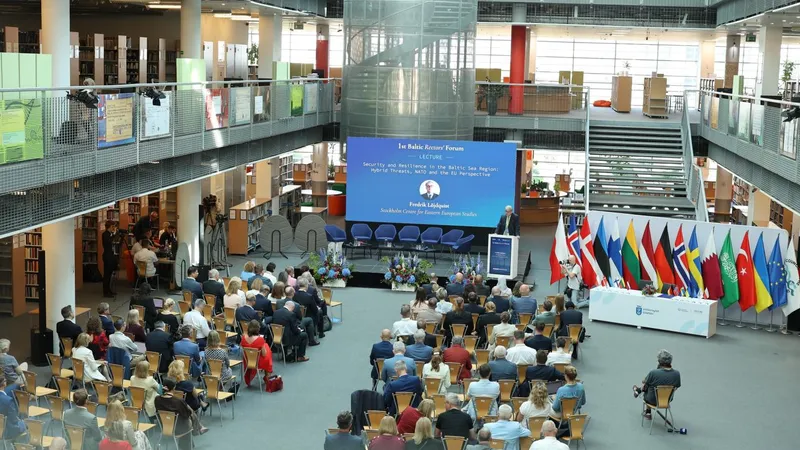
More than one hundred rectors, alongside representatives of academia, public administration, business and international organisations from across the Baltic Sea region, gathered in Gdańsk for the first Baltic Rectors' Forum. Hosted by the University of Gdańsk at its main library, the event set out to create a lasting platform for cooperation between universities, companies and public institutions around the future of the Baltic.
In brief
More than a hundred rectors and representatives of science, administration, business and international organisations from Baltic countries met in Gdańsk for the first Baltic Rectors' Forum. The University of Gdańsk organised the forum, held in the University of Gdańsk Library building, with ORLEN, the Ministry of Science and Higher Education and the Port of Gdańsk as strategic partners. The debates covered offshore, nuclear energy, the blue economy and energy security, and Gdynia Maritime University rector Adam Weintrit took part in a panel on the resilience of the Baltic Sea. The meeting ended with the signing of the Baltic Rectors' Declaration, known as the Gdańsk Declaration.
The forum brought together delegates from universities and institutions in Poland, Germany, Denmark, Sweden, Finland, Norway, Lithuania, Latvia and Ukraine. Alongside the academic community, it drew government officials, including from three ministries, as well as experts in energy, security and climate transition. Among the guests were Eliza Zeidler of the Ministry of State Assets and Rüdiger Strempel, Secretary General of the Baltic Marine Environment Protection Commission (HELCOM). International partners also travelled to Gdańsk, among them the Massachusetts Institute of Technology.
A sea that binds strategies
Opening the proceedings, the Rector of the University of Gdańsk, Prof. Piotr Stepnowski, observed that the Baltic is ceasing to be a purely geographical region and is becoming one of Europe's most important strategic areas. In the face of Russia's aggression against Ukraine, the security of the sea's critical infrastructure has become a priority, and energy questions, he stressed, have long since moved beyond the purely economic. He described the Baltic as a global laboratory for the energy transition, arguing that these new challenges are redefining the role of universities as the intellectual backbone of the changes under way.
Offshore, the blue economy and security
Discussions centred on issues critical to the region's entire maritime economy: the development of the offshore sector, nuclear energy and the so-called blue economy, energy security, marine environment protection and the internationalisation of research. Particular attention went to the region's resilience to the effects of climate change and to the joint search for solutions that serve sustainable development.
The voice of maritime higher education was heard in particular through Gdynia Maritime University. Its Rector, Prof. Adam Weintrit, took part in a panel devoted to closer scientific cooperation aimed at strengthening the Baltic's resilience, protecting the marine environment and advancing sustainable development. The presence of a maritime-focused university was a reminder that the region's future, from shipping and ports to offshore energy, depends in large part on the people and research emerging along the coast.
A triangle of science, business and administration
Participants agreed that the region's development calls for the combined efforts of three communities: academia, business, and governments and public administration. The Mayor of Gdańsk, Aleksandra Dulkiewicz, underlined the need for such cooperation. The forum also sat within the wider context of Poland's engagement in the Council of the Baltic Sea States (CBSS).
The meeting culminated in the signing of the Baltic Rectors' Declaration (the Gdańsk Declaration), a document setting out the direction of cooperation among the region's universities for the years ahead.
The event was organised by the University of Gdańsk, with the support of strategic partners: ORLEN, the Ministry of Science and Higher Education and the Port of Gdańsk.
Source: Gazeta Morska · Compiled by: Kamil Kusier
Related articles
 Education From Newton's prism to a microplate reader. A Science Evening in Charzykowy on light and matter
 Energy and offshore Offshore wind enters the classroom in Świnoujście. ORLEN Neptun to teach logistics and navigation students
 Education Drones at the Naval Academy, Dar Młodzieży in Gdynia, a sports hall at UG. Coastal universities open the year
 Sailing and water sports Poland argues over where Dar Młodzieży should retire, while its successor still does not exist
 Education Dar Młodzieży is back in Gdynia after five months, two Atlantic crossings and three intakes of cadets
 Navy and defence Polish Naval Academy swears in 114 cadets as an intake of 185 begins officer training
Comments (0)
The discussion is moderated by the editors: a comment appears after review. Your e-mail address is not published.
Nobody has commented on this article yet.