









Skagen: Denmark’s northern gateway where the North Sea meets the Baltic
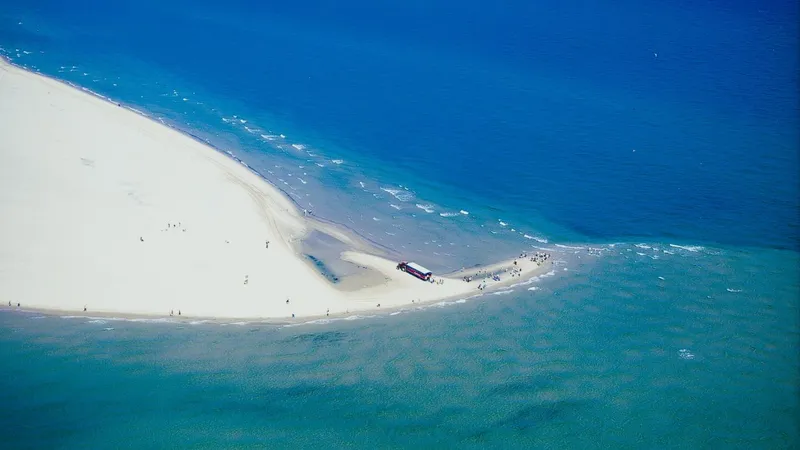
At the very tip of Denmark’s Jutland Peninsula lies Skagen – a town whose identity and global recognition are built around one extraordinary natural phenomenon. At Grenen, the narrow sandbar stretching into the sea, the powerful waters of the North Sea (Skagerrak) and the Baltic (Kattegat) collide in a spectacle that fascinates tourists, scientists, and the travel industry alike.
In brief
Skagen, at the tip of Denmark's Jutland, draws tourists with the Grenen headland, where the waters of the North Sea (Skagerrak) and the Baltic Sea (Kattegat) meet. Differences in salinity, temperature and currents mean the waters take a long time to mix, creating a visible boundary. Swimming at the Grenen headland is prohibited because of strong currents and eddies, and tourists are taken to the end of the headland by the Sandormen off-road bus. Skagen's attractions also include the Rabjerg Mile dunes, the church buried in sand, the Skagen Painters museums and the nature centre at the Det Gra Fyr lighthouse.
A living laboratory of the seas
The meeting of the seas at Grenen is more than a scenic attraction. It is a demonstration of oceanography in action: two bodies of water with different salinity, density, and currents push against each other without fully merging. This creates visible patterns – foaming lines of surf, swirling eddies, and a dramatic sense of two oceans locked in motion.
For visitors, this is a unique opportunity to witness natural forces at work, and for the tourism industry, it offers a powerful narrative: a destination where geography becomes both experience and education.
Symbolism and destination value
Locally, Grenen has become a cultural landmark. Tradition holds that anyone who can stand simultaneously in the North Sea and the Baltic has truly experienced Skagen. This symbolism strengthens the town’s identity and positions it as a must-see destination for tourists seeking both adventure and memorable photo opportunities.
Accessibility and visitor experience
Grenen is well-equipped for tourism, with marked walking trails and the famous “Sandormen” (Sandworm) shuttle bus transporting visitors to the tip of the peninsula. For safety reasons, swimming is prohibited due to strong currents, but observation from the shore provides the most dramatic and rewarding views.
The combination of accessibility and natural spectacle makes Grenen an ideal highlight for tour operators, incentive travel programs, and educational trips.
Skagen beyond the seas
While the meeting of the seas is Skagen’s main attraction, the town offers a rich cultural and natural landscape. Visitors can explore Råbjerg Mile, the sand-covered church, Skagen Painters museums, modern lighthouses like Det Grå Fyr, and coastal nature centers. These sites complement Grenen, turning Skagen into a full-fledged destination for nature, culture, and maritime tourism.
Industry perspective
For the travel industry, Skagen represents a unique asset. The Grenen phenomenon is visually striking, easily accessible, and instantly recognizable – perfect for marketing campaigns and destination branding. It demonstrates how a single natural event can define a region, attract international visitors, and create opportunities for educational and cultural programming.
Grenen is more than a geographical curiosity. It is a living, moving spectacle of nature that leaves a lasting impression on every visitor.
Source: Gazeta Morska · Compiled by: Kamil Kusier
Related articles
 Sailing and water sports GB1's America's Cup AC75 reaches Naples, swapping cyclors for batteries
 Safety and rescue From lightships to solar power: 160 years of the Grundkallen light station
 Shipbuilding industry Lionel Messi orders a Sunreef catamaran. The Ultima 88 is being built at the Gdańsk firm’s UAE yard
 Investments A Szczecin firm is to design the world's tallest Christ statue. A 207-metre core in 40 days
 Sailing and water sports A century-old Inga Lisa and Czarny Diament after 32 years at sea. Over 30 classic yachts in Gdynia
 Sailing and water sports Eleven years of trying and metres at the finish. Witold Karałow's Scamp 4 wins the 75th Blue Ribbon
Comments (0)
The discussion is moderated by the editors: a comment appears after review. Your e-mail address is not published.
Nobody has commented on this article yet.