









Shipbuilding is stellar. Marcin Ryngwelski on the Kort nozzle and precision installation at the yard
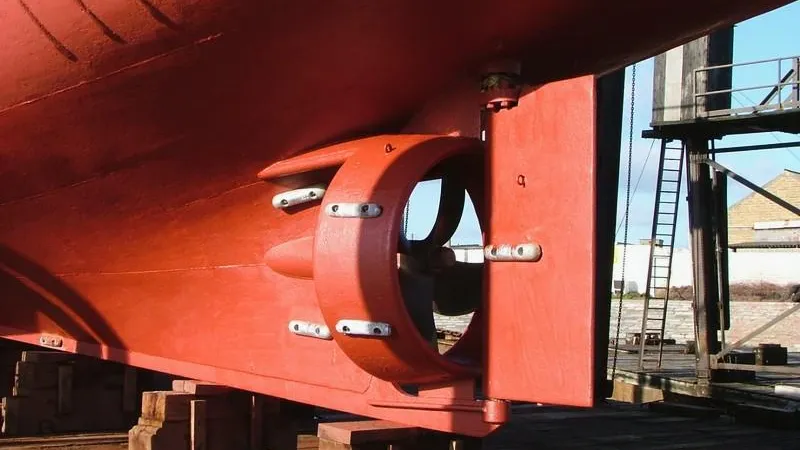
In modern ship propulsion, every knot matters, and every bit of thrust counts. That’s where solutions like the Kort nozzle come in—a deceptively simple piece of engineering that continues to make a major difference, especially in vessels requiring high maneuverability and pulling power. Put simply, the Kort nozzle is a structural element that enhances the performance of a propeller, particularly at low speeds. It's a concept that has stood the test of time.
In brief
Marcin Ryngwelski, president of the management board of PGZ Stocznia Wojenna, describes the Kort nozzle as a structural element that supports the propeller and increases its efficiency. The solution was patented in the USA in 1936 by German engineer Ludwig Kort, and propellers in Kort nozzles were used on the vessels ZODIAK and PLANETA built for the Maritime Offices in Szczecin and Gdynia. Assembly takes place in the shipyard's Mechanical Department, and the thruster well must meet tolerances measured in millimetres with components weighing up to several dozen tonnes. A leak test is carried out after assembly.
dysza Korta fot. Wikimedia Commons
Ludwig Kort – the engineer who changed the flow
The invention takes its name from Ludwig Kort, a German engineer who dedicated years to studying hydrodynamics and the efficiency of jet propulsion systems—not only in maritime applications but also in aviation.
In 1936, after extensive research, Kort patented the design in the United States. His idea—to enclose a propeller inside a hydrodynamically optimized nozzle—proved revolutionary. To this day, Kort's name is synonymous with improved propulsion in high-resistance, low-speed maritime operations.
Real-world application: from theory to steel
Though modern vessels increasingly rely on azimuth thrusters and hybrid-electric solutions, the Kort nozzle still has its place—particularly in vessels like tugboats, pushers, and utility ships, where responsiveness and thrust are mission-critical.
A fun fact? Kort nozzle-equipped propellers have been installed on ZODIAK and PLANETA, two state-of-the-art vessels built for the Maritime Offices in Szczecin and Gdynia, Poland. They are used in hydrographic and support roles where precision handling is essential.
Installation at the yard: it’s not just plug-and-play
Installing a propulsion unit with a Kort nozzle is a job for experts—this is precision mechanical work involving multi-ton equipment, tight tolerances (often down to millimeters), and specialized tooling.
At Polish shipyards, these operations are typically handled by the Mechanical Department, often in coordination with third-party specialists. The process starts with a Technology Instruction Manual issued in accordance with the manufacturer's guidelines.
Before installation, the nozzle well ("propeller tunnel") must be perfectly prepared, ensuring exact dimensions and cleanliness. Once mounted, sealing tests are conducted to ensure complete watertightness during operation. There’s no room for leaks—or mistakes—when dealing with main propulsion.
Note: The Kort nozzle is not a standalone element installed separately by the yard. It’s an integrated part of the entire propulsion unit.
Bottom line? Shipbuilding is stellar
The Kort nozzle remains a great example of how legacy engineering can still power the future. In today’s advanced maritime sector, proven solutions continue to earn their place—especially when paired with skilled workmanship, precise installation, and deep domain expertise.
Source: Gazeta Morska · Compiled by: Kamil Kusier
Related articles
 Shipbuilding industry Poland christens ro-pax ferry Bursztyn Unity in Szczecin on Independence Day. Ystad service starts 18 November
 Energy and offshore Orlen Neptun deploys V-LiDAR buoys at Baltic West ahead of Poland's 2027 offshore wind auction
 Energy and offshore Equinor takes over Bałtyk 2 and 3 O&M base in Łeba. Port to serve 1.44 GW of offshore wind for 30 years
 Navy and defence Port Gdański Eksploatacja secures NATO NCAGE code. Gdańsk port company lines up for defence tenders
 Shipbuilding industry Ex-Enterprise towed to Mobile under $418.5m contract. Test case for Nimitz-class disposal begins
 Energy and offshore Energa renames Gdańsk gas plant company as foundations for 6,000-tonne turbine and boiler are laid
Comments (0)
The discussion is moderated by the editors: a comment appears after review. Your e-mail address is not published.
Nobody has commented on this article yet.