









Shipbuilding industry is awesome. Marcin Ryngwelski on compressed air and starting the main engine
The compressed air system is one of the fundamental support installations on any ship or naval vessel. Without it, the main engine cannot be started, and several key control and maintenance operations would be impossible. Although compressed air may appear to be a simple utility system, its design, integration and operation at sea require careful planning and high reliability. Marcin Ryngwelski, CEO of PGZ Naval Shipyard, explains the role of this system and its importance in vessel operation.
In brief
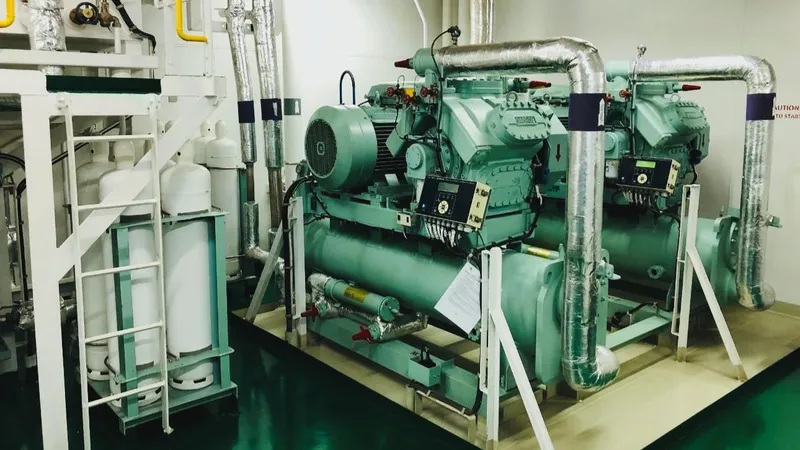
The compressed air installation is a precondition for starting a vessel's main engine, stresses Marcin Ryngwelski, president of PGZ Stocznia Wojenna. The system includes compressors, steel receivers, piping and control and safety fittings, and also serves to control engine systems, drive critical systems and power pneumatic tools. Classification societies require an air reserve sufficient for at least six main engine start attempts. Late delivery of equipment to the shipyard forces additional technological openings or dismantling of fittings.
Why compressed air is critical
Most people associate an air compressor with a small device used to inflate tires. On board a vessel, the scale and purpose are entirely different.
- The main engine of a ship is not started like a car engine. It does not have a standard ignition system. The start-up process is controlled and relies directly on compressed air. Without this system, the vessel simply cannot get underway, says Ryngwelski.
Compressed air is used for:
- starting the main engine,
- control and actuation of engine systems,
- operating critical safety and control valves,
- handling specific onboard systems (including launch systems on naval platforms),
- powering pneumatic tools and maintenance equipment,
- cleaning operations such as cooler flushing.
System components
In technical terms, the compressed air installation consists of:
- compressors that generate air at the required pressure,
- steel air receivers for storage,
- pipelines distributing air throughout the vessel,
- valves and control elements ensuring safe operation.
- It appears simple as a list of equipment, but in practice the routing, accessibility, structural interface and service conditions require precise planning. This begins at the design stage, notes Ryngwelski.
Design and integration in the shipyard
The choice of propulsion and auxiliary systems determines the dimensions and capacity of the compressed air installation. The shipyard and its design office must plan:
- the placement of compressors and air receivers,
- foundations and structural supports,
- pipeline routing with collision-free access,
- space for maintenance and inspection.
- If equipment is delivered too late, the hull structure may already be closed. This can force additional access openings or removal of installed outfitting. Proper logistics timing is essential, Ryngwelski emphasizes.
Classification requirements
Classification societies impose minimum air storage capacity for operational safety.
- The air stored in the start air receivers must allow at least six consecutive starting attempts of the main engine. This is a mandatory requirement that ensures the vessel can be safely restarted, explains Ryngwelski.
The compressed air system is not merely auxiliary equipment. It is part of the essential operational infrastructure of the vessel. Its reliability depends on correct system design, careful installation and coordinated delivery scheduling.
Source: Gazeta Morska · Compiled by: Kamil Kusier
Related articles
 Shipbuilding industry Poland christens ro-pax ferry Bursztyn Unity in Szczecin on Independence Day. Ystad service starts 18 November
 Energy and offshore Orlen Neptun deploys V-LiDAR buoys at Baltic West ahead of Poland's 2027 offshore wind auction
 Energy and offshore Equinor takes over Bałtyk 2 and 3 O&M base in Łeba. Port to serve 1.44 GW of offshore wind for 30 years
 Navy and defence Port Gdański Eksploatacja secures NATO NCAGE code. Gdańsk port company lines up for defence tenders
 Shipbuilding industry Ex-Enterprise towed to Mobile under $418.5m contract. Test case for Nimitz-class disposal begins
 Energy and offshore Energa renames Gdańsk gas plant company as foundations for 6,000-tonne turbine and boiler are laid
Comments (0)
The discussion is moderated by the editors: a comment appears after review. Your e-mail address is not published.
Nobody has commented on this article yet.