









Shipbuilding industry is next-level: Marcin Ryngwelski on how a shipyard installs mooring equipment
Precision, expertise, and teamwork — these are the foundations of the complex process of installing mooring systems on modern vessels and naval ships. PGZ Naval Shipyard offers a behind-the-scenes look at how this essential operation is carried out, from the design office to the crew training phase.
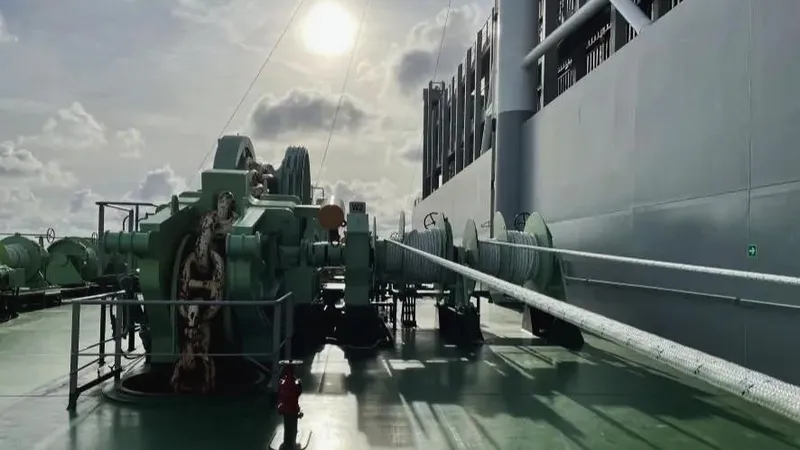
In brief
PGZ Stocznia Wojenna has presented the process of installing mooring equipment on ships and naval vessels, from design to crew training. Marcin Ryngwelski, president of PGZ Stocznia Wojenna, pointed out that crane operators, equipment fitters, electricians, welders, markers and hull fitters work on the installation of winches, and that the foundations are made of high-strength steel. Mooring equipment is tested under load during Harbor Acceptance Test trials, after which the crew undergoes training in line with classification society requirements and SOLAS regulations. The mooring solutions are supplied by TOWIMOR of Toruń.
- A mooring line is more than just a rope. It represents safety, homecoming, and connection with the shore. But before a sailor hears the command ‘Cast off the mooring lines’, there's a long and highly technical process behind it, says Marcin Ryngwelski, CEO of PGZ Naval Shipyard.
From Design to Precision Installation
Everything starts in the design office, where engineers, guided by the specifications of the Navy or commercial shipowners, analyze the placement, accessibility, and load distribution for the mooring equipment.
- Proper mooring winches are selected based on the vessel’s type and size.
- A reinforced steel foundation is designed and built to withstand extreme forces exerted during mooring operations.
- The area is precisely cleaned and aligned before welding the foundation to the deck.
- The winch is then accurately positioned and secured with mounting bolts and hardware.
- It’s a high-precision operation involving not only crane operators and device technicians, but also electricians, tracers, welders, and hull fitters. Coordination is key, emphasizes Marcin Ryngwelski.
Guiding the Lines: Fairleads and Bollards
Installing mooring winches is just part of the task. Proper line management requires additional equipment — bollards, fairleads, and deck fittings — to ensure safe and smooth operation of the mooring system. Poor alignment can cause premature wear of mooring lines, increasing operational costs and safety risks.
Harbor Acceptance Tests and Crew Training
Once installed, the system is tested as part of the Harbor Acceptance Test (HAT) protocol. This phase verifies the mechanical and electrical performance of the winches under load, simulating real-world mooring forces.
- Functionality isn’t enough — reliability is everything. That’s why HAT is such a critical step before commissioning, notes Marcin Ryngwelski.
Following successful testing, the future crew receives training in line with classification society regulations, SOLAS, and manufacturer guidelines — covering operation, maintenance, and safety procedures.
Polish Excellence in Mooring Systems
PGZ Naval Shipyard collaborates with TOWIMOR, a Toruń-based company recognized as Poland’s leading manufacturer of mooring equipment. Their solutions serve both commercial and military fleets, ensuring high performance in even the harshest maritime conditions.
Source: Gazeta Morska · Compiled by: Kamil Kusier
Related articles
 Energy and offshore Słajszewo to get a new beach road around Poland’s first nuclear plant site before summer 2027
 Shipbuilding industry Poland christens ro-pax ferry Bursztyn Unity in Szczecin on Independence Day. Ystad service starts 18 November
 Energy and offshore Orlen Neptun deploys V-LiDAR buoys at Baltic West ahead of Poland's 2027 offshore wind auction
 Energy and offshore Equinor takes over Bałtyk 2 and 3 O&M base in Łeba. Port to serve 1.44 GW of offshore wind for 30 years
 Navy and defence Port Gdański Eksploatacja secures NATO NCAGE code. Gdańsk port company lines up for defence tenders
 Shipbuilding industry Ex-Enterprise towed to Mobile under $418.5m contract. Test case for Nimitz-class disposal begins
Comments (0)
The discussion is moderated by the editors: a comment appears after review. Your e-mail address is not published.
Nobody has commented on this article yet.