









Shipbuilding industry is awesome. Marcin Ryngwelski on active and passive stabilizers
Roll motion cannot be eliminated, because it results directly from how the hull interacts with wind and waves. However, it can be significantly reduced. Properly integrated stabilizers allow a vessel to maintain operational capability and comfort in a seaway. Marcin Ryngwelski, CEO of PGZ Naval Shipyard, explains how stabilizers work and why their installation is structurally and technologically demanding.
In brief
Fin stabilisers must be provided for already at the technical design stage of a vessel, because their installation requires hull reinforcements and tolerances measured in millimetres, says Marcin Ryngwelski, president of PGZ Stocznia Wojenna. Stabilisers are divided into passive ones, such as U-tank anti-roll tanks, and active ones controlled by gyroscope-based automation. Roll characteristics are tested on models at Centrum Techniki Okrętowej in Gdańsk, and the finished system is verified in harbour acceptance trials (HAT) and sea acceptance trials (SAT).
Roll motion as a design consideration
- Every vessel will roll. This is a natural hydrodynamic response, says Ryngwelski.
Roll is the rotation of the hull around its longitudinal axis and depends on hull form, weight distribution and metacentric height. The engineering goal is not to remove roll entirely but to limit its amplitude and rate.
Why stabilizers must be planned early
Stabilizers influence hull geometry, internal layout and system routing.
- A stabilizer has to be included already in the design phase. The intended operating waters and mission decide which solution is suitable. A frigate operating in the North Atlantic and a passenger vessel in the Mediterranean will have different requirements, notes Ryngwelski.
Passive vs. active systems
System | Key features |
|---|---|
Passive stabilizers | Use hydrodynamic resistance or fluid movement; examples include bilge keels and anti-roll tanks. No active control required. |
Active stabilizers | Use powered actuation to counter roll in real time. The most common are fin stabilizers, positioned below the waterline and controlled automatically. |
Fin stabilizers — precision work below the waterline
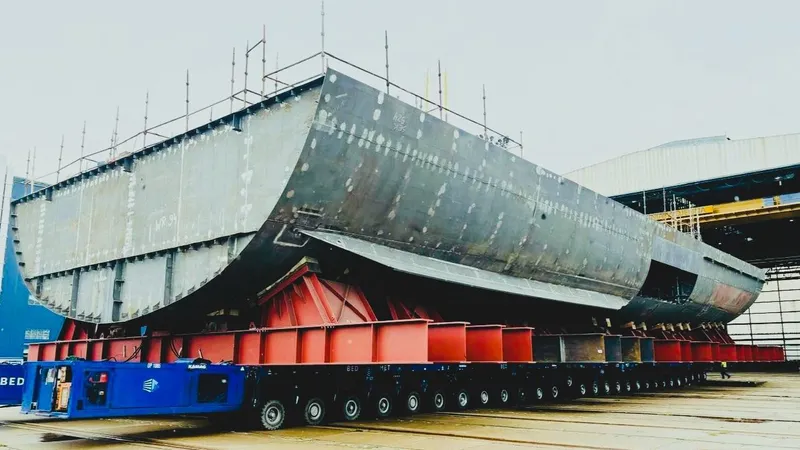
Fin stabilizers are usually placed amidships. Their installation requires hull cutouts, structural reinforcement and watertight integration.
-The tolerances are in millimeters. Welding below the waterline must meet the highest strength and watertightness standards. It requires specialized teams who perform this type of work regularly, Ryngwelski explains.
Integration includes:
- hydraulic or electromechanical actuation,
- electrical power and control connections,
- gyro-based control logic and calibration.
Every step is documented and verified by the classification society.
Performance verification
Expected roll behavior is often tested before ship construction, including model basin tests at the Ship Design and Research Centre in Gdańsk.
After installation, stabilizers undergo:
- harbour acceptance tests (HAT),
- sea acceptance trials (SAT).
- Sea trials confirm that stabilizers deliver the expected performance in real sea conditions.
Stabilizers do not eliminate roll but manage it effectively. Their performance results from coordinated naval architecture, precision hull fabrication and controlled testing.
Source: Gazeta Morska · Compiled by: Kamil Kusier
Related articles
 Shipbuilding industry Poland christens ro-pax ferry Bursztyn Unity in Szczecin on Independence Day. Ystad service starts 18 November
 Energy and offshore Orlen Neptun deploys V-LiDAR buoys at Baltic West ahead of Poland's 2027 offshore wind auction
 Energy and offshore Equinor takes over Bałtyk 2 and 3 O&M base in Łeba. Port to serve 1.44 GW of offshore wind for 30 years
 Navy and defence Port Gdański Eksploatacja secures NATO NCAGE code. Gdańsk port company lines up for defence tenders
 Shipbuilding industry Ex-Enterprise towed to Mobile under $418.5m contract. Test case for Nimitz-class disposal begins
 Energy and offshore Energa renames Gdańsk gas plant company as foundations for 6,000-tonne turbine and boiler are laid
Comments (0)
The discussion is moderated by the editors: a comment appears after review. Your e-mail address is not published.
Nobody has commented on this article yet.