









Science meets performance: Szczecin model offers lessons beyond sport
As data-driven decision-making reshapes modern industries, cooperation between academia and professional sport is emerging as a testing ground for advanced performance optimization. The partnership between University of Szczecin and Pogoń Szczecin demonstrates how such integration can deliver measurable results while offering insights relevant to sectors such as maritime, offshore, and logistics.
In brief
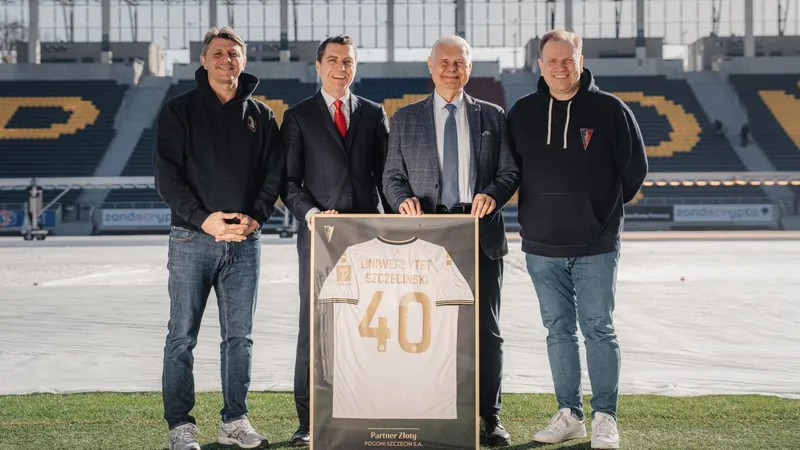
The University of Szczecin and Pogoń Szczecin are developing a data driven partnership covering the Ekstraklasa men's first team, the women's team and the academy structures. The Centre for Structural and Functional Human Research conducts laboratory tests assessing the exercise capacity, strength, power and physiological parameters of Pogoń Szczecin players. The test results serve training periodisation, injury prevention through identifying functional deficits and the return to play process. The University of Szczecin is also implementing a dual career concept combining a sporting career with academic education.
A modern cooperation framework
The collaboration between University of Szczecin and Pogoń Szczecin—known as the “Pride of Pomerania”—represents a structured approach to combining academic research with high-performance sports operations. The partnership covers the men’s first team competing in the Ekstraklasa, the women’s squad, and the club’s academy system.
Data-driven performance optimization
At the core of this model is the Centre for Structural and Functional Research on Humans (CBSFC), which provides advanced sports diagnostics and performance analytics. Laboratory-based testing enables precise evaluation of endurance, strength, power, and physiological parameters, forming the basis for individualized training load management.
Performance planning and injury prevention
The collected data supports effective training periodization, allowing coaching staff to align peak performance with key phases of the competitive season. Injury prevention is another critical pillar, with early identification of functional deficits and asymmetries helping to reduce injury risk and improve player availability.
Return-to-sport based on objective metrics
CBSFC also contributes to return-to-sport (RTS) protocols by delivering objective benchmarks for assessing an athlete’s readiness to resume full training and competition. This evidence-based approach strengthens decision-making across coaching and medical teams.
Flexible education: the dual-track model
In parallel, the University of Szczecin is implementing a flexible “dual-track” education system. This model allows student-athletes to balance academic responsibilities with training schedules and competition demands, with plans to expand it to other student groups in the future.
Implications for maritime and offshore sectors
The integrated, data-driven approach seen in Szczecin reflects broader trends in maritime and offshore industries, where operational efficiency increasingly depends on analytics, human performance optimization, and interdisciplinary cooperation. The case of University of Szczecin and Pogoń Szczecin highlights how structured collaboration between science and practice can become a competitive advantage across sectors.
Source: Gazeta Morska · Compiled by: Kamil Kusier
Related articles
 Education From Newton's prism to a microplate reader. A Science Evening in Charzykowy on light and matter
 Energy and offshore Offshore wind enters the classroom in Świnoujście. ORLEN Neptun to teach logistics and navigation students
 Education Drones at the Naval Academy, Dar Młodzieży in Gdynia, a sports hall at UG. Coastal universities open the year
 Sailing and water sports Poland argues over where Dar Młodzieży should retire, while its successor still does not exist
 Education Dar Młodzieży is back in Gdynia after five months, two Atlantic crossings and three intakes of cadets
 Navy and defence Polish Naval Academy swears in 114 cadets as an intake of 185 begins officer training
Comments (0)
The discussion is moderated by the editors: a comment appears after review. Your e-mail address is not published.
Nobody has commented on this article yet.