









Poland becomes a Baltic port power. Maritime University of Gdynia opens academic year
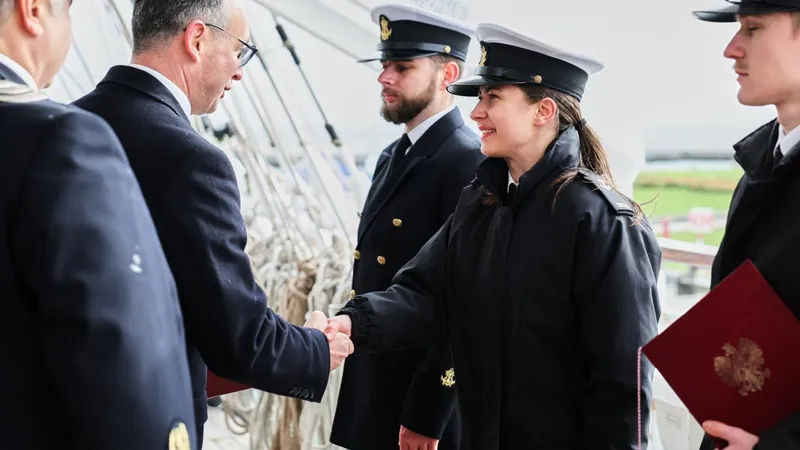
Poland is steadily strengthening its position on the Baltic Sea. Speaking at the opening of the academic year at the Maritime University of Gdynia, Prime Minister Donald Tusk emphasized that the Baltic once again plays a decisive role in shaping the nation’s future – in terms of both security and economic development.
In brief
Prime Minister Donald Tusk announced during the inauguration of the academic year of Gdynia Maritime University aboard the Dar Młodzieży that Poland is becoming a port power on the Baltic Sea. The government will allocate almost PLN 1 billion by 2029 to build two training ships. The successor to the Dar Młodzieży, a three-masted sailing ship for Gdynia Maritime University, is to be ready in 2028 and will allow 120 cadets to be trained at once, while the second vessel will be a training and research ship for the Maritime University of Szczecin. Prime Minister Donald Tusk also announced the rebuilding of the Polish fleet and flag.
-
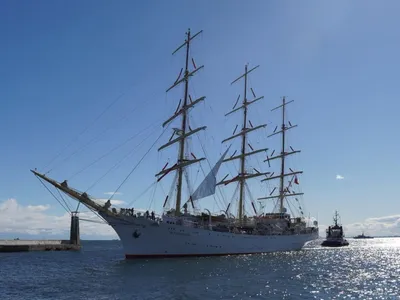
- We are becoming – without the slightest exaggeration – a port power on our sea. The Baltic is now the site of the largest energy projects in Poland’s history: offshore wind farms, a nuclear power plant, major infrastructure upgrades, and port expansions, Tusk said aboard the training tall ship Dar Młodzieży.
Investing in human capital
The government’s maritime strategy extends beyond infrastructure to focus on building future talent. According to the Prime Minister, the future of Poland’s presence on the Baltic will depend on well-trained, determined, and forward-looking seafarers and maritime professionals.
Nearly PLN 1 billion (approx. EUR 215 million) will be allocated by 2029 for the construction of two new training vessels:
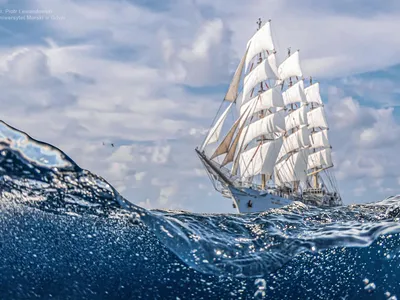
- A new three-masted tall ship, replacing the iconic Dar Młodzieży after 44 years of service. Scheduled for completion in 2028, it will accommodate practical training for up to 120 cadets simultaneously.
- A training and research vessel for the Maritime University of Szczecin, enabling hands-on education at sea as well as multidisciplinary research in marine sciences.
The Baltic as a strategic arena
With port expansions, offshore wind development, nuclear power initiatives, and seabed resource exploration, the Baltic Sea is becoming central to Poland’s economic and security agenda. Future graduates of maritime universities will be expected not only to serve as captains and officers on Polish vessels but also to lead in sectors such as offshore energy, marine engineering, and cybersecurity.
- We will rebuild the Polish fleet and the national flag. Future graduates will not only navigate ships but also drive innovation in offshore wind, energy, and cutting-edge maritime technologies, Tusk stressed.
Poland’s ambitious Baltic vision
These investments signal a long-term vision: to transform the Baltic into a space not just of trade and transit, but of strategic value for Poland’s energy independence, maritime security, and industrial growth. By coupling infrastructure with education, Poland positions itself as a leading maritime power in the Baltic region.
Source: Gazeta Morska · Compiled by: Kamil Kusier
Related articles
 Education From Newton's prism to a microplate reader. A Science Evening in Charzykowy on light and matter
 Energy and offshore Offshore wind enters the classroom in Świnoujście. ORLEN Neptun to teach logistics and navigation students
 Education Drones at the Naval Academy, Dar Młodzieży in Gdynia, a sports hall at UG. Coastal universities open the year
 Sailing and water sports Poland argues over where Dar Młodzieży should retire, while its successor still does not exist
 Education Dar Młodzieży is back in Gdynia after five months, two Atlantic crossings and three intakes of cadets
 Navy and defence Polish Naval Academy swears in 114 cadets as an intake of 185 begins officer training
Comments (0)
The discussion is moderated by the editors: a comment appears after review. Your e-mail address is not published.
Nobody has commented on this article yet.