









Maritime Survival Training: Future Military Pilots in Action at Zeebrugge
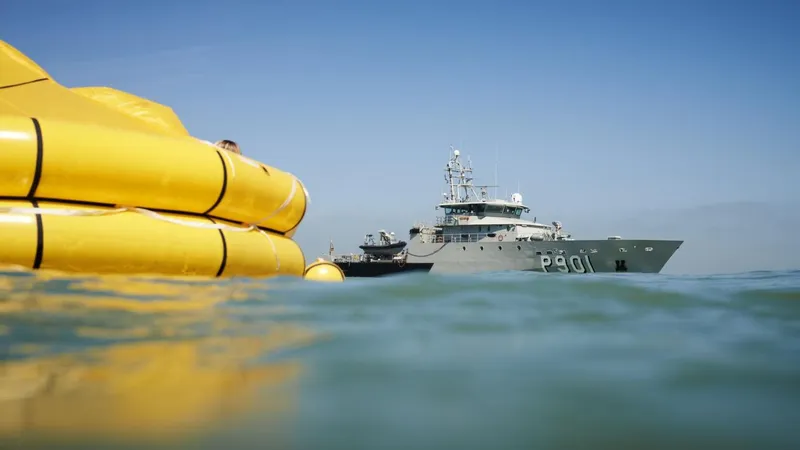
Young military pilot trainees and future aircrew members recently undertook the essential Sea Survival Initial Course in Zeebrugge, a critical step in preparing aviators for emergency situations over water. The Belgian Navy provided vital logistical support, including the deployment of the patrol vessel Castor for practical exercises at sea.
In brief
Young military pilots and future aircrew members completed a two-day Sea Survival Initial Course in Zeebrugge, for which the Belgian Navy provided the patrol vessel Castor. The first day of training consisted of pool sessions: jumps from height, swimming in survival suits and using a life raft, while the second took place at open sea under the supervision of SERE instructors from the Belgian Air and Space Component. Instructors noted that water covers 72 percent of the Earth's surface, and the course ended with a scenario involving a jump into the sea, reaching the raft, calling for help and recovery aboard the ship.
The course combined theoretical lessons and hands-on training. The first day focused on pool exercises where participants practiced deep-water jumps, swimming in survival suits, boarding life rafts, and teamwork under simulated emergency conditions. The second day moved to the open sea, supervised by Survival, Evasion, Resistance, and Extraction (SERE) instructors from the Belgian Air and Space Component.
This training is crucial due to the maritime nature of many flight operations, with approximately 72% of the Earth’s surface covered by water. Pilots frequently fly over vast sea areas, and in case of technical failure or hostile action, they must be ready to ditch safely and survive until rescue arrives, explains the training center commander.
For the trainees, the course was both a physical and mental challenge. It also marked their first operational collaboration with the Navy. The realistic final scenario involved jumping into the water, reaching a life raft, signaling their position, and being rescued aboard the patrol vessel. Managing stress and seasickness proved to be among the most demanding aspects.
- This training is not just about technical skills but also about developing calmness and teamwork under pressure, says one pilot trainee. - I now feel confident handling survival equipment and procedures, which makes me more prepared for flying over large bodies of water.
The course complies with international safety standards and is a mandatory part of military aviator training. Its importance will grow as Belgium prepares to introduce the F-35 fighter jets into service, marking a new chapter for the country’s air and space capabilities and for these young pilots’ careers.
Source: Gazeta Morska · Compiled by: Kamil Kusier
Related articles
 Navy and defence Saab presents first GlobalEye for the Swedish Air Force, three aircraft on order
 History Two Lancaster wrecks, one operation. The bombers fell over the Baltic laying mines still disarmed today
 Safety and rescue Three hundred metres and 42 seconds. A Russian Mi-8 crossed into Polish airspace near Braniewo
 Navy and defence Polish fighters intercept Russian Il-20 over the Baltic, the tenth such intercept this year
 Safety and rescue Nearly 22-hour search on Puck Bay. One of two missing jet ski users found
 Navy and defence Kaliningrad in Moscow’s shadow. Russia’s fortress, NATO and the future of Baltic security
Comments (0)
The discussion is moderated by the editors: a comment appears after review. Your e-mail address is not published.
Nobody has commented on this article yet.