









Floating cranes: the vessels that lift ships. Marcin Ryngwelski on when the quay is not enough
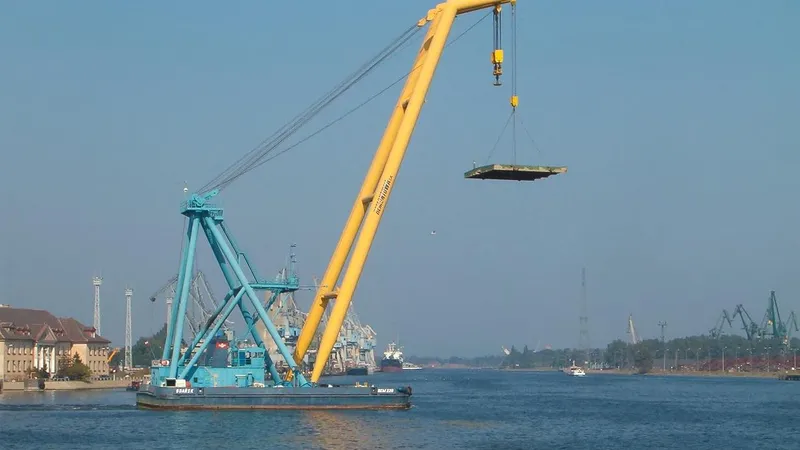
Shipyard cranes are a fixture of the skylines of Gdańsk, Gdynia, Szczecin, Rotterdam and Karlskrona, and the gantries of the former Gdańsk Shipyard - now a UNESCO World Heritage site - have become part of popular culture in their own right. There is, however, another category of crane without which many shipyards simply could not operate. In the latest instalment of his shipbuilding series, Marcin Ryngwelski, president of the management board of PGZ Naval Shipyard, looks at floating cranes.
In brief
Marcin Ryngwelski, chief executive of PGZ Stocznia Wojenna, pointed out that the largest floating crane in Polish shipyards remains Conrad Consul with a lifting capacity of 400 tonnes, while the best known is Maja. A conventional shipyard crane lifts up to 150 tonnes at a reach of 15 metres, but at a reach of 30 metres its capacity drops to 30 tonnes, which according to Marcin Ryngwelski makes floating cranes indispensable for installing main engines and superstructures after launching. A floating crane undergoes class surveys by classification societies like any other vessel. The largest floating cranes at Asian shipyards reach lifting capacities of several thousand tonnes.
A ship that lifts ships
Let us start with something that is easy to overlook: a floating crane is a fully fledged vessel.
- A floating crane is subject to the same classification society rules as any other unit. It has to pass class surveys before it can be cleared for operation - stresses Marcin Ryngwelski.
Some are self-propelled, while others can only move with the assistance of tugs and pushers. Either way, they are all governed by the same laws of physics and the same regulations as ships.
Why a quayside crane will not do
The answer comes down to a single parameter: lifting capacity as a function of outreach.
- A typical shipyard crane may have a capacity of up to 150 tonnes, but only with the jib extended to 15 metres. Beyond that range the capacity drops sharply, and at an outreach of 30 metres it is down to just 30 tonnes - explains the head of PGZ Naval Shipyard.
Large yards, meanwhile, build vessels of considerable beam, which makes installing equipment or structural blocks from the quayside practically impossible. The same problem affects repair yards. If a job requires fitting or replacing components located 30 metres from the quay, turning the vessel around and repositioning it against the berth every time would be prohibitively expensive.
There is one more scenario in which a floating crane becomes irreplaceable. Where the build or repair strategy for large vessels assumes that main engines or superstructures will be installed after launching, their weight exceeds what quayside cranes can handle.
Maja versus the Asian giants
The largest floating cranes operating in Asian shipyards reach capacities of several thousand tonnes. Against that backdrop Poland's fleet looks modest, but it still commands respect.
- The largest floating crane in our yards is Conrad Consul, with a capacity of 400 tonnes, although the best known is Maja - notes Marcin Ryngwelski.
Precision, ballast and the bill to pay
Operating a floating crane also has its downsides. The first is cost. Services of this kind do not come cheap, and in most cases charges begin with the mobilisation of the crane and its crew alone.
The second challenge is stability and operational safety. When a load is being lifted, the utmost care must be taken to prevent an uncontrolled list. That is why vessels of this type are fitted with highly advanced ballast systems.
Despite the costs and the operational demands, the balance sheet is clear.
- A shipyard with its own floating crane holds a technological edge in the market and can take on highly complex projects - concludes Marcin Ryngwelski.
Source: Gazeta Morska · Compiled by: Kamil Kusier
Related articles
 Maritime economy WB Group enters Germany with Berlin subsidiary and acquisition of a Bavarian propulsion maker
 Energy and offshore Słajszewo to get a new beach road around Poland’s first nuclear plant site before summer 2027
 Shipbuilding industry Poland christens ro-pax ferry Bursztyn Unity in Szczecin on Independence Day. Ystad service starts 18 November
 Energy and offshore Orlen Neptun deploys V-LiDAR buoys at Baltic West ahead of Poland's 2027 offshore wind auction
 Energy and offshore Equinor takes over Bałtyk 2 and 3 O&M base in Łeba. Port to serve 1.44 GW of offshore wind for 30 years
 Navy and defence Port Gdański Eksploatacja secures NATO NCAGE code. Gdańsk port company lines up for defence tenders
Comments (0)
The discussion is moderated by the editors: a comment appears after review. Your e-mail address is not published.
Nobody has commented on this article yet.