Two Polish rocket successes in 48 hours in Ustka. Domestic technologies reach new heights
Poland has recorded one of the most important milestones in its modern rocket development. Within just 48 hours, two independent Polish launch systems completed fully successful suborbital missions at the Central Air Force Range in Ustka, underscoring the rapid maturity of domestic rocket technologies.
business aviation pomerania defense industry equipment and technology news24 november 2025 | 14:52 | Source: Gazeta Morska | Prepared by: Kamil Kusier | Print
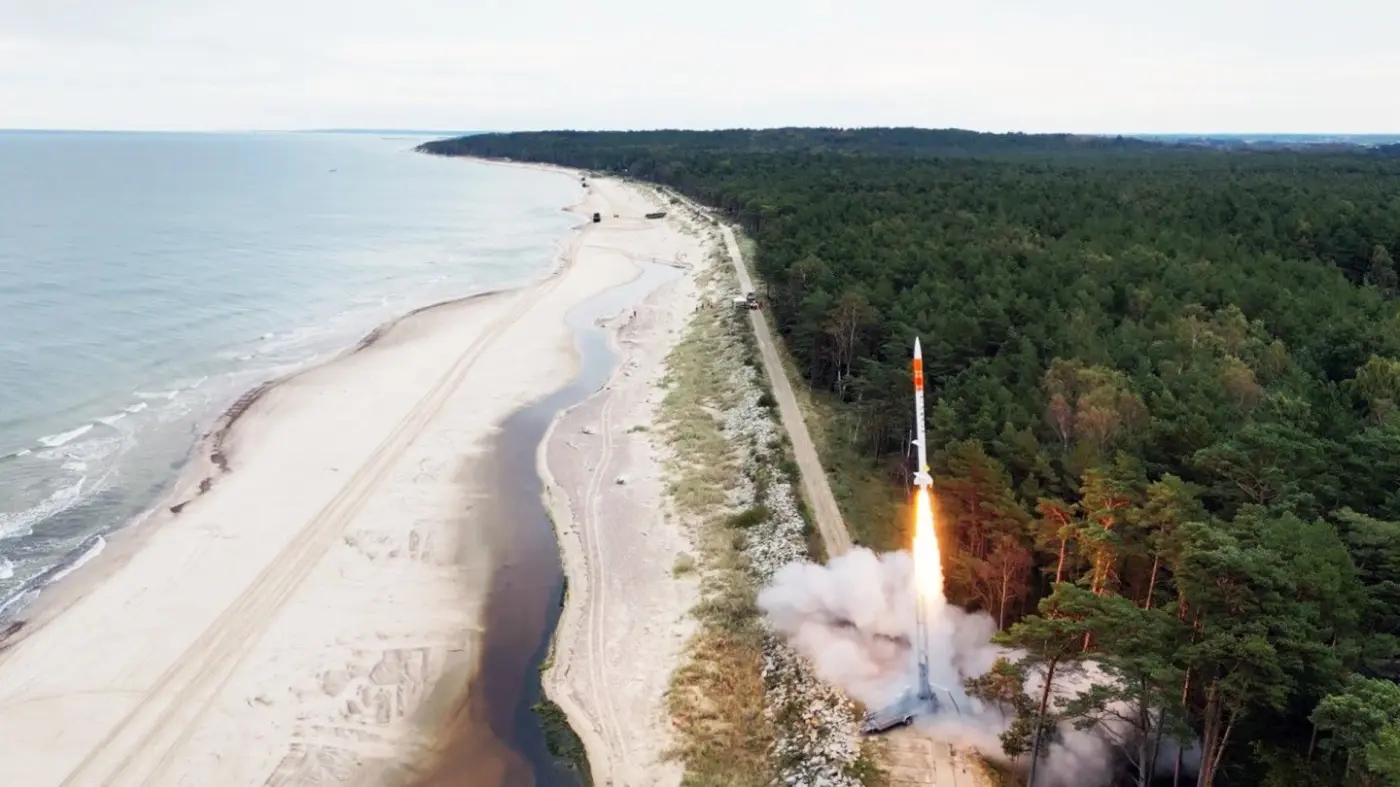
fot. SpaceForest
Tri-stage rocket developed by WITU–WZL1–Gamrat achieves full mission success
On 24 November, a tri-stage suborbital rocket developed by a consortium of the Military Institute of Armament Technology (WITU), Military Aviation Works No. 1 (WZL1) in Łódź, and Gamrat completed a fully nominal flight profile.
The vehicle demonstrated:
- accurate three-stage separation,
- guided flight to a designated point in space,
- adherence to the planned trajectory,
- stable ascent to approximately 65 km.
According to deputy minister of defence Cezary Tomczyk, the mission validated several key technologies developed in Poland, including guidance, navigation and telemetry systems, as well as solid-propellant propulsion. The launch marks a significant step toward establishing a national suborbital launch capability for scientific and defence-related payloads.
Perun suborbital rocket completes another successful flight two days earlier
Just two days earlier, on 22 November, the Gdynia-based company SpaceForest conducted another successful flight of its Perun suborbital launch vehicle. Powered by a hybrid rocket engine, Perun once again confirmed the reliability of its propulsion system, avionics and stabilization.
The mission represents:
- a major step forward for Polish hybrid propulsion,
- continued maturation of Perun as a competitive European suborbital research platform,
- further validation of Poland’s ability to deliver microgravity research services.
Although the two rockets come from separate programmes — Perun being a commercial system, and the WITU–WZL1–Gamrat vehicle serving defence development — both successes highlight the accelerating pace of Poland’s rocket sector.
Why the dual success matters
Two fully successful launches within 48 hours signal:
- a technical breakthrough in Poland’s rocket engineering,
- growing national competence in suborbital flight systems,
- progress in domestic propulsion technologies (solid and hybrid),
- rising European relevance of Poland’s aerospace sector,
- strengthened technological sovereignty in defence and research.
Together, these missions position Poland as an emerging, credible player in the European rocket landscape — and signal that Polish-built launch systems are reaching higher, faster and with steadily increasing reliability.
see also
Buy us a coffee, and we’ll invest in great maritime journalism! Support Gazeta Morska and help us sail forward – click here!
Kamil Kusier
redaktor naczelny
comments
Add the first comment
see also
StartupHack 3.0 at GPNT: Space and maritime technologies at the core of innovation
Polish technology powers zero-emission public transport. AREX secures largest municipal contract
Defence.Hub strengthens capabilities in technologies supporting maritime infrastructure security
Hanseatic Global Terminals takes full ownership of Florida International Terminal
Aleksandra Kosiorek: The sea has always been a space of openness for us, and that will not change
Gdańsk to launch Baltic Sea monitoring center
Türkiye advances indigenous GNSS ambitions: what FGN-100-D3 means for the maritime sector
Lithium at the core. TKMS and E3 Lithium align on Canada’s submarine ambitions
Błażej Konkol appointed vice president for infrastructure at the Port of Gdańsk Authority
WB Group expands into Romania, strengthening presence in the Black Sea region
ADVERTISEMENT
ADVERTISEMENT