









Dar Młodzieży calls at Cádiz ahead of Atlantic crossing to the United States
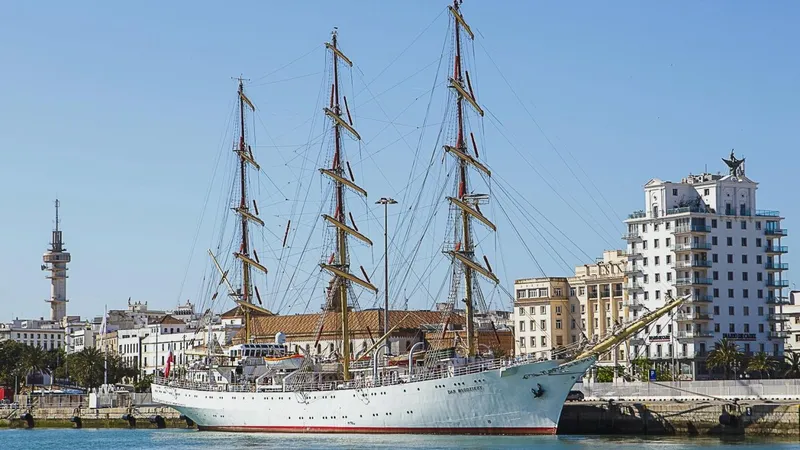
Polish sail training vessel Dar Młodzieży has arrived in Cádiz, entering a strategically important phase of its 2026 transatlantic voyage. The Spanish port serves as the final major operational and training hub before the vessel departs for the Atlantic crossing toward the Bahamas and the eastern seaboard of the United States.
In brief
The training frigate Dar Młodzieży entered Cádiz on 8 May, completing the European leg of a voyage that began in mid-April in Gdynia and covered about 2,500 nautical miles. In Cádiz the first exchange of Gdynia Maritime University trainees is taking place, along with fuel bunkering, replenishment of provisions and rigging inspections. Dar Młodzieży has more than 4 thousand nautical miles ahead to the first American ports, and the Cádiz, Bahamas, United States leg is expected to last 25 to 35 days. The voyage programme includes celebrations of the 250th anniversary of United States independence and calls at Norfolk, New York and Boston.
Cádiz as a strategic Atlantic gateway
The arrival in Cádiz marks the completion of the European leg of the voyage that began in Gdynia in mid-April. After covering approximately 2,500 nautical miles, the Polish full-rigged ship reached one of Europe’s historically most significant Atlantic departure ports.
Located on Spain’s southwestern coast, Cádiz has long functioned as a maritime gateway for vessels preparing to enter Atlantic trade and sailing routes. Its geographical position allows efficient logistical turnaround while offering optimal access to prevailing wind systems leading south toward the Canary Islands and westbound Atlantic passages.
For Dar Młodzieży, this is not merely a routine port call but the operational transition from regional navigation to deep-ocean sailing.
Cadet rotation and training continuity
A key element of the Cádiz stop is the scheduled cadet exchange organized by the Gdynia Maritime University.
Students completing the first training segment are disembarking, while a new group of first-year navigation students joins the vessel for the transatlantic phase. This rotation model maximizes training capacity while maintaining continuity of onboard educational operations.
Such crew changes require a rapid reorganization of the shipboard routine, including watchkeeping assignments, emergency procedures, and familiarization with the vessel’s operational structure.
Technical and supply operations before ocean passage
The Cádiz turnaround also includes critical pre-crossing preparations. Operational tasks underway include:
- fuel bunkering,
- replenishment of provisions and freshwater,
- technical inspections of onboard systems,
- rigging checks and safety equipment verification.
Given the next leg is expected to cover more than 4,000 nautical miles before reaching the first US ports, Cádiz represents the final major provisioning point before extended offshore operations.
The Atlantic leg toward the Bahamas and the US East Coast is estimated to take between 25 and 35 days, depending on meteorological conditions and routing strategy.
Diplomatic and promotional mission
Beyond its training function, the 2026 voyage carries significant representational value.
Dar Młodzieży is scheduled to participate in events linked to the 250th anniversary of US independence, including international tall ships gatherings and ceremonial appearances.
Planned calls include Norfolk, New York, and Boston, with the highlight expected to be participation in the major Independence Day tall ships parade in New York Harbor.
The deployment reinforces Poland’s maritime visibility abroad while continuing the long-standing educational mission of one of Europe’s most recognizable sail training vessels.
The Atlantic as the core training stage
While the Cádiz port call concludes only the opening chapter of the expedition, the departure from Spain will effectively begin the most demanding operational phase.
Extended ocean navigation, round-the-clock watch systems, sail handling in varying weather conditions, and prolonged vessel self-sufficiency form the practical core of cadet training aboard Dar Młodzieży.
In operational terms, Cádiz is therefore more than a stopover—it is the dividing line between the European approach phase and the true transatlantic sailing mission.
Source: Gazeta Morska · Compiled by: Kamil Kusier
Related articles
 Education From Newton's prism to a microplate reader. A Science Evening in Charzykowy on light and matter
 Energy and offshore Offshore wind enters the classroom in Świnoujście. ORLEN Neptun to teach logistics and navigation students
 Education Drones at the Naval Academy, Dar Młodzieży in Gdynia, a sports hall at UG. Coastal universities open the year
 Sailing and water sports Poland argues over where Dar Młodzieży should retire, while its successor still does not exist
 Education Dar Młodzieży is back in Gdynia after five months, two Atlantic crossings and three intakes of cadets
 Navy and defence Polish Naval Academy swears in 114 cadets as an intake of 185 begins officer training
Comments (0)
The discussion is moderated by the editors: a comment appears after review. Your e-mail address is not published.
Nobody has commented on this article yet.