









Contract signed for the construction of a new training sailing vessel for Gdynia Maritime University
The vessel is intended to be beautiful, modern, fast, capable of winning prestigious regattas, and promoting Poland in ports around the world—just like its distinguished predecessors. If everything proceeds according to plan, students of Gdynia Maritime University will begin their sea training aboard the new sailing ship within three years.
In brief
Gdynia Maritime University will receive the first tranche of PLN 131 million in government funding for the construction of a new sail training ship, under an agreement signed on 18 March 2026. The document was signed by Rector Adam Weintrit and Deputy Minister of Infrastructure Arkadiusz Marchewka. The cost of the vessel, similar in size to Dar Młodzieży at over 108 metres in length and 14 metres in beam, is estimated at more than PLN 300 million, with the funds coming from a billion-zloty programme for maritime universities. Rector Adam Weintrit announced that construction will take place within the next three years.
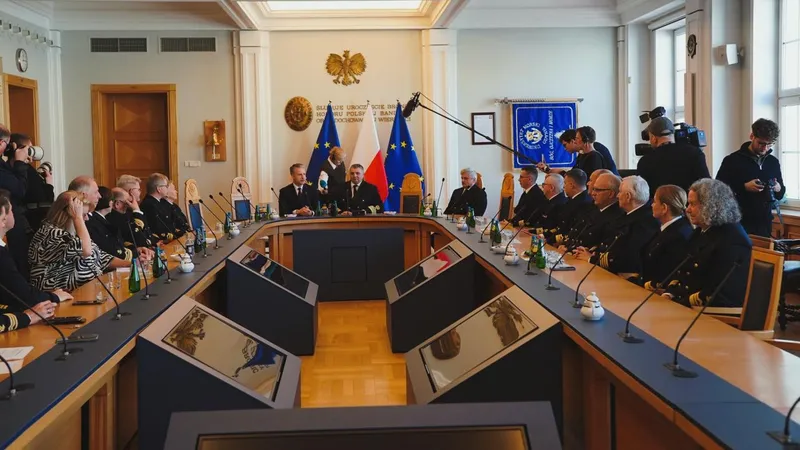
On Wednesday, March 18, 2026, at the university’s headquarters in Gdynia, an agreement was signed transferring the first tranche of government funding—PLN 131 million—for the construction of the vessel.
The document was signed by Prof. Adam Weintrit, Rector of Gdynia Maritime University, and Arkadiusz Marchewka, Deputy Minister of Infrastructure.
The Rector announced that a team of specialists, led by Captain Dariusz Jellonek, Director of the Shipowning and Maritime Training Department, has already been established and is currently preparing extensive technical documentation for the project.
- What has been announced for many years is finally becoming a reality, said Deputy Minister Marchewka.
According to the Deputy Minister, the university not only has secured funding but is also well prepared to carry out the investment. The next step will be to launch a tender procedure to select a shipyard responsible for construction.
- The vessel will be a source of national pride on seas and oceans worldwide, he added.
The new sailing ship is expected to have dimensions similar to the currently operated Dar Młodzieży, measuring over 108 meters in length and 14 meters in beam. The estimated cost of the project exceeds PLN 300 million.
The first tranche of funding must be utilized within the current year. Subsequent financing will come from a broader investment program of the Ministry of Infrastructure dedicated to Polish maritime universities, with a total budget of PLN 1 billion.
This program will also finance a new research vessel for the Maritime University of Szczecin, estimated at PLN 650 million. However, the Gdynia training sailing vessel is expected to be completed first.
- We believe construction will take approximately three years, said the Rector.
According to Prof. Weintrit, the vessel could embark on its inaugural voyage in the early 2030s.
The university has partnered with Dykstra Naval Architects (Netherlands), a renowned design office specializing in high-performance three- and four-masted sailing vessels that compete successfully in major ocean regattas.
- We will not bring any embarrassment—we aim to compete in and win events such as The Tall Ships Races, emphasized the Rector.
The tradition of the “White Frigate,” represented by Dar Pomorza and currently Dar Młodzieży, will be maintained, including the characteristic white hull design.
Prof. Weintrit also stressed that, following the eventual decommissioning of Dar Młodzieży, the new sailing vessel should remain the university’s flagship training ship.
While it is theoretically possible for students to complete practical training exclusively on commercial vessels, the Rector noted that such training would be less effective.
- There are around 90 maritime universities worldwide, and the best of them operate sailing vessels. For nearly a century, they have been used to train students. It is the best possible school—teaching respect for the sea and teamwork, which cannot be achieved on standard merchant ships, he explained.
The university will therefore maintain its training model, including four months of onboard practice on training vessels, including the sailing ship, as part of the curriculum for third officer certification. Students will also train on the university’s research vessels Horyzont II and Imor.
The remaining eight months of sea practice will continue to be completed on commercial vessels operated by leading global shipping companies.
The future of Dar Młodzieży remains undecided. However, it is widely agreed that the historic vessel—famous for circumnavigating the globe in 1987–1988—will not be scrapped.
A potential comprehensive refit has been considered, but currently cannot be undertaken due to the lack of a replacement vessel.
Final decisions will be made after the new ship is completed. One thing is certain: the investment must be delivered efficiently and without delay, as Dar Młodzieży, built in 1981 at the Gdańsk Shipyard, is nearing the end of its operational life. The vessel is outdated, requires frequent repairs, and its maintenance costs continue to rise.
- If Dar Młodzieży were to undergo classification today, it would not meet current regulatory requirements, concluded the Rector.
Source: Gazeta Morska · Compiled by: Szymon Szadurski
Related articles
 Education From Newton's prism to a microplate reader. A Science Evening in Charzykowy on light and matter
 Energy and offshore Offshore wind enters the classroom in Świnoujście. ORLEN Neptun to teach logistics and navigation students
 Education Drones at the Naval Academy, Dar Młodzieży in Gdynia, a sports hall at UG. Coastal universities open the year
 Sailing and water sports Poland argues over where Dar Młodzieży should retire, while its successor still does not exist
 Education Dar Młodzieży is back in Gdynia after five months, two Atlantic crossings and three intakes of cadets
 Navy and defence Polish Naval Academy swears in 114 cadets as an intake of 185 begins officer training
Comments (0)
The discussion is moderated by the editors: a comment appears after review. Your e-mail address is not published.
Nobody has commented on this article yet.