Nuclear bastions return to strategic focus. Arctic and Pacific emerge as new arenas of great power competition
In naval strategic thought, a bastion refers to a fortified maritime zone — a heavily defended sea area where one’s own naval forces can operate with relative safety. Such an area is typically enclosed by friendly or allied coastlines, incorporates defensive infrastructure, and is subject to intensive patrols by national forces. The concept of a maritime bastion gained prominence during the Cold War as a means to ensure the secure deployment of nuclear-powered ballistic missile submarines (SSBNs). These units played a crucial role as a tool of nuclear deterrence, particularly within the framework of the so-called second-strike capability, intended to be executed in the event of an attempt to eliminate other strategic nuclear delivery systems, such as strategic aviation or land-based ballistic missiles.
security navy worldwide commentary news14 october 2025 | 07:37 | Source: Gazeta Morska | Prepared by: dr Łukasz Wyszyński, dr Paweł Kusiak | Print
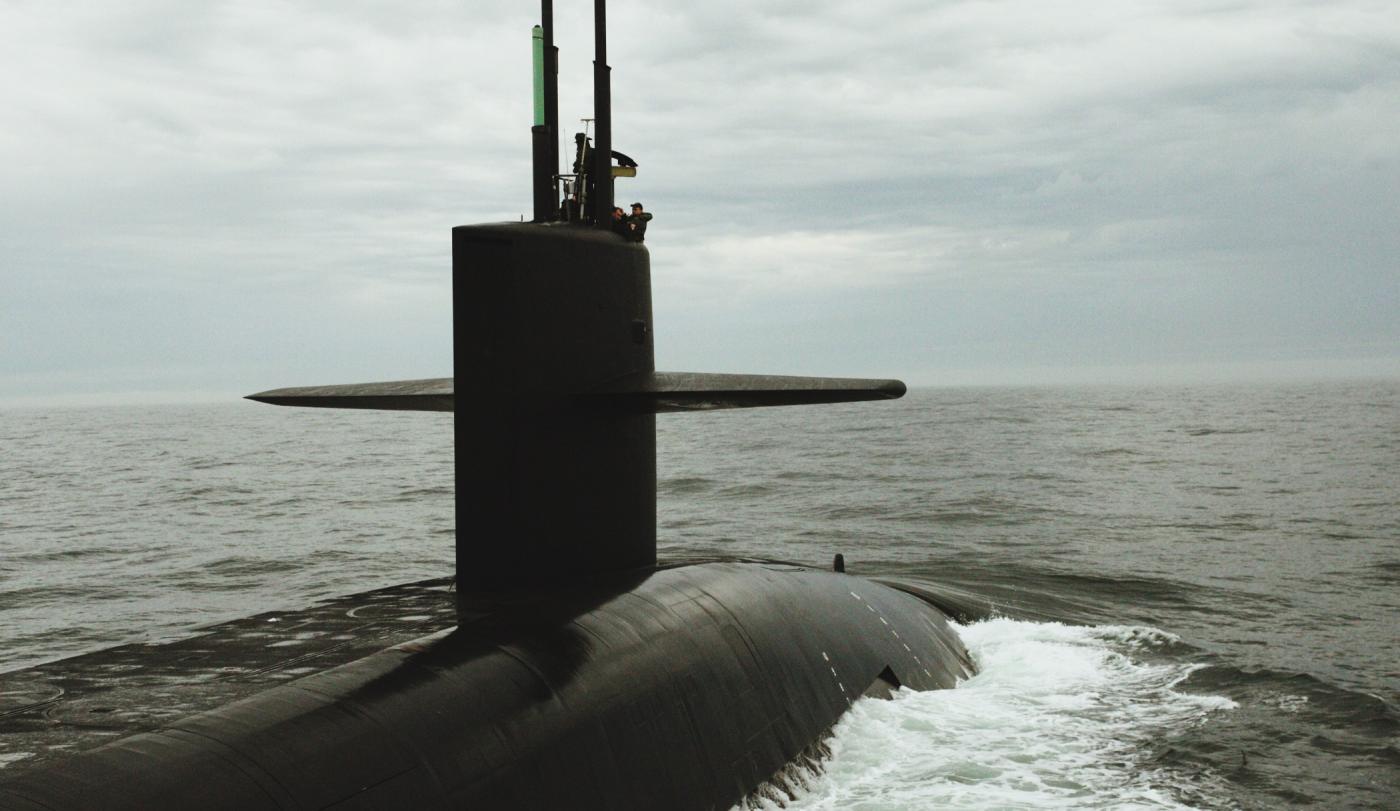
Okręt podwodny USS Alaska SSBN 732 typu Ohio | fot. U.S. Navy
Soviet maritime bastions
By the late 1960s, thanks to longer-range ballistic missiles, the Soviet Union gained the ability to strike the territory of the United States from submarines operating near its own shores. This meant that Soviet “boomers”, the carriers of strategic nuclear ballistic missiles, no longer had to break through to the open Atlantic to threaten targets in North America. Instead, they could remain close to their bases, under the protection of an extensive defensive umbrella composed of the Soviet Navy and Naval Aviation.
The USSR Navy therefore adopted the bastion strategy (known in the USSR and later in Russia more commonly as the “fortified maritime area” concept), establishing designated sea zones shielded by integrated anti-submarine warfare (ASW), surface and air defenses — forming a protective “cocoon” for deployed SSBNs. According to NATO estimates, at its peak, the Soviet Union allocated up to 75% of its nuclear-powered submarines (mainly SSN hunter-killer submarines), the majority of surface vessels of the Northern Fleet and Pacific Fleet, as well as hundreds of aircraft to secure these areas.
The Soviets defined several bastions, primarily in waters adjacent to their territory: the Barents Sea (bastion of the Northern Fleet, covering the area from the Kola Peninsula to the ice-covered waters of the Arctic); the Sea of Okhotsk (bastion of the Pacific Fleet, shielded from the open Pacific Ocean by the Kuril Islands); the White Sea (including Kandalaksha Bay) and the Kara Sea, which were periodically used as protected patrol zones; as well as the Laptev Sea, the Sea of Japan, and Arctic regions covered by sea ice, offering concealment under the ice sheets.
While in the 1960s Western analysts expected that the Soviet Navy would push into the Atlantic to disrupt NATO sea lines of communication and challenge carrier strike groups, reality evolved differently. By the 1970s, U.S. intelligence began to observe that, in the event of conflict, the USSR would likely prioritize the defense of its strategic submarine forces operating within bastions over a direct contest for control of the open ocean.
One of the drivers behind this strategy were assessments of Soviet submarines’ limited ability to operate undetected outside controlled zones — a critical factor for the credibility of nuclear deterrence. Intelligence obtained from the notorious John Walker spy ring (active from 1967 to 1985) confirmed Soviet fears about their submarines’ vulnerability to NATO tracking. Consequently, their strategy focused on ensuring the survivability of nuclear forces, rather than on direct fleet engagements on the high seas. However, this did not preclude offensive actions by the Soviet Navy aimed at locating and destroying U.S., British, or French SSBNs, and complicating NATO control of strategic maritime theaters in a potential European conflict.
The bastions became a strategic priority and influenced Soviet naval procurement, including ships equipped with air defense (AD) capabilities and anti-submarine warfare (ASW) assets tailored to operate within protected bastion zones.
By the end of the Cold War, the USSR had developed two main strategic bastions: the Arctic bastion of the Northern Fleet in the Barents Sea and the Pacific bastion in the Sea of Okhotsk. To this day, the Barents Sea and the Sea of Okhotsk remain key patrol zones for Russia’s strategic submarine forces.
Contemporary Russian bastions
Despite the collapse of the USSR, the Russian Federation did not abandon the bastion strategy — on the contrary, it largely preserved and expanded it. Today, the Russian Northern Fleet (which operates the majority of SSBNs) remains based on the Kola Peninsula and treats the adjacent waters of the Barents Sea and the Arctic as a strategic bastion, one of the pillars of Russian nuclear deterrence. This is confirmed, among others, by the 2024 report of Norwegian intelligence, which clearly states that the defense of the Northern Bastion and maintaining access to the North Atlantic remain key to Russia’s security concept. A similar view is present among analysts at Chatham House, where the belief is strongly represented that the “northern cocoon” is intended to ensure the survivability of SSBNs in the event of conflict, guaranteeing that Russia retains its second-strike capability even if the adversary gains superiority in other theaters.
The modern Russian bastion is a multi-layered defensive system, sometimes referred to as the “Arctic dome.” Moscow has deployed integrated ISR systems and air and naval defense networks around the Kola Peninsula, creating a multi-layered interdiction perimeter at sea and in the air. The goal is not full area denial, as Russia understands it cannot hermetically seal the Arctic, but to impose high operational costs on any potential adversary approaching the bastion. This defensive zone stretches from the Kola Peninsula, across the Barents Sea, up to the Norwegian Sea. It enables freedom of maneuver for the Northern Fleet while shielding key infrastructure such as the entrance to the Northern Sea Route and energy installations on the Yamal Peninsula.
The importance of the bastion strategy for modern Russia is illustrated by the fact that it is currently developing a second, external defensive layer around the Arctic, extending beyond the core bastion. As noted again by Chatham House, Moscow aims to expand its A2/AD capabilities beyond the Arctic Zone of the Russian Federation, creating an additional security ring on the fringes of the Arctic and the North Atlantic. This “outer bastion” is meant to secure the operations of strategic submarines even beyond territorial waters and provide the fleet with the freedom to operate far from home ports. In practical terms, this means projecting an anti-access bubble over critical northern choke points — the GIUK (Greenland–Iceland–UK) and GIN (Greenland–Iceland–Norway) gaps — forcing NATO navies to account for the risk of pre-emptive attack as soon as they approach the Arctic. Russia seeks to push any potential conflict as far away from the Kola Peninsula as possible, ensuring that NATO incursions into the Arctic are met with immediate response, escalating potential clashes closer to the Atlantic rather than the heart of the bastion.
From Russia’s perspective, all these measures are defensive in nature, driven by a growing sense of vulnerability of the northern flank to NATO reconnaissance and strike systems. Climate change and the melting of Arctic sea ice mean that the ice no longer provides a natural protective barrier, making the Arctic more accessible to foreign fleets and aircraft. Furthermore, the accession of Finland and Sweden to NATO in 2023 and 2024 significantly extended the NATO-Russia border in the High North and complicated Moscow’s strategic situation. Russian ground forces in the Arctic have been largely depleted, with units from the Kola Peninsula redeployed to the war in Ukraine, weakening local defensive capacity. Under these conditions, the role of the Northern Fleet and the maritime component has grown — it has become the main guarantor of deterrence while the ground forces temporarily lost strength. This explains why the Russian defense doctrine still views the Arctic as its bastion, a zone whose loss would expose the country’s strategic “soft underbelly.”
see also
Bastions in the new Cold War
The militarization of the Arctic by Russia, the revival of the bastion concept, and broader tensions in the international security system have not gone unnoticed by the West. In 2019, NATO reactivated the Joint Force Command Norfolk (JFC Norfolk), and the U.S. Navy re-established the 2nd Fleet to strengthen its presence in the North Atlantic and secure sea lines of communication against potential Russian threats. In the following years, the Alliance significantly increased the tempo of exercises on the northern flank. One example is Cold Response 2022 in Norway, involving 30,000 troops from multiple nations — twice as many as in earlier editions. New NATO members in the north (Finland and Sweden) are now integrating into collective defense planning, closing the gap in the Baltic Sea and Arctic, turning the Nordic-Baltic region into a more coherent zone of deterrence and defense.
In response to the Russian bastion, NATO has refreshed and expanded its concepts for ASW operations and A2/AD penetration in the High North. Initiatives have emerged to develop automated undersea surveillance systems, maritime drones, and ground-based sensor networks for continuous Arctic monitoring. Particular emphasis is placed on securing the GIUK gap, the key maritime chokepoint through which Russian submarines must pass to enter the Atlantic. The Royal Navy has launched the Atlantic Bastion program to boost ASW capabilities in the North Atlantic, while Norway is investing in new submarines and space-based intelligence systems to better track Russian activity in the Arctic.
A shift in the nature of Russian naval exercises also indicates the growing importance of bastion-based strategy. An analysis published in the Scandinavian Journal of Military Studies in 2024 found that, after the invasion of Ukraine, most Russian naval drills moved from the Norwegian Sea to the Barents Sea. Their objective shifted toward rehearsing the rapid deployment and dispersal of SSBNs and strengthening the Northern Fleet bastion. In other words, under conditions of constrained resources due to the war, Moscow is prioritizing Arctic security over demonstrative operations deeper into the Atlantic. Such long-range deployments are now maintained mainly in connection with the previously mentioned outer bastion zone and strategic energy shipping lanes operated by the so-called shadow fleet.
At the same time, NATO, though cautious, is becoming more assertive in the region. A notable example is the presence of U.S. and British warships in the Barents Sea in summer 2022, their first appearance there since the Cold War, as part of a freedom of navigation operation. In practice, it was a strategic signal that the Russian bastion is not considered untouchable.
All these dynamics form a clear picture of one of the fronts of the “new Cold War” — in this case, the Arctic theater. The struggle centers on freedom of maneuver and strategic control in the High North. The Russian bastion is the central element of this contest, and its significance is evidenced by the scale of resources committed by Russia, mirrored by NATO countermeasures. The Arctic, once considered peripheral and treated as a zone of cooperation (“Arctic exceptionalism”), is transforming into an arena of intensifying militarization and geopolitical competition.
Bastions, cimate change and technological innovation
Modern bastions operate under changing conditions that raise questions about their long-term viability and effectiveness. Climate change is rapidly transforming the Arctic — sea ice is receding, and the region is warming four times faster than the global average. This means that previously inaccessible Arctic sea routes are becoming navigable, opening the region to military and civilian presence for a larger part of the year. In response, Russia is expanding its military infrastructure in the High North. It has reactivated dozens of Soviet-era bases (over 50 facilities since 2008) and deployed new air defense systems (e.g., S-400 batteries on Novaya Zemlya and Franz Josef Land) to reinforce the protective umbrella over its bastion.
At the same time, technological progress has an ambiguous effect on the bastion concept. On one hand, modern A2/AD systems, including integrated sensor networks, satellites, air power, unmanned platforms, and long-range precision missiles, can make a bastion even harder to penetrate. As noted by James Lacey in War On The Rocks, today’s Russian and Chinese bastions are “more heavily fortified and more dangerous than ever before, bristling with precision weapons, radars, and emerging technologies such as laser and electromagnetic weapons.” In this view, a well-protected bastion can potentially survive a saturation strike while also projecting offensive power far beyond its core defensive perimeter.
On the other hand, advances in submarine detection and precision strike capabilities could undermine the classical bastion model. New generations of satellites, long-range sonar arrays, and unmanned systems capable of under-ice penetration may reduce the stealth advantage of even theoretically “secure” SSBN patrol areas. Moreover, the Russian Navy today is a fraction of its Cold War strength, fielding less than 20% of the submarine fleet it had 30 years ago, with its surface combatants and ASW aviation also significantly reduced. Some analysts argue that modern Russia may not be able to effectively defend a bastion in the event of a full-scale conflict. Jonas Kjellén, in his 2025 study Russian Northern Fleet Bastion Revisited, argues that geostrategic and technological changes have eroded the rationale behind the bastion strategy. Russia possesses a large arsenal of land-based ICBMs, and maintaining expensive SSBNs and defending them in bastions may be less cost-effective than in the past. Put bluntly, given geographic constraints (narrow access routes to the ocean) and U.S. superiority in submarine tracking technologies, the bastion strategy may no longer guarantee the sanctuary status for Russian boomers that it did in the 1980s.
However, it is important to note that despite these doubts, Russia continues to heavily invest in its naval deterrent, developing modern Borei-class submarines and Bulava ballistic missiles. From Moscow’s perspective, abandoning bastions in favor of an exclusively land-based ICBM deterrent (including silo-based, road-mobile, and rail-mobile systems) is unacceptable. This is not only about military utility but also the prestige of being an Arctic and oceanic great power. In practice, bastions remain a central element of Russian nuclear strategy, even if their defense now requires adaptation to new geopolitical and technological realities.
see also
China and bastions beyond the Arctic
Although the bastion concept emerged during the Cold War rivalry between the United States and the Soviet Union, in the 21st century it has taken on a global dimension. China, despite lacking an Arctic coastline, is increasingly asserting its presence in the Arctic while simultaneously adopting bastion-like strategies in other regions.
In 2018, Beijing released its White Paper on Arctic Policy, declaring itself a “near-Arctic state” and promoting the concept of the “Polar Silk Road.” In cooperation with Russia, China has already invested over $15 billion in Arctic infrastructure — including ports, LNG projects on the Yamal Peninsula, and research facilities along the Northern Sea Route. Officially, these investments are scientific and commercial, but multiple analyses suggest that many Chinese installations in the Arctic have dual-use potential, with possible military applications. For example, China has established long-range satellite ground stations in the Arctic and operates a fleet of icebreakers (with nuclear-powered icebreakers under development), which could in the future facilitate military operations in the region. Beijing’s ambitions are clear — Chinese strategists speak of an aspiration to become a “polar great power”, shaping the rules of navigation and security governance in the Arctic — a prospect viewed with growing concern in Washington and NATO.
In parallel, China is implementing the bastion concept in the Indo-Pacific. The South China Sea is widely regarded as serving a bastion role for the People’s Liberation Army Navy (PLAN) — a protected operating area for its Jin-class SSBNs armed with nuclear ballistic missiles. The area offers favorable hydrological and geographic conditions, being surrounded by China’s coast and militarized islands — notably the artificially expanded Spratly Islands. It has been heavily fortified with A2/AD systems, including anti-ship missiles, long-range air defenses, naval aviation, and surface fleets, designed to create a secure operating zone for Chinese strategic submarines. These Chinese bastions, stretching from the mainland coast to disputed island chains, are intended not only to protect China’s nuclear deterrent but also to enable power projection in the event of conflict.
The strategic relevance of bastions in the contemporary era
A historical and contemporary assessment leads to a clear conclusion: bastions for nuclear-powered ballistic missile submarines (SSBNs) remain strategically significant in the 21st century, even if their nature is evolving. For Russia, the Arctic bastion continues to serve as a core pillar of strategic stability and nuclear deterrence. As long as the bulk of its SSBN fleet remains stationed on the Kola Peninsula, Moscow will treat the surrounding waters as a zone of vital national interest, to be defended at any cost. Continuous investment in Arctic military infrastructure, expansion of strategic submarine forces, and the construction of layered A2/AD defenses illustrate that Russia views its bastion as a guarantee of nuclear survivability in the face of NATO’s conventional superiority.
At the same time, NATO also recognizes the strategic implications of the Russian bastion. Hence its adaptation efforts — reactivating commands, scaling up anti-submarine warfare (ASW) exercises, and deploying new sensing and monitoring technologies — are aimed at ensuring the Alliance can operate and project deterrence even near protected Russian zones.
However, under the conditions of modern conflict, the role of bastions is no longer absolute. Rapid shifts — from climate change to technological innovation — may redefine their utility. The rise of autonomous underwater systems, persistent satellite surveillance, and advanced long-range strike capabilities could increasingly challenge the notion that SSBNs can remain undetected within a bastion. Submarines tasked with strategic deterrence patrols may need to become even quieter and more sophisticated to maintain their stealth advantage.
Yet as long as the major nuclear powers base their deterrence posture on hard-to-detect ballistic missile submarines, the logic of securing protected patrol areas will remain valid.
In summary, bastions continue to function as a key asset in great power competition. They form one of the pillars of Russia’s nuclear security architecture, a component of China’s strategic planning, and a challenge for NATO and the United States, which themselves maintain designated SSBN operating zones. With geopolitical rivalry intensifying in the Arctic and beyond, the bastion concept is experiencing a strategic revival — not as a relic of the Cold War, but as a practical tool shaping today’s balance of power.
Buy us a coffee, and we’ll invest in great maritime journalism! Support Gazeta Morska and help us sail forward – click here!
Redakcja Gazeta Morska
użytkownik
comments
Add the first comment
see also
Strait of Hormuz at a strategic crossroads: sinking of IRIS Dena and implications for maritime transport
The submarine contract of the decade? Canada weighs South Korea against Germany
When two powers clash, Poland must be ready to act. Military security must be the priority
Commodore Przemysław Karaś appointed deputy commander of the Maritime Operations Centre - Naval Component Command
Radmor hosts delegation from the Republic of Turkey. Advancing maritime security cooperation
French Navy expands global operations from the Pacific to the Red Sea
"Let everyone know we will prevail". Poland’s armed forces set strategic course for 2026-2039
“Army 500” and strategic transformation: Poland sets the course for long-term deterrence and allied readiness
Medical evacuation from offshore vessel in the Baltic. Rescue 511 helicopter and m/s Huragan deployed
Karol Nawrocki: “The strength of the republic lies in its armed forces”. Security requires national unity
ADVERTISEMENT
ADVERTISEMENT