









Atlantic Alliance 2025: Dutch and U.S. forces deepen amphibious interoperability aboard HNLMS Johan de Witt
The east coast of the United States is currently the scene of Atlantic Alliance 2025, a high-readiness joint exercise uniting Dutch and American naval and air units. At the center of this operation is the amphibious transport ship HNLMS Johan de Witt, serving as a key platform for integrated sea-to-shore operations and as the base of operations for 860 Squadron with its NH90 NFH maritime helicopters.
In brief
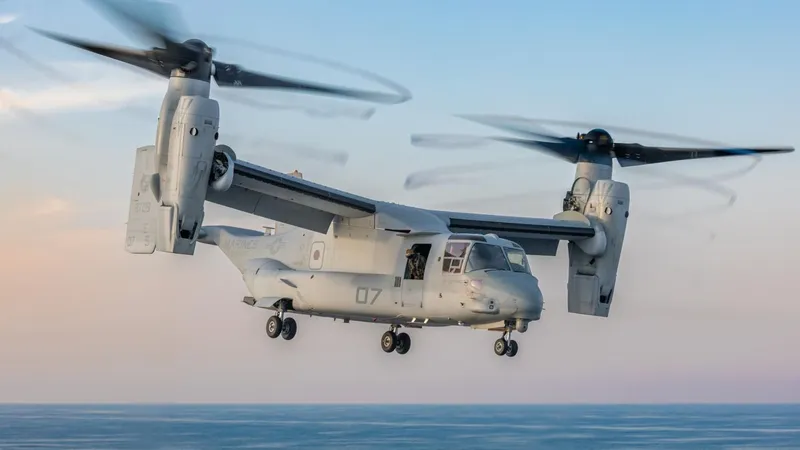
Exercise Atlantic Alliance 2025 off the coast of the United States brings together the naval and air forces of the Netherlands and the United States, with the amphibious ship HNLMS Johan de Witt as the main platform. An American MV-22B Osprey tiltrotor landed on the deck of HNLMS Johan de Witt for the first time in a decade, followed moments later by a CH-53E Super Stallion heavy helicopter. The scenarios include force transfer, protection of coastal infrastructure and simulations of high-intensity conflict. Exercise Atlantic Alliance 2025 will run until 11 July.
Bell-Boeing V-22 Osprey | fot. Koninklijke Marine
Atlantic Alliance 2025 focuses on strengthening NATO’s expeditionary capabilities through intensive training in amphibious warfare. Dutch Korps Mariniers and U.S. Marine Corps forces are working side by side in complex scenarios including rapid troop deployment, coastal infrastructure security, and high-intensity conflict simulation.
A milestone moment of the exercise occurred when a U.S. MV-22B Osprey tiltrotor aircraft landed aboard HNLMS Johan de Witt—the first such landing in over a decade. Shortly thereafter, a CH-53E Super Stallion, the largest helicopter in the U.S. military, followed. These heavy-lift platforms, significantly larger than the NH90s routinely operated from Dutch vessels, presented real-world logistical and deck handling challenges, all of which were successfully met by the Dutch crew.
Such combined operations are a powerful demonstration of NATO interoperability in action, allowing crews to test shared protocols, coordinate multinational command structures, and enhance readiness for real-world maritime deployments. The successful integration of U.S. rotorcraft aboard a European naval platform reflects the alliance’s commitment to adaptability and cooperation in all domains—on, above, and from the sea.
Atlantic Alliance 2025 continues through 11 July, reinforcing transatlantic ties and preparing allied forces for joint amphibious missions in high-threat environments across the globe.
Source: Gazeta Morska · Compiled by: Kamil Kusier
Related articles
 Navy and defence Saab presents first GlobalEye for the Swedish Air Force, three aircraft on order
 History Two Lancaster wrecks, one operation. The bombers fell over the Baltic laying mines still disarmed today
 Safety and rescue Three hundred metres and 42 seconds. A Russian Mi-8 crossed into Polish airspace near Braniewo
 Navy and defence Polish fighters intercept Russian Il-20 over the Baltic, the tenth such intercept this year
 Safety and rescue Nearly 22-hour search on Puck Bay. One of two missing jet ski users found
 Navy and defence Kaliningrad in Moscow’s shadow. Russia’s fortress, NATO and the future of Baltic security
Comments (0)
The discussion is moderated by the editors: a comment appears after review. Your e-mail address is not published.
Nobody has commented on this article yet.