









A double rainbow over Ustka: the Baltic stages its theatre of light
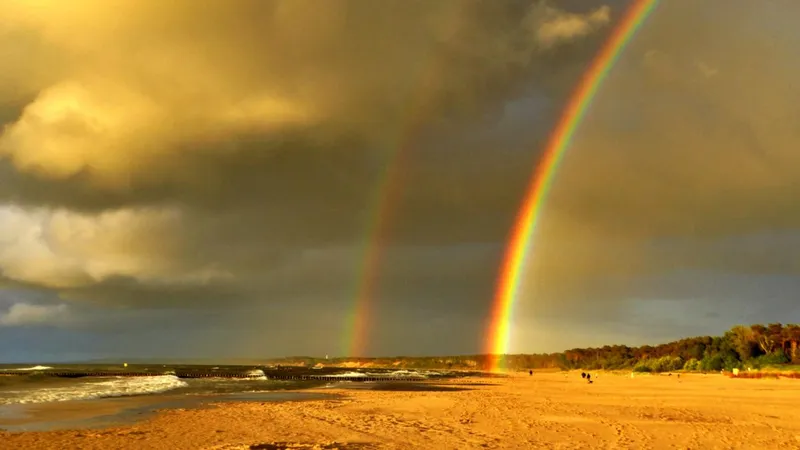
On the evening of Saturday, 13 June, the coast near Ustka, on Poland's Baltic shore, became the setting for one of the most picturesque spectacles a summer sky can conjure over the Baltic – a full arc of rainbow, doubled in places, lit by the warm glow of the setting sun.
In brief
A full rainbow arc, doubled in places and lit by the setting sun, appeared over the coast near Ustka on 13 June. Mariusz Jasłowski, meteorologist of Gazeta Morska, explained that with the sun low behind the observer and a wall of precipitation in front, the arc spans almost a full semicircle. The second, paler arc is a secondary rainbow, formed by a double reflection of light inside the droplets and having a reversed order of colours. The darker band of sky between the arcs is Alexander's band.
Walkers who happened to be on the beach at that hour caught the phenomenon in its fullest, textbook form. Above the treeline and the dunes rose a broad arc whose colours – from red to violet – stood out against the navy wall of a departing storm cloud. The low evening sun bathed the sand, the groynes and the surface of the sea in a honeyed, almost orange light, lending the whole scene an exceptionally saturated palette.
How a rainbow forms over the sea
A rainbow appears when sunlight enters water droplets suspended in the air – usually just after a shower has passed – and is refracted and internally reflected within them. Each droplet splits white light into its component colours, and an observer always sees the arc on the side of the sky opposite the sun, around the so-called antisolar point.
- This is a textbook example of an evening rainbow. The sun was already low on the horizon, right behind the observers, while a curtain of rain was passing in front of them. In that configuration the arc rises exceptionally high, almost a full semicircle, explains Mariusz Jasłowski, meteorologist at Daily Mare. - The warm, golden tone of the whole scene comes from the fact that evening light has to push through a thicker layer of atmosphere, which dims the cooler colours and lets the warm ones through.
The lower the sun sits above the horizon, the higher and wider the arc spreads – with the sun just above the horizon a rainbow can take on the shape of an almost complete semicircle, exactly as in the photographs from the Ustka beach.
Why there are two arcs
On several of the frames a second, fainter arc is clearly visible above the main one.
- That second arc is a secondary rainbow. It forms when light reflects twice inside a droplet, which is why it is paler and its colours are reversed compared with the main bow, says Jasłowski. - It is also worth noticing that the sky between the two arcs is distinctly darker. That is what is known as Alexander's band – a region that, for purely physical reasons, the dispersed light does not reach.
More than just a view
For anyone who spends time at sea, a rainbow is not only a treat for the eye but also a clear weather signal. It appears wherever rain is falling, or has just fallen, and the sun has already broken through the clouds.
- For sailors and beachgoers a rainbow is a simple sign: somewhere nearby it is raining, and a front is moving on, adds the Daily Mare meteorologist. - A Baltic summer, with its fast-changing weather and frequent afternoon showers, is especially generous with sights like this.
It is also a reminder of how photogenic the Polish coast can be outside the full glare of a sunny day – in those brief moments when the storm gives way and the light turns to gold.
Source: Gazeta Morska · Compiled by: Kamil Kusier
Related articles
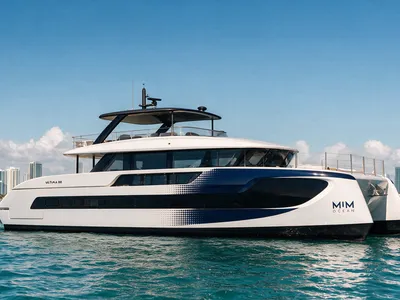 Shipbuilding industry Lionel Messi orders a Sunreef catamaran. The Ultima 88 is being built at the Gdańsk firm’s UAE yard
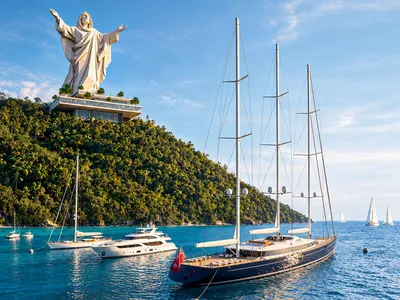 Investments A Szczecin firm is to design the world's tallest Christ statue. A 207-metre core in 40 days
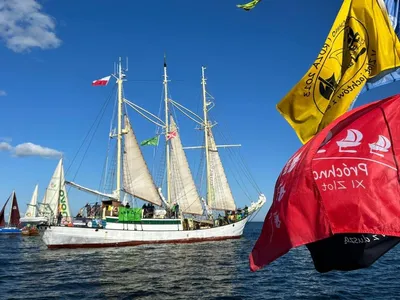 Sailing and water sports A century-old Inga Lisa and Czarny Diament after 32 years at sea. Over 30 classic yachts in Gdynia
 Sailing and water sports Eleven years of trying and metres at the finish. Witold Karałow's Scamp 4 wins the 75th Blue Ribbon
 Sailing and water sports Stanisław Trepczyński's bronze in Puck after five hours of fighting for wind
 Environment The world's largest seahorses move into the Gdynia Aquarium. In this species it is the male that gets pregnant
Comments (0)
The discussion is moderated by the editors: a comment appears after review. Your e-mail address is not published.
Nobody has commented on this article yet.