Teamwork at Sea: Mine Countermeasures Exercise Wraps Up in the Baltic Sea
BALTIC SEA - Twelve ships from seven NATO nations successfully concluded the German-led Baltic MCM naval exercise in the Baltic Sea recently, a high-intensity two-week exercise that united ships and crews to hone skills in mine warfare and beyond.
worldwide nato news11 april 2025 | 20:10 | Source: Gazeta Morska | Prepared by: Daniel Nawrocki | Print
fot. NATO
Standing NATO Mine Countermeasures Group One (SNMCMG1) participated with six ships, working alongside a second task unit under the German-led Commander Baltic Naval Squadron (COMBALTRON). SNMCMG1 participated in the MCM naval exercise while simultaneously executing its mission in support of Baltic Sentry, NATO’s effort to safeguard critical undersea infrastructure in the region.
- Exercises like Baltic MCM strengthen the operational muscle memory that lets us act fast, together, when it matters most. This wasn’t only about mine countermeasures—it was about building a reliable, responsive team at sea,” said Commander Erik Kockx, Commander Task Group of SNMCMG1. “Exercises like Baltic MCM strengthen the operational muscle memory that lets us act fast, together, when it matters most.”
Practicing the Fundamentals
While mine countermeasures is the specialty of the participating vessels, Baltic MCM focused heavily on seamanship, coordination, and naval core skills. The first part of the exercise included formation navigation drills. Besides the tactical utility of the formations, they challenge the communication procedures and establish common understanding between ships with different national practices. Using NATO protocols, the crews synchronized their operations.
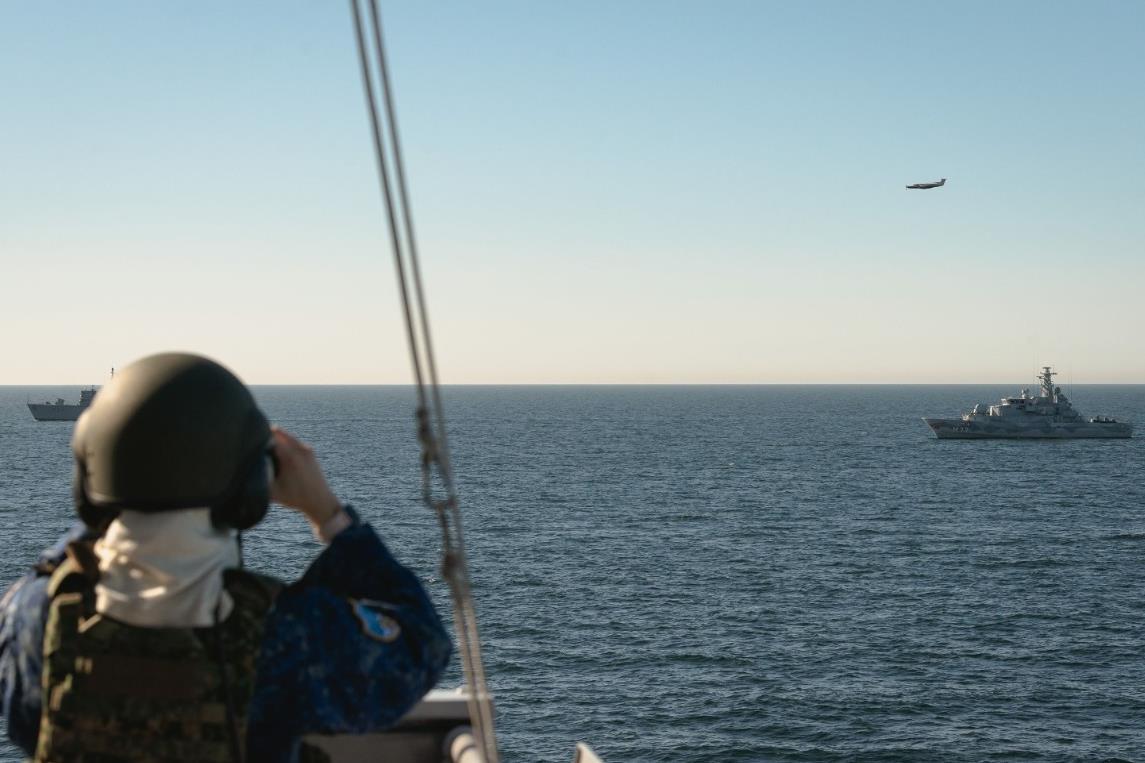
Live gunnery exercises followed, beginning with fixed targets and advancing to air defence scenarios. In one phase, an aircraft towed a training target pod as a simulated air threat, challenging ships to engage a moving aerial target while underway—requiring sharp accuracy and precise coordination.
“Firing from a moving ship at a moving target is not an easy task, but our crews proved they’re more than capable,” Kockx added.
Seamanship, Replenishment and Team Spirit
Alongside tactical drills, ships practiced traditional seamanship skills, including flag-based manoeuvring, during which crews use visual signals, flags, to communicate course and speed changes. This not only tested navigation precision but also reinforced visual methods of coordination in radio-silent environments.
The group also rehearsed replenishment at sea, an essential capability for sustained operations. Vessels practiced fuelling while underway, proving both their technical ability and trust in one another.
Simulated damage control and firefighting drills added to the full-spectrum training, sharpening emergency response procedures vital to keeping ships and crews safe.
A Farewell with Flair
As the exercise came to an end, the participating units held a traditional Sail Past - an informal and spirited send-off. Ships passed close aboard in formation, exchanged salutes, and even indulged in light-hearted naval traditions: water hoses spraying across decks and music echoing over the waves.
It was a showcase of how different navies come together, train together, and operate as one. Through shared experience, coordination, and mutual trust, NATO’s maritime forces continue to prove that they are Stronger Together - Always Vigilant.
Daniel Nawrocki
redaktor
comments
Add the first comment
see also
Navantia and Fincantieri deepen cooperation on the european patrol corvette programme
Unmanned systems and naval firepower modules. WB Group showcases integrated capabilities at Enforce Tac 2026
Swedish ports record lowest ship calls in 18 years. Implications for the maritime sector
Hapag-Lloyd to acquire ZIM for $4.2bn: strategic consolidation in the container shipping market
Damen Shipyards and Blue Water Autonomy announce license for Liberty-class autonomous vessel for the U.S. Navy
ITS Virginio Fasan and USS Bulkeley conduct PASSEX in eastern Mediterranean
NATO strengthens operations in the north: alliance boosts Arctic presence
ORLEN acquires 25% stake in Aphrodite field on the Norwegian Continental Shelf
Ukraine maintains a safe maritime corridor amid ongoing war
Naval Academy in Gdynia and Ecole Navale join forces. A new phase of international military cooperation
ADVERTISEMENT
ADVERTISEMENT