









World's longest immersed tunnel takes shape on the Baltic seabed. But the opening is splitting in two
The first of 89 concrete elements of the future Fehmarnbelt tunnel, the longest of its kind in the world, now rests on the Baltic seabed, bringing Denmark and Germany a step closer together. It is a historic moment, but a second, less eye-catching message came with it: the project is at least two years behind schedule, and the tunnel will open in stages, first for cars and only later for trains.
In brief
The first of the 89 segments of the Fehmarnbelt tunnel settled on the bottom of the strait linking Denmark and Germany on 7 May. The element, 217 metres long and weighing more than 73.5 thousand tonnes, left the factory in Rødbyhavn, Denmark, on 4 May, and the lowering itself took about 14 hours. Completion of the 18-kilometre Fehmarnbelt tunnel has been pushed back from 2029 to 2031, and on 18 May the company Femern A/S confirmed a phased opening: the road section first, the rail section at least a year later. The investment costs about 8 billion dollars, of which the European Commission contributed about 1.3 billion euros.
The first of 89 elements on the seabed
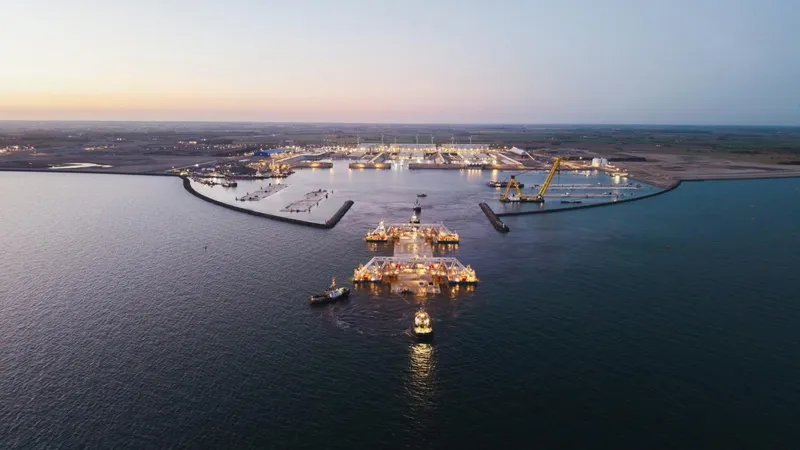
The operation took several days. The element, 217 metres long and weighing more than 73,500 tonnes, left the tunnel factory at Rødbyhavn on the Danish island of Lolland on 4 May, and on 7 May it came to rest on the bed of the strait. It was towed by five tugboats and by IVY, a vessel purpose-built for the job; the immersion itself took around 14 hours, after which the element was connected to the Danish portal with hydraulic arms and its position confirmed by laser. Eighty-eight more elements lie ahead over the coming years, lowered into a trench reaching 40 metres below the surface. Once complete, the 18 km Fehmarnbelt will be by far the longest immersed tunnel in the world.
Four tubes beneath the strait
Each element holds four main tubes, two for the motorway and two for the railway, plus a service tube for technical installations. The prefabricated sections are laid one by one in the seabed trench, on a previously prepared bed of gravel. Once it all opens, the crossing between Rødbyhavn and Puttgarden on the German island of Fehmarn is to take 10 minutes by car and 7 minutes by train, while the rail journey from Hamburg to Copenhagen will fall from about four and a half hours to roughly two and a half. The tunnel will replace a heavily used Scandlines ferry crossing. The whole project is estimated at around $8 billion; the European Commission has designated Fehmarnbelt a priority project and contributed about €1.3 billion. It is led by the Danish state-owned Femern A/S, with parent company Sund & Bælt, and built by the FLC consortium, which includes VINCI among others.
An opening in two stages
This is where the second half of the story begins. The project is now at least two years behind the original plan: completion of the main tunnel has slipped from 2029 to 2031. On 18 May, Femern A/S confirmed that the opening will be staged, with the road section entering service first and the railway following at least a year later. The bottleneck is on the German side. Germany's limits on underwater noise in its own waters are slowing the work, and German environmental authorities spent a long time withholding approval of the immersion vessel and its methods, tightening requirements on noise and sediment disturbance. On top of that, a separate 1.7 km Fehmarnsund tunnel, which will link the island of Fehmarn to the German mainland, will not be ready before the end of 2032, and the route through Schleswig-Holstein is the subject of legal challenges. Sund & Bælt's chief executive, Mikkel Hemmingsen, acknowledged that a phased opening allows the tunnel to be used by drivers sooner and reduces complexity in the final stage, but that delaying the railway is unfortunate for the green transition and for passengers. The marine works alone are expected to run well into 2027, and Femern has promised a full, updated schedule once several elements are on the seabed.
Part of a bigger puzzle
Fehmarnbelt is a link in the EU's Scandinavian-Mediterranean Corridor, the transport spine connecting northern Europe with its centre and south. Its only completed fixed link so far is the Øresund crossing between Denmark and Sweden, in service since 2000. A third link is still at the study stage: in March 2026 a Swedish government inquiry recommended that Denmark and Sweden prepare a joint basis for a new Øresund crossing, primarily a tunnel to Copenhagen. Regardless of the tunnel's delays, the region is already changing: in May 2026 the railways Vy, DSB and Deutsche Bahn announced a direct Oslo–Copenhagen–Berlin train, due to launch in 2028.
For the maritime economy, Fehmarnbelt above all marks the end of an era in the strait. The fixed link will take over traffic that ferries have carried for decades, shifting freight and passengers from sea to road and rail, which will directly affect ferry operators and shortsea shipping in the western Baltic. During construction, the 18 km trench, the towing of huge elements and the work on the seabed all affect navigation in the strait itself.
Strategically, the tunnel strengthens the Scandinavia–central Europe freight spine, and that concerns Polish ports too, along with north–south logistics, where the Scandinavian-Mediterranean corridor sits alongside and competes with the Baltic-Adriatic one. In other words, although the tunnel is being built hundreds of kilometres from the Polish coast, it will redirect cargo flows that also pass through our own backyard.
Source: Gazeta Morska · Compiled by: Kamil Kusier
Related articles
 Energy and offshore Equinor takes over Bałtyk 2 and 3 O&M base in Łeba. Port to serve 1.44 GW of offshore wind for 30 years
 Navy and defence Port Gdański Eksploatacja secures NATO NCAGE code. Gdańsk port company lines up for defence tenders
 Shipbuilding industry Ex-Enterprise towed to Mobile under $418.5m contract. Test case for Nimitz-class disposal begins
 Energy and offshore Energa renames Gdańsk gas plant company as foundations for 6,000-tonne turbine and boiler are laid
 Equipment and technology WB Group takes Polish drones from Tokyo to SOFEX in Jordan in a single week
 Ports and logistics PGE books Gdańsk’s T5 terminal for the long haul: Baltica 2 first, then more offshore wind farms
Comments (0)
The discussion is moderated by the editors: a comment appears after review. Your e-mail address is not published.
Nobody has commented on this article yet.