







Where European shipyards actually make money. Ulstein at a 7 per cent margin, Damen with 160 ships a year
A family-owned Norwegian yard with 500 employees posted an operating margin above 7 per cent in 2025. A Dutch group that delivered 160 vessels in the same year and holds an order book of more than 10 billion euros earned just under 2 per cent net on its revenue. A German yard with the best known brand in cruise shipbuilding closed the year with a loss of 383.8 million euros. Three sets of results, three business models and one shared conclusion: what decides the profitability of a European yard today is what it adds to the steel, meaning its own design, its systems and its service business.
In brief
Norway's Ulstein Group posted an operating profit of 219.2 million Norwegian kroner in 2025 on revenue of 3.0 billion kroner, with an operating margin above 7 percent. The Dutch Damen Shipyards Group delivered 160 vessels in 2025 and earned a net profit of 61.1 million euros on revenue of 3.25 billion euros. Germany's Meyer Werft closed 2025 with an after-tax loss of 383.8 million euros. Stocznia Szczecińska Wulkan made a net profit of PLN 36 million in 2025.
Ulstein: small, specialised, the most profitable
Ulstein Group, based in Ulsteinvik in Møre og Romsdal, is a family company founded in 1917 and now in its third generation, led by CEO Gunvor Ulstein with Tore Ulstein as chair of the board. It employs around 500 people.
The group closed 2025 with revenue of NOK 3.0 billion and an operating profit of NOK 219.2 million, with pre-tax profit of NOK 182.7 million. A year earlier the figures were NOK 3.1 billion and NOK 198.8 million, and in 2023 only NOK 1.4 billion and NOK 49 million. The operating margin therefore rose from around 3.5 per cent to over 7 per cent, and the company calls the result the strongest in its history.
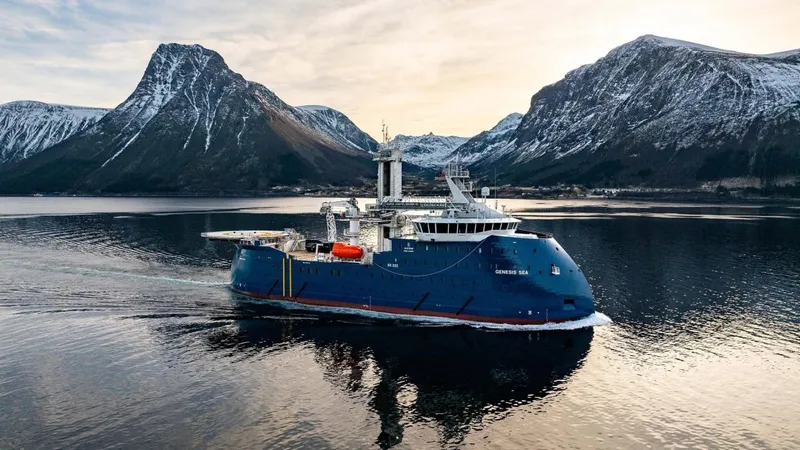
The model is easy to describe and hard to copy. Ulstein sells its own ship designs, with the recognisable X-BOW, X-STERN and TWIN X-STERN hull solutions, builds vessels for offshore and offshore wind, and services a fleet of 450 ships through Ulstein Power & Control. Ten new CSOVs have been contracted over the past two years. The yard deliberately develops aftermarket work and conversions to reduce its exposure to market cycles.
Damen: scale, 160 ships a year and a thin margin
Damen Shipyards Group of the Netherlands increased revenue in 2025 from 3.02 to 3.25 billion euros, EBITDA from 169 to 185 million euros and net profit from 58.3 to 61.1 million euros. It delivered 160 vessels during the year, and its order book for 2026 and beyond exceeds 10 billion euros.
The figures impress until they are converted into a margin. Net profit is just under 2 per cent of revenue, proportionally far less than at the much smaller Ulstein. Damen earns through scale, a catalogue of standard designs and a global service network rather than a high margin on any individual ship.
Meyer Werft: a shrinking loss is still a loss
Meyer Werft of Germany reduced its after-tax loss from 569.2 million euros in 2024 to 383.8 million euros in 2025, while revenue more than doubled to 2.83 billion euros. EBITDA improved from minus 527.6 million to minus 251.8 million euros. Management expects to move towards break-even in 2026, even though no ocean cruise ship deliveries are scheduled this year.
The Papenburg yard delivered Asuka III to NYK Cruises and Disney Destiny to Disney Cruise Line in 2025, Neptun Werft delivered two river vessels and the Wismar site continues converting Disney Adventure. CEO Andre Walter points to new cruise ship contracts priced profitably and to the yard's entry in June into building converter platforms for offshore wind at Rostock. The weight of previous years comes from loss-making contracts signed before the restructuring.
Germany: a sector carried by state decisions
The German market shows most clearly where stability in this industry comes from today. Late in 2025 the federal government and the state of Lower Saxony announced an order for Meyer Werft worth around 10 billion euros. Rheinmetall announced the acquisition of NVL, a group building naval vessels. The yards in Flensburg and Rendsburg found new owners from within the industry weeks after insolvency proceedings began.
The German shipbuilding association VSM summed up 2025 as a year of strong order activity and renewed investor confidence, noting that Germany needs every dock and every slipway, because naval, commercial and specialised projects are all competing for yard capacity.
Portugal shows how easily work moves abroad
In July 2026 Portugal signed an agreement with Italy for three FREMM EVO frigates from Fincantieri, worth around 3.9 billion euros and financed through the EU's SAFE instrument, which absorbed close to 70 per cent of Portugal's entire allocation under that programme. The ships will be built in Italian yards, while the Portuguese industrial return is to consist mainly of revitalising the state-owned Arsenal do Alfeite and its role in sustaining the vessels. Fincantieri beat France's Naval Group and Spain's Navantia in the process.
It is a signal for the whole of Europe. Even very large public budgets do not build an industry where there is no capacity to absorb the order. They build it where that capacity already exists.
Poland: a smaller part of the picture, but a telling one
Against that background, Polish yards look like a market that has just come through the worst of it. Stocznia Szczecińska Wulkan, after a loss of more than PLN 130 million in 2023, posted a net profit of PLN 17 million in 2024 and PLN 36 million in 2025, and 85 per cent of its revenue now comes from production rather than from renting out its assets. PGZ Stocznia Wojenna, built on the assets of the bankrupt naval shipyard, recorded its first positive result in 2022 on revenue of PLN 177.1 million, and closed 2023 with a net profit of over PLN 36 million and an operating profit of PLN 31 million.
Poland's Supreme Audit Office has pointed out that earlier improvements at state-owned yards came mainly from asset sales rather than from production, and that two companies had to implement recovery programmes. The current improvement is therefore recent.
The private side of the market has been working for far longer and on a different scale. Remontowa Holding comprises 22 companies and more than 7,000 employees, and its Remontowa Shiprepair yard repairs or converts more than 200 ships a year. Remontowa Shipbuilding is building a series of electric ferries for the Scottish operator CalMac. CRIST builds the hulls of fibre-optic cable-laying vessels for OMS Group, with the first of them, CS Resilience, to be outfitted and commissioned at Ulstein Verft in Norway.
That last sentence is the shortest description of Poland's position in the European value chain. The hull comes from Gdynia, the brand and the margin from Norway.
There is, however, one part of the picture where Polish industry works exactly as strong Western centres do. PGZ Stocznia Wojenna is not only a builder of warships but an integrator that distributes work across the country. The bow section of the submarine rescue ship ORP Ratownik, 24 metres long, 26 metres high and weighing more than 1,000 tonnes, is being built in Szczecin and will be moved to Gdynia in June 2027. Remontowa, CRIST and Nauta have entered Polish Navy programmes in a similar way.
This is the model that has worked in Norway and the Netherlands for decades: one yard holds the design, the integration and the responsibility towards the customer, while sections, outfitting and installations are spread across a network of plants and subcontractors. The difference is that in Poland this network is still forming, and it is forming around naval orders rather than commercial ones.
Where the money is in this industry
Taken together, these results point to a conclusion that sounds obvious until the numbers are compared. Building the ship itself is now the lowest-margin link in the chain. Ulstein, with 500 employees and revenue roughly one thirteenth of Damen's, earns proportionally four times better, because it sells its own design, its control systems and the service of a fleet that sails the world long after leaving the yard. Damen earns through scale and its catalogue, and Meyer is working off a decade of contracts signed below cost.
Size does not protect against losses, and a recognisable brand does not replace the arithmetic. What does protect a yard is access to a flow of orders that can be planned a decade ahead. That is why so much now turns on state decisions: the German order for Meyer worth around 10 billion euros, Rheinmetall's acquisition of NVL, Portugal's 3.9 billion euros drawn from SAFE, and Poland's Miecznik, Ratownik and Delfin programmes are all the same mechanism. The commercial market tests efficiency, but public orders are deciding which European yards survive the next decade.
Seen in that light, Polish shipbuilding is genuinely getting back on its feet, and that deserves recognition. Wulkan moved from a loss of over PLN 130 million to profit within two years, the naval yard in Gdynia has built an operation running three shipbuilding programmes at once and spreading work between Gdynia, Gdańsk and Szczecin, and the private yards have kept delivering vessels to owners across Northern Europe throughout. That is work completed, not work announced.
At the same time it has to be said plainly that this is only the climb out of the hole. What lies ahead is what already works in Norway and the Netherlands: ship designs of one's own that earn for twenty years, service and conversions as a steady source of revenue, people in trades with a measurable generational gap, and a predictable flow of orders, without which nobody invests in halls, cranes and automation. Without that, in a decade Poland will still be building very good hulls for other people's brands, with the margin staying on the other side of the Baltic.
Source: Gazeta Morska · Compiled by: Kamil Kusier
Related articles
 Energy and offshore Equinor takes over Bałtyk 2 and 3 O&M base in Łeba. Port to serve 1.44 GW of offshore wind for 30 years
 Navy and defence Port Gdański Eksploatacja secures NATO NCAGE code. Gdańsk port company lines up for defence tenders
 Shipbuilding industry Ex-Enterprise towed to Mobile under $418.5m contract. Test case for Nimitz-class disposal begins
 Energy and offshore Energa renames Gdańsk gas plant company as foundations for 6,000-tonne turbine and boiler are laid
 Equipment and technology WB Group takes Polish drones from Tokyo to SOFEX in Jordan in a single week
 Ports and logistics PGE books Gdańsk’s T5 terminal for the long haul: Baltica 2 first, then more offshore wind farms
Comments (0)
The discussion is moderated by the editors: a comment appears after review. Your e-mail address is not published.
Nobody has commented on this article yet.