









WB Group signs four Canadian agreements at MSPO 2026, covering optics, local production and StormRider
WB Group signed four agreements with Canadian partners during the 34th International Defence Industry Exhibition in Kielce. The agreements with CAE, WESCAM, Robotics Centre and Rosborough Boats cover unmanned systems, training and operational readiness, electro-optical sensors, local manufacturing and the maritime domain. For the Polish supplier base, they mark entry into defined projects in a market that acted as Lead Nation at this year's exhibition.
In brief
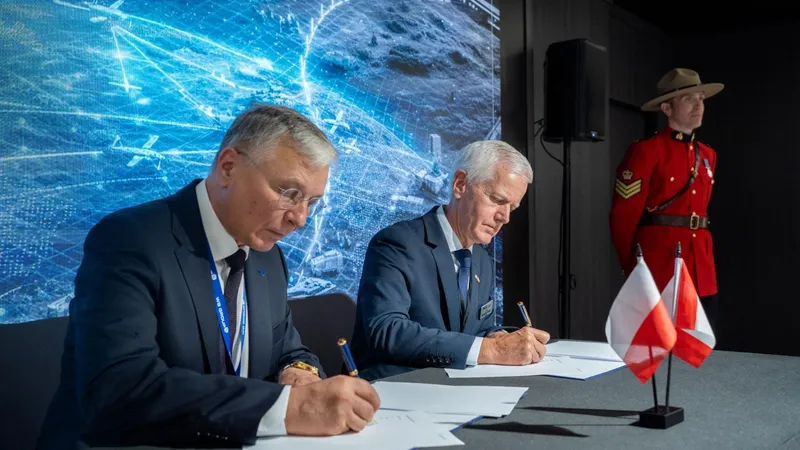
Grupa WB concluded four agreements with the Canadian companies CAE, WESCAM, Robotics Centre and Rosborough Boats during the 34th International Defence Industry Exhibition MSPO in Kielce. The agreement with CAE on cooperation in simulation and operational readiness of unmanned systems was signed by Piotr Wojciechowski, president of Grupa WB, and Thibaut Trancart, vice president of CAE. The agreements with WESCAM, Robotics Centre and Rosborough Boats cover the integration of electro-optical turrets, local production of Polish unmanned systems in Ottawa and Canadian hulls for the StormRider unmanned surface system. Canada served as the Lead Nation at this year's MSPO.
Canada as Lead Nation in Kielce
This year's edition of the Kielce exhibition was the largest Canadian presence in Poland to date. The country sent its biggest ever business mission in the defence and security area and held the position of Lead Nation.
That changes the starting point for Polish suppliers. The Canadian procurement market has long been a distant one for the Polish defence industry, served mainly by American and Western European vendors. Having the full government and industry representation in one place allowed four separate cooperation tracks to be closed within two exhibition days.
CAE and the route to operational readiness
On the first day of the exhibition, WB Group signed a cooperation agreement with the Canadian company CAE. The document was signed by Piotr Wojciechowski, President of WB Group, and Thibaut Trancart, Vice-President and General Manager at CAE.
The ceremony was attended by Magdalena Sobkowiak-Czarnecka, Secretary of State at the Polish Ministry of National Defence, David McGuinty, Canada's Minister of National Defence, and Maninder Sidhu, Canada's Minister of International Trade. The presence of three government representatives at a commercial signing illustrates how closely the Polish and Canadian tracks were run in parallel at state and industry level this year.
The cooperation is intended to combine WB Group's experience in advanced unmanned platforms with CAE's competencies in simulation, synthetic training environments and mission preparation. The partners will examine solutions supporting the integration, deployment and operational readiness of autonomous systems, with potential users in Canada, Poland and other allied states.
This is an area where the commercial case rests less on hardware than on the time needed to reach full capability. With unmanned systems, the cost of training operators and maintaining their proficiency is spread across the whole life cycle of the platform rather than concentrated at delivery.
Electro-optical sensors for Polish platforms
On the second day in Kielce, WB Group signed three further agreements, with WESCAM, Robotics Centre and Rosborough Boats. The signing was attended by Victor Fedeli, Ontario's Minister of Economic Development, Job Creation and Trade, and Emmanuelle Lamoureux, Ambassador of Canada to Poland.
The agreement with WESCAM covers systems operating in the visible and infrared bands and the scope for using them in WB Group products. One of the directions under review is the integration of electro-optical turrets with Polish reconnaissance and strike systems, aimed at users in Canada and Poland. The sensor turret remains one of the components that most determines the usefulness of an unmanned aircraft on a reconnaissance mission, and one of the hardest to source at short notice.
A new plant in Ottawa and local manufacturing
Robotics Centre specialises in the production of unmanned aircraft and has recently opened a new facility in Ottawa. Its agreement with WB Group covers the scope for using those capabilities to manufacture Polish unmanned systems locally for the Canadian market.
Local content is a standard requirement in defence procurement rather than a concession. The customer expects domestic industrial participation, jobs and in-country service, while the supplier gains resilience against export restrictions and a shorter support chain. For a Polish manufacturer of unmanned systems it is also the most demanding element of any such agreement, because it touches the division of value and the scope of documentation transferred.
Canadian hulls for StormRider
Rosborough Boats is a Canadian boatbuilder with long experience, including deliveries to the country's navy. Under the agreement, the partners will assess the use of Canadian platforms in the further development of the StormRider surface system and possible deliveries to European and North American markets.
For WB Group this is the newest of the areas covered in Kielce. The StormRider surface system, presented at this year's exhibition, follows a direction in which experience from unmanned aircraft is being carried over to the water, and a proven hull shortens the path from demonstrator to a vessel fit for service.
A government framework for industry
This year's exhibition also produced a new framework at state level. Władysław Kosiniak-Kamysz, Deputy Prime Minister and Minister of National Defence, and David McGuinty, Canada's Minister of National Defence, signed an agreement on bilateral defence cooperation. One of its directions is industrial cooperation, including opening the Canadian market to Polish armament and unmanned systems.
The four agreements concluded by WB Group in Kielce map directly onto that track. They cover the introduction of Polish solutions to the Canadian market and the option of manufacturing them locally, as well as joint projects intended for users in Poland, Canada and other allied states.
Source: Gazeta Morska · Compiled by: Kamil Kusier
Related articles
 Energy and offshore Equinor takes over Bałtyk 2 and 3 O&M base in Łeba. Port to serve 1.44 GW of offshore wind for 30 years
 Navy and defence Port Gdański Eksploatacja secures NATO NCAGE code. Gdańsk port company lines up for defence tenders
 Shipbuilding industry Ex-Enterprise towed to Mobile under $418.5m contract. Test case for Nimitz-class disposal begins
 Energy and offshore Energa renames Gdańsk gas plant company as foundations for 6,000-tonne turbine and boiler are laid
 Equipment and technology WB Group takes Polish drones from Tokyo to SOFEX in Jordan in a single week
 Ports and logistics PGE books Gdańsk’s T5 terminal for the long haul: Baltica 2 first, then more offshore wind farms
Comments (0)
The discussion is moderated by the editors: a comment appears after review. Your e-mail address is not published.
Nobody has commented on this article yet.