









WB Group meets Nigeria’s defence minister as Poland joins the race for Africa’s arms market
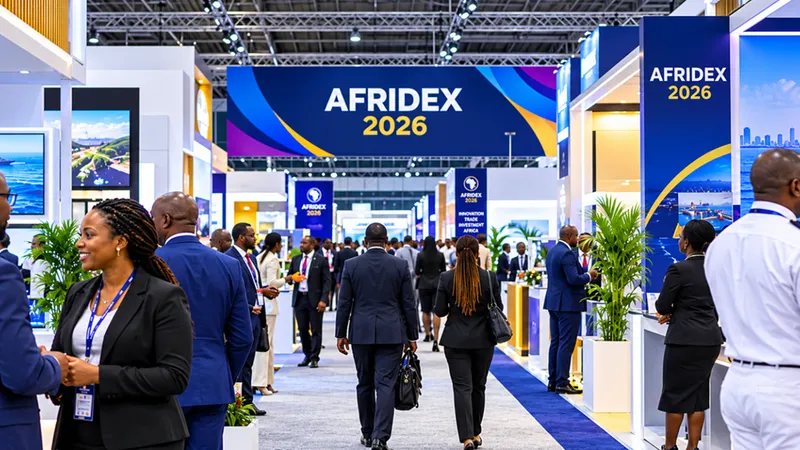
Arms imports by West African states almost doubled between 2010-14 and 2020-24, with Nigeria alone taking 34 per cent of the regional total, while Russia, long the dominant supplier to sub-Saharan Africa, has slipped to second place behind China. That is the market Poland's defence industry walked into this week. A Polish national pavilion is open at the first Africa International Defence Exhibition (AFRIDEX) in Lagos, and on the opening day Nigeria's Minister of Defence, General (retired) Christopher Gwabin Musa, visited the stand of WB Group, Poland's largest private defence company.
In brief
WB Group showcased border and critical infrastructure protection systems at the first AFRIDEX defence fair in Lagos, held on 26-29 October. Nigeria's Minister of Defence, General Christopher Gwabin Musa, visited the WB Group stand at AFRIDEX on the first day. According to SIPRI, Russia's share of arms imports to Sub-Saharan Africa fell from 30 percent in 2016-2020 to 12 percent in 2021-2025. AFRIDEX hosts a Polish national pavilion, one of 14 national pavilions.
A ministerial visit on day one
Christopher Gwabin Musa came to the WB Group stand with the Chief of the Air Staff of the Nigerian Air Force, Air Marshal Sunday Kelvin Aneke, and Michał Cygan, head of the Polish diplomatic mission in Nigeria. The minister was briefed on WB Group's portfolio of integrated systems for border security and critical infrastructure protection, two areas where Nigeria's needs are acute. Its army and air force are still fighting Boko Haram and Islamic State West Africa Province in the north east, and armed banditry and kidnapping persist in the north west.
WB Group arrived in Lagos with equipment that has been in combat for more than a decade. Its FlyEye reconnaissance drones have flown over Ukrainian front lines since 2015, and in May 2026 the company signed Poland's largest ever unmanned systems contracts, funded through the EU's SAFE instrument, covering FlyEye, Warmate loitering munitions and Gladius strike systems. The group also runs a production line for FlyEye in Ukraine and has a joint venture, Delta WB, in Georgia. For a buyer who wants systems assembled at home rather than shipped in crates, that record of setting up production abroad is part of the pitch.
Who is selling to Africa now
The shift in suppliers is visible in the figures published by the Stockholm International Peace Research Institute (SIPRI). In 2016-20 Russia accounted for 30 per cent of major arms imports by sub-Saharan Africa, ahead of China (20 per cent), France (9.5 per cent) and the United States (5.4 per cent). In 2021-25 China led the subregion with 22 per cent and deliveries to 23 states, Russia fell to 12 per cent, and Türkiye moved into third place with 11 per cent. For the continent as a whole the United States was first (19 per cent), followed by China (17 per cent), Russia (15 per cent) and France (8.3 per cent). As recently as the 2020-24 period Russia had still been Africa's top supplier with 21 per cent.
The cause is the war in Ukraine. Russian arms exports fell by 64 per cent in 2021-25, and nearly three quarters of what Moscow still sells goes to India, China and Belarus. SIPRI cautions that African deals with Russia are often kept secret, notably in Algeria, so Russia's real share may be somewhat higher. France remains a serious player in francophone states, holding 14 per cent of West African imports, but the United Kingdom does not feature among the four main suppliers to the continent.
West Africa is where the action is. The region's combined imports rose 82 per cent between 2010-14 and 2020-24, and Nigeria accounts for 16 per cent of all sub-Saharan imports. China holds 26 per cent of the West African market, France 14 per cent, and Russia and Türkiye 11 per cent each.
- The growth in arms imports to West Africa has been striking - said Katarina Djokic, Researcher with the SIPRI Arms Transfers Programme.
Nigeria's own modernisation plans illustrate the point. The Nigerian Air Force has announced the planned acquisition of Turkish Aksungur drones, additional T129 helicopters and more Chinese CH-4 drones, lists AH-1Z attack helicopters among its expected aircraft, and is taking delivery of 24 Italian M-346 fighter-attack aircraft. Many of those programmes have no published contract values yet, which is exactly why a show where buyers and sellers meet in person matters.
Lagos sets its terms: build here, train here, maintain here
AFRIDEX runs from 26 to 29 October at Eko Atlantic, the reclaimed waterfront district on Victoria Island in Lagos. It is hosted by the Defence Industries Corporation of Nigeria (DICON) under the patronage of the federal government and organised by dmg events. Fourteen national pavilions are confirmed, among them Poland, China, Germany, India, Italy, Türkiye, Ukraine, the United Arab Emirates and the United States. Exhibitors include Türkiye's MKE, Turkish Aerospace and STM, China's Norinco and Poly Technologies, Italy's Beretta, Serbia's Yugoimport and Sweden's MilDef, with Leonardo as exhibitor and sponsor. Russia is absent from the list of national pavilions.
The host's expectations were spelled out at the opening ceremony, where Senate President Godswill Akpabio read a message from President Bola Ahmed Tinubu. The message said that every major acquisition should develop skills, transfer knowledge, strengthen local industry and build the capacity to maintain what is operated.
- The measure of a successful partnership is the capability it leaves behind - President Bola Ahmed Tinubu wrote in his message to the exhibition.
DICON's Director-General, Major General Babatunde Ibrahim Alaya, had already invited foreign partners to bring manufacturing to Nigeria so that the corporation and its partners can produce locally, citing the DICON Act of 2023, which recasts the corporation as a modern manufacturer with wider responsibilities in research and international cooperation. General Birame Diop, President of the ECOWAS Commission and a former Senegalese armed forces minister, went further and told delegates that access to defence equipment and critical technologies can be constrained by the interests and priorities of external powers, which in his view makes an event such as AFRIDEX both timely and necessary. For new entrants, that is an invitation: African buyers are actively looking beyond their traditional suppliers.
Poland's track record on the continent
The Polish pavilion in Lagos is coordinated by MK Business Link. Beyond the exhibition hall, Poland's state-owned Polska Grupa Zbrojeniowa (PGZ) has been quietly building an African order book. In February 2026 PGZ signed a contract with an undisclosed state in Central and East Africa for LMC mortars, Alex-338 sniper rifles and WKW-50 anti-materiel rifles made by Zakłady Mechaniczne Tarnów, together with ammunition. In 2023 it contracted Grot assault rifles from Fabryka Broni Łucznik-Radom for another customer in the same region, and Tarnów's ZU-23-2CP anti-aircraft systems have been exported to African armies for years. The customers are rarely named, which is the norm in this part of the world.
PGZ's chief executive Adam Leszkiewicz said in September that the group is preparing a dedicated export plan with trade missions to North Africa among other regions, and described the whole continent as a highly interesting market. The aim, he said, is to offer complete solutions built with industrial partners rather than single products.
Defence is one strand of a wider push. In spring Poland's deputy prime minister and digital affairs minister Krzysztof Gawkowski visited Togo and Nigeria to discuss digital transformation, cybersecurity and artificial intelligence, with talk of Polish corporate engagement in Nigeria and the region reaching up to 2 billion dollars. With Lagos State Governor Babajide Sanwo-Olu he discussed investment in the city's new port, where Polish companies are already involved with financial backing from the export credit agency KUKE, part of the Polish Development Fund group. Polish officials also make a point that resonates in Lagos: Poland has no colonial past in Africa, which African partners tend to read as a mark of credibility.
The maritime angle for the Gulf of Guinea
For a maritime trade readership, the naval dimension of AFRIDEX deserves attention. The Gulf of Guinea was for years the world's worst piracy hotspot, and the presidential message to the exhibition listed piracy and crime at sea alongside terrorism and banditry as threats that disrupt trade and development. Eko Atlantic hosted the Nigerian Navy's 70th anniversary International Fleet Review earlier this year, at which three Chinese-built fast patrol vessels were commissioned, and the exhibition's waterfront has been set aside for maritime security demonstrations covering surveillance systems, small craft and unmanned surface vessels.
Competition in that segment is already well established. Türkiye's HAVELSAN is showing naval combat management systems in Lagos and expanding its partnership with Nigeria, and its BAHA unmanned aircraft has already been delivered to the Nigerian armed forces. China supplies patrol craft. Poland has credible references of its own: Kormoran II class minehunters are built at Remontowa Shipbuilding in Gdańsk, Miecznik frigates are under construction at PGZ Stocznia Wojenna in Gdynia, and WB Group has moved into the maritime field with its StormRider 550 craft, unveiled at the MSPO show in Kielce in September, and naval communications systems. Baltic experience in protecting critical infrastructure at sea, now a daily task for Polish forces, translates directly into the problems facing navies in the Gulf of Guinea.
What a Polish entry needs to succeed
The opening speeches in Lagos set a clear test for any newcomer. Christopher Gwabin Musa described the threats his country faces as hybrid and fast evolving across every domain of warfare, and framed the exhibition as a platform for collective security rather than a shopping trip. Buyers want partners who will stay: training, spares, maintenance and, wherever possible, local assembly.
Polish industry has an answer to most of that list. Combat-proven equipment from Ukraine, demonstrated willingness to set up production abroad, no colonial baggage and manufacturing capacity that is expanding on the back of SAFE-funded domestic orders give Polish companies a competitive case against Türkiye and China where African customers are looking for alternatives. The harder part is patience and scale. Contracts in Africa are built over years through bilateral relationships, and the biggest competitors have had local offices, service networks and export financing on the continent for a long time.
That is why presence counts. The defence minister of Africa's largest economy at a Polish stand, a Polish pavilion next to the German and Turkish ones, and a run of PGZ contracts with African customers show that the gap left by Russia is real and that Poland intends to compete for it. Whether that turns into signed deals will become clear over the next two or three years, but the first step, showing up under its own flag, has been taken.
Source: Gazeta Morska · Compiled by: Kamil Kusier
Related articles
 Energy and offshore Equinor takes over Bałtyk 2 and 3 O&M base in Łeba. Port to serve 1.44 GW of offshore wind for 30 years
 Navy and defence Port Gdański Eksploatacja secures NATO NCAGE code. Gdańsk port company lines up for defence tenders
 Shipbuilding industry Ex-Enterprise towed to Mobile under $418.5m contract. Test case for Nimitz-class disposal begins
 Energy and offshore Energa renames Gdańsk gas plant company as foundations for 6,000-tonne turbine and boiler are laid
 Equipment and technology WB Group takes Polish drones from Tokyo to SOFEX in Jordan in a single week
 Ports and logistics PGE books Gdańsk’s T5 terminal for the long haul: Baltica 2 first, then more offshore wind farms
Comments (0)
The discussion is moderated by the editors: a comment appears after review. Your e-mail address is not published.
Nobody has commented on this article yet.