Over 200-Ton HDPE Pipes Delivered to Poland for Baltic Offshore Wind Projects
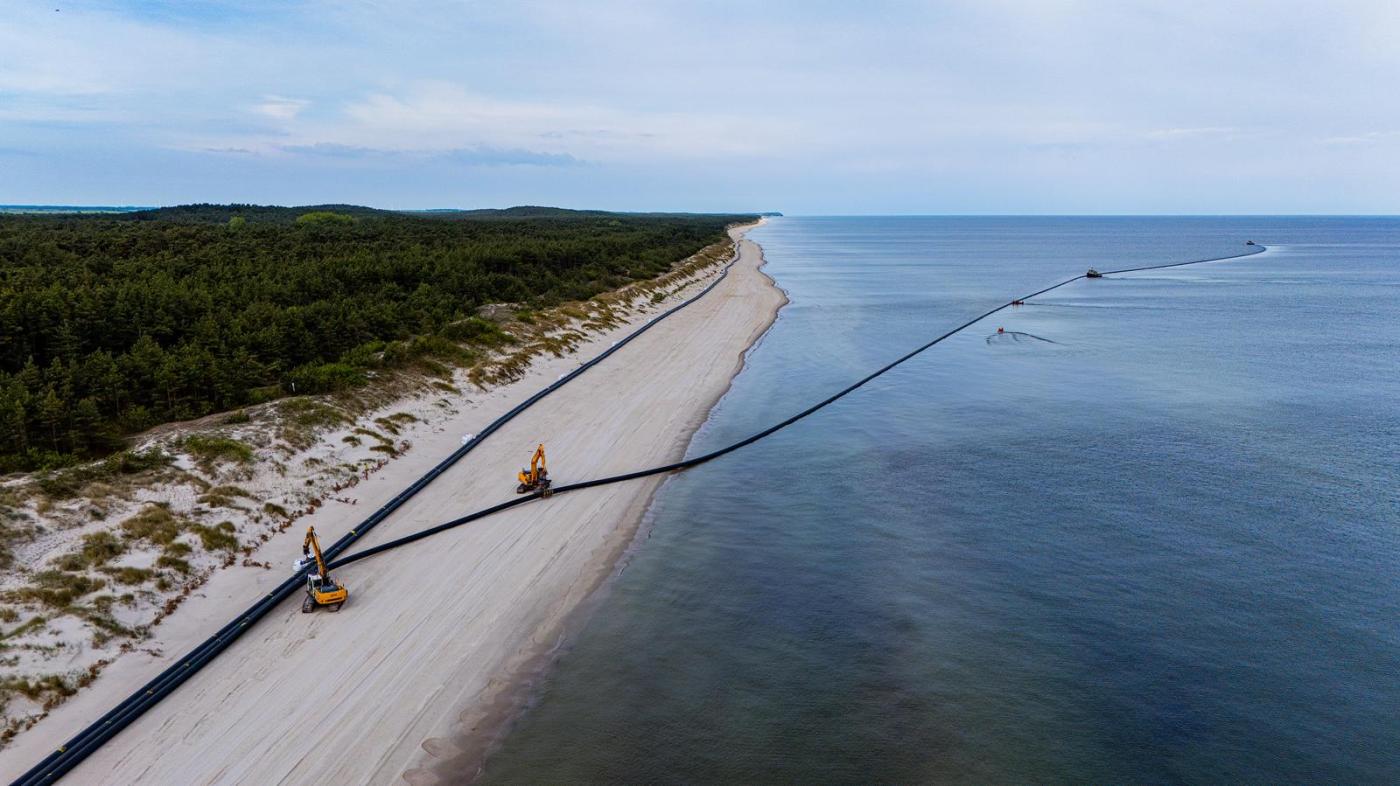
Four massive HDPE pipes—each 1.5 km long and weighing over 200 tons—have been successfully transported by sea from Norway to Poland to support the offshore wind projects Bałtyk 2 and Bałtyk 3, developed jointly by Equinor and Polenergia. The pipes were brought ashore near the coastal town of Mrzeżyno and will house export cables transmitting power generated offshore to the onshore grid.
business power engineering maritime economy offshore pomerania news17 june 2025 | 18:32 | Source: Gazeta Morska | Prepared by: Kamil Kusier | Print
fot. Polenergia
The complex maritime transport operation began near Stathelle, Norway, where a primary tugboat towed two pipes at a time across the Baltic Sea. The final phase, involving beach landing, posed significant logistical challenges. It required three auxiliary tugboats for nearshore stabilization, three cranes operating from the beach to pull the pipes ashore, and coordinated safety and support teams from WOPR (Water Volunteer Rescue Service) both on land and at sea. These teams ensured controlled access, structural protection of the pipes, and environmental safety throughout the 3-day operation.
The entire logistics chain demanded close coordination between marine and onshore operational teams. From the outset, safety and environmental protection have been top priorities. Once onshore, the pipe ends were sealed, weighted, and stabilized with big bags and ballast. The area is continuously monitored by technical crews and security personnel.
The pipes will soon be relocated to the landfall zone, the designated starting point for horizontal directional drilling (HDD). This trenchless method enables the installation of power export cables beneath the shoreline without disturbing the environment.
The Bałtyk 2 and Bałtyk 3 offshore wind farms will have a combined capacity of 1.44 GW—enough to power over 2 million Polish households with clean, renewable energy. First power is expected in 2027, with commercial operations commencing in 2028.
see also
Buy us a coffee, and we’ll invest in great maritime journalism! Support Gazeta Morska and help us sail forward – click here!
Kamil Kusier
redaktor naczelny
comments
Add the first comment
see also
Navantia and Fincantieri deepen cooperation on the european patrol corvette programme
Galeon Yachts and Meyer Shank Racing: merging luxury yachts with motorsport expertise
Unmanned systems and naval firepower modules. WB Group showcases integrated capabilities at Enforce Tac 2026
Swedish ports record lowest ship calls in 18 years. Implications for the maritime sector
February in Szczecin’s shiprepair sector. Ice, overhauls and North Sea expansion
Advanced ROV trials conducted at CTO to validate subsea technologies for offshore applications
University of Gdańsk and PGZ Naval Shipyard join forces for innovation and security
Stadt Naval to deliver electric propulsion system for Polish rescue vessel Ratownik
Gdańsk port’s Basen Górniczy to gain modern port infrastructure
First month of Jantar Unity operations. Polsca ferry paves the way for Batory program units
ADVERTISEMENT
ADVERTISEMENT